


Page 92 - Hematology_ Basic Principles and Practice ( PDFDrive )
P. 92
Chapter 6  Protein Architecture: Relationship of Form and Function  63


                                      Bound peptide
                                                                              TCR


                                                                           Peptide


                                                                                             MHC

                                Heavy chain                    Light chain


                                A                                           B
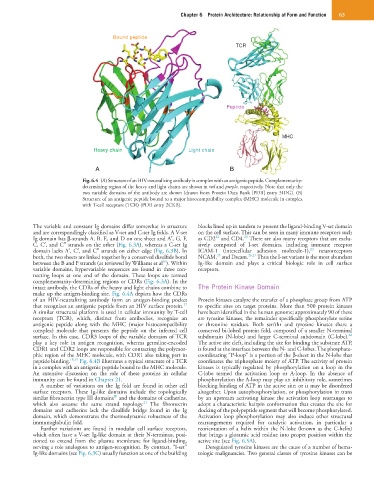
                            Fig. 6.4  (A) Structure of an HIV-neutralizing antibody in complex with an antigenic peptide. Complementarity-
                            determining region of the heavy and light chains are shown in red and purple, respectively. Note that only the
                            two variable domains of the antibody are shown (drawn from Protein Data Bank [PDB] entry 3IDG). (B)
                            Structure of an antigenic peptide bound to a major histocompatibility complex (MHC) molecule in complex
                            with T-cell receptors (TCR) (PDB entry 2CKB).


            The variable and constant Ig domains differ somewhat in structure   blocks lined up in tandem to present the ligand-binding V-set domain
            and are correspondingly classified as V-set and C-set Ig folds. A V-set   on the cell surface. This can be seen in many immune receptors such
                                                                        22
                                                                                 23
            Ig domain has β-strands A, B, E, and D on one sheet and A′, G, F,   as CD2  and CD4.  There are also many receptors that are exclu-
            C, C′, and C″ strands on the other (Fig. 6.3A), whereas a C-set Ig   sively  composed  of  I-set  domains,  including  immune  receptor
                                                                                                      24
            domain lacks A′, C′, and C″ strands on either edge (Fig. 6.3B). In   ICAM-1  (intercellular  adhesion  molecule-1),   neuroreceptors
                                                                        25
            both, the two sheets are linked together by a conserved disulfide bond   NCAM,  and Dscam. 26,27  Thus the I-set variant is the most abundant
                                                      16
            between the B and F strands (as reviewed by Williams et al ). Within   Ig-like  domain  and  plays  a  critical  biologic  role  in  cell  surface
            variable domains, hypervariable sequences are found in three con-  receptors.
            necting  loops  at  one  end  of  the  domain. These  loops  are  termed
            complementarity-determining regions or CDRs (Fig. 6.3A). In the
            intact antibody, the CDRs of the heavy and light chains combine to   The Protein Kinase Domain
            make up the antigen-binding site. Fig. 6.4A depicts how the CDRs
            of  an  HIV-neutralizing  antibody  form  an  antigen-binding  pocket   Protein kinases catalyze the transfer of a phosphate group from ATP
                                                             17
            that recognizes an antigenic peptide from an HIV surface protein.    to specific sites on target proteins. More than 500 protein kinases
            A similar structural platform is used in cellular immunity by T-cell   have been identified in the human genome; approximately 90 of these
            receptors  (TCR),  which,  distinct  from  antibodies,  recognize  an   are tyrosine kinases, the remainder specifically phosphorylate serine
            antigenic  peptide  along  with  the  MHC  (major  histocompatibility   or  threonine  residues.  Both  ser/thr  and  tyrosine  kinases  share  a
            complex)  molecule  that  presents  the  peptide  on  the  infected  cell   conserved bi-lobed protein fold, composed of a smaller N-terminal
                                                                                                                   28
            surface. In this case, CDR3 loops of the variable domains of TCR   subdomain  (N-lobe)  and  larger  C-terminal  subdomain  (C-lobe).
            play  a  key  role  in  antigen  recognition,  whereas  germline-encoded   The active site cleft, including the site for binding the substrate ATP,
            CDR1 and CDR2 loops are responsible for contacting the polymor-  is found at the interface between the N- and C-lobes. The phosphate-
            phic region of the MHC molecule, with CDR1 also taking part in   coordinating “P-loop” is a portion of the β-sheet in the N-lobe that
            peptide binding. 18,19  Fig. 6.4B illustrates a typical structure of a TCR   coordinates the triphosphate moiety of ATP. The activity of protein
            in a complex with an antigenic peptide bound to the MHC molecule.   kinases  is  typically  regulated  by  phosphorylation  on  a  loop  in  the
            An  extensive  discussion  on  the  role  of  these  proteins  in  cellular   C-lobe  termed  the  activation  loop  or  A-loop.  In  the  absence  of
            immunity can be found in Chapter 21.                  phosphorylation the A-loop may play an inhibitory role, sometimes
              A  number  of  variations  on  the  Ig  fold  are  found  in  other  cell   blocking binding of ATP in the active site; or it may be disordered
            surface  receptors. These  Ig-like  domains  include  the  topologically   altogether. Upon autophosphorylation, or phosphorylation in trans
                                      20
            similar fibronectin type III domains  and the domains of cadherins,   by  an  upstream  activating  kinase  the activation  loop  rearranges  to
                                                21
            which  also  assume  the  same  strand  topology.   The  fibronectin   adopt a characteristic hairpin conformation that creates the site for
            domains  and  cadherins  lack  the  disulfide  bridge  found  in  the  Ig   docking of the polypeptide segment that will become phosphorylated.
            domain, which demonstrates the thermodynamic robustness of the   Activation  loop  phosphorylation  may  also  induce  other  structural
            immunoglobulin fold.                                  rearrangements  required  for  catalytic  activation,  in  particular  a
              Further  variations  are  found  in  modular  cell  surface  receptors,   reorientation of a helix within the N-lobe (known as the C-helix)
            which often have a V-set Ig-like domain at their N-terminus, posi-  that brings a glutamic acid residue into proper position within the
            tioned  to  extend  from  the  plasma  membrane  for  ligand-binding,   active site (see Fig. 6.5A).
            serving a role analogous to antigen-recognition. By contrast, “I-set”   Deregulated tyrosine kinases are the cause of a number of hema-
            Ig-like domains (see Fig. 6.3C) usually function as one of the building   tologic malignancies. Two general classes of tyrosine kinases can be

