


Page 90 - Hematology_ Basic Principles and Practice ( PDFDrive )
P. 90
Chapter 6  Protein Architecture: Relationship of Form and Function  61


            are major structural components of many cell surface and secreted   The Domain Structure of Proteins
            proteins,  and  also  of  many  viral  proteins.  Protein  methylation  on
            arginine or lysine residues is carried out by methyltransferases with   In general, the minimal biologically functional unit of protein three-
            S-adenosyl methionine (SAM) as the primary methyl group donor.   dimensional  structure  is  the  protein  domain.  Domains  are  locally
            Methylation is an important mechanism of epigenetic regulation, as   compact and semi-independent units of usually contiguous polypep-
            histone methylation and demethylation influence the availability of   tide chain. The common size of a domain is between 100 and 200
            DNA for transcription. N-acetylation, the transfer of an acetyl group   amino acid residues, although much larger and smaller domains are
            to the amine nitrogen at the N-terminus of the polypeptide chain,   also frequently observed. Protein domains are composed of closely
            occurs in a majority of eukaryotic proteins. Lysine acetylation and   packed  secondary  structure  elements—α-helices,  β-sheets,  or  a
            deacetylation is an important regulatory mechanism in a number of   combination of both—and the loops that connect them. Domains
            proteins.  It  is  best  characterized  in  histones,  where  histone  acetyl   are stabilized by hydrophobic interactions among these elements and
            transferases (HATs) and histone deacetylases (HDACs) regulate gene   typically have very hydrophobic central cores, with more hydrophilic
            expression via modification of histone tails. Many cytoplasmic pro-  amino  acids  extending  from  their  surface.  Alternating  patterns  of
            teins  are  also  acetylated,  and  therefore  acetylation  seems  to  play  a   hydrophobic residues in secondary structure elements are a reflection
                                                              2
            greater role in cell biology than simply transcriptional regulation.    of the role of hydrophobicity in driving protein folding and stability.
            Lipidation is a modification that targets proteins to membranes in   Helices are often amphipathic and pack in a folded domain such that
            organelles, vesicles, and the plasma membrane. Examples of lipida-  their  hydrophobic  face  is  buried  in  the  domain  interior  and  their
            tion include myristoylation, palmitoylation, and prenylation. Each type   hydrophilic face is exposed on the surface. Likewise, β-sheets often
            of modification gives proteins distinct membrane affinities, although   have a buried hydrophobic face and an exposed hydrophilic face. The
            all types of lipidation increase the hydrophobicity of a protein and   importance  of  the  hydrophobic  core  to  the  stability  of  protein
            thus its affinity for membranes. In N-myristoylation, the myristoyl   domains is highlighted by the fact that point mutations that introduce
            group (14-carbon saturated fatty acid) is transferred to an N-terminal   polar or charged residues into the protein interior often cause mis-
            glycine  by  N-myristoyltransferase.  The  myristoyl  group  does  not   folding and thus a loss of function. Although these general charac-
            always  permanently  anchor  the  protein  in  the  membrane;  in  a   teristics are shared by protein domains that are found in an aqueous
            number  of  proteins  the  N-terminal  myristoyl  group  has  been   environment,  such  as  that  on  the  cytosol  or  on  the  cell  surface,
            observed to pack into the protein core. N-myristoylation can there-  membrane-embedded proteins have very different properties reflec-
            fore  act  as  a  conformational  localization  switch,  in  which  protein   tive of their residence in the lipid bilayer. Several common domain
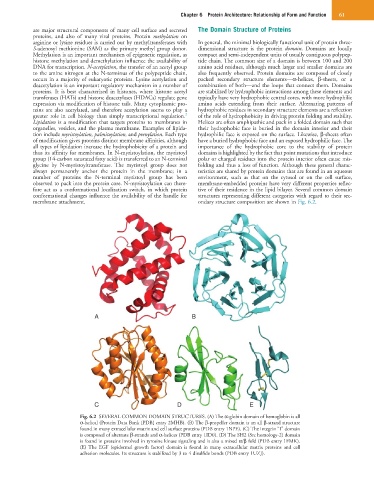
            conformational changes influence the availability of the handle for   structures representing different categories with regard to their sec-
            membrane attachment.                                  ondary structure composition are shown in Fig. 6.2.


                                A                               B


                                C                          D                       E
                           Fig. 6.2  SEVERAL COMMON DOMAIN STRUCTURES. (A) The α-globin domain of hemoglobin is all
                           α-helical (Protein Data Bank [PDB] entry 2MHB). (B) The β-propeller domain is an all β-strand structure
                           found in many extracellular matrix and cell surface proteins (PDB entry 1NPE). (C) The integrin “I” domain
                           is composed of alternate β-strands and α-helices (PDB entry 1ID0). (D) The SH2 (Src homology-2) domain
                           is found in proteins involved in tyrosine kinase signaling and is also a mixed α/β fold (PDB entry 1FMK).
                           (E) The  EGF  (epidermal  growth  factor)  domain  is  found  in  many  extracellular  matrix  proteins  and  cell
                           adhesion molecules. Its structure is stabilized by 3 to 4 disulfide bonds (PDB entry 1UZJ).

