


Page 91 - Hematology_ Basic Principles and Practice ( PDFDrive )
P. 91
62    Part I  Molecular and Cellular Basis of Hematology

                                                                        12
           Deciphering this basic protein building block is key for under-  transduction.   Unstructured  segments  are  well  suited  for  protein
        standing  the  structure  and  evolution  of  proteins.  Kinetically,  the   interactions controlled by posttranslational modifications. For example,
        domain structure of a protein may simplify the folding process into   sites  of  tyrosine  phosphorylation  are  typically  unstructured  and
                      3
        a step-wise course.  Thus a long amino acid sequence may fold into   therefore accessible for modification, but after phosphorylation they
        multiple domains rapidly and correctly. For many proteins, individ-  become  ordered  upon  phosphorylation-dependent  binding  to  a
        ual domains fold in a cotranslational manner; from the N-terminal   partner protein.
        region, a growing nascent polypeptide chain immediately begins to   Most  proteins  are  composed  of  multiple  domains,  which  may
        fold domain-by-domain during translation from the ribosome in a   confer multiple functions, couple a targeting function to a catalytic
                         4
        very  efficient  manner.   Genetically,  it  was  long  suspected  that  the   function, or provide for allosteric regulation. In the following sections
        exon structure of genes was correlated with the domain structure of   we highlight the structure of a few proteins and domains and that
               5
        proteins.  Subsequent multigenome analysis did find a strong corre-  are of central and recurring importance in hematology in order to
        lation between domain organization and exon–intron arrangement   illustrate the relationship between domain architecture and function.
        in genomic DNA. The exon–domain correlation facilitates extensive   We discuss representative examples from the extracellular space (the
                                     6
        exon shuffling events during evolution,  although it is not necessar-  immunoglobulin  domain),  from  intracellular  signaling  (protein
        ily  always  one-exon/one-domain.  This  mechanism  ensures  that  a   kinase  domain),  and  from  the  cell  membrane  (G  protein–coupled
        stable and functionally efficient domain can be repeatedly used as a   receptors and the vitamin K receptor).
        module  assembled  into  many  proteins  with  shared  functions.  A
        well-known early example is the nucleotide-binding domain identi-
        fied  in  various  dehydrogenases;  its  robust  alternate  β-strand–α-  The Immunoglobulin Domain and Variations
        helix–β-strand  fold  provides  a  common  structural  unit  for  these
        enzymes. 7                                            As implied by its name, the immunoglobulin (Ig) domain was first
                                                                                13
           Recent computational approaches demonstrate that almost all the   recognized in antibodies.  A detailed discussion on antibody biology
        growing number of known sequences come from new combinations   can be found in Chapter 24. The human genome project has identi-
        of  various  domains,  and  more  than  70%  of  all  sequences  can  be   fied the Ig superfamily (IgSF) as the largest superfamily in human
                                                          8
        partially modeled from known structures with homologous domains.    genome,  due  to  its  extensive  usage  in  a  more  recently  developed
                                                                                     9
                                                  9
        This has been reflected in the human genome sequence.  Impressive   immune system in vertebrates.  In fact, the Ig domain is an evolu-
        progress has already been made in computational protein prediction   tionarily ancient structural unit that can be found in Caenorhabditis
                                                                   14
        and design, principally based on the known structural elements. 10  elegans.  Although Ig-like domains also exist in a few intracellular
           Importantly, not all protein sequences fold into a compact domain.   proteins, they are found predominantly in the extracellular space and
        Depending  on  computational  methods  used,  35%  to  50%  of  the   are the most abundant structural unit found in cell surface receptors,
        human  proteome  is  estimated  to  lack  a  folded  three-dimensional   serving key recognition functions in both the immune and nervous
        structure. Nevertheless, these intrinsically disordered proteins (or more   systems.  Along  with  a  handful  of  other  modular  domains  such  as
        often, intrinsically disordered regions within proteins) can perform   fibronectin  type  III  domains  and  epidermal  growth  factor  (EGF)
        critically  important  biologic  functions  that  complement  those  of   domains, they form modular structures of most receptor molecules
                       11
        structured proteins.  Intrinsically disordered protein segments typi-  on the cell surface. 15
        cally  contain  relatively  few  bulky  hydrophobic  amino  acids  such     An Ig domain is composed of roughly 100 residues, folding into
        as  tryptophan,  phenylalanine,  leucine,  and  isoleucine,  which  are   two β-sheets packing face-to-face, forming a β-barrel. This distinc-
        required to form the hydrophobic core of a domain. Many disordered   tively folded structure is commonly known as the immunoglobulin
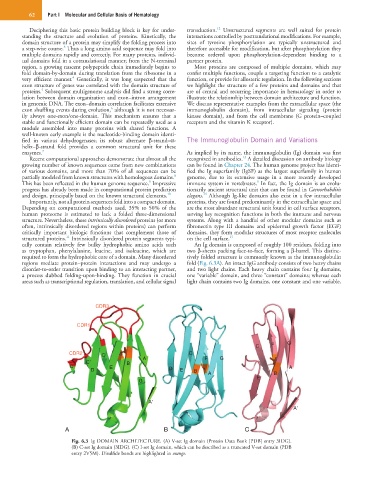
        regions  mediate  protein–protein  interactions  and  may  undergo  a   fold (Fig. 6.3A). An intact IgG antibody consists of two heavy chains
        disorder-to-order transition upon binding to an interacting partner,   and two light chains. Each heavy chain contains four Ig domains,
        a  process  dubbed  folding-upon-binding.  They  function  in  crucial   one “variable” domain, and three “constant” domains; whereas each
        areas such as transcriptional regulation, translation, and cellular signal   light chain contains two Ig domains, one constant and one variable.


                                CDR3


                          CDR1


                                                                                     C    F    G
                        CDR2      C     F                      C
                             C’           B     A                   F    G
                        C”           E                  D                                       A
                               D                            E   B    A                     B
                                              G                                      E


                                                  A’
                                                                                                 A’


                      A                                B                         C
                        Fig. 6.3  Ig DOMAIN ARCHITECTURE. (A) V-set Ig domain (Protein Data Bank [PDB] entry 3IDG).
                        (B) C-set Ig domain (3IDG). (C) I-set Ig domain, which can be described as a truncated V-set domain (PDB
                        entry 2V5M). Disulfide bonds are highlighted in orange.

