


Page 970 - Hematology_ Basic Principles and Practice ( PDFDrive )
P. 970
Chapter 57  Pharmacology and Molecular Mechanisms of Antineoplastic Agents for Hematologic Malignancies  853


                                             Purine synthesis        Pyrimidine synthesis
                           Inhibition of purine biosynthesis:
                           via phosphoribosyl pyrophosphate             Inhibition of pyrimide synthesis
                                                                                         a
                           aminotransferase (e.g., 6MP, 6TG             (e.g., PALA, pyrazofurin )
                           via dihyfrofolate reductase: MTX)
                           Inhibition of adenosine deaminase  Ribonucleotides
                           (e.g., pentostatin)
                                                                 Inhibition of ribonucleotide reductase
                                                                 (e.g., hydroxyurea, fludarabine, gemcitabine,
                                     Incorporation into RNA
                                     (e.g., 5-azacytidine)       CdA)
                          Topoisomerase II–mediated DNA  Deoxyribonucleotides  Inhibition of cTMP synthesis
                          cleavage via stabilization of DNA                (e.g., 5-FU, MTX)
                          cleavable complex (e.g., anthracyclines,
                                 a
                          epirubicin, mitoxantrone, VP16, M26,   Inhibition of DNA polymerase α
                          m-AMSA, dactinomycin)                  (e.g., Ara-C, gemcitabine)

                         Topoisomerase I–mediated DNA   Incorporation into
                         cleavage via stabilization of DNA  DNA (e.g., Ara-C,
                         cleavable complex              fludarabine, gemcitabine,  Binding to DNA blocking DNA
                                                                          a
                         (e.g., CPT11,                  CdA, 6-MP, 6-TG, Ara-G )  and RNA production (e.g.,
                         topotecan)         Topo I  Topo II                     dactinomycin, mithramycin)


                                                                               Single-strand binding and intra-
                                                                               and interstrand cross-linkage of
                                 Scission of DNA
                                 (e.g., ? bleomycin                            DNA (e.g., alkylating agents,
                                                                               heavy metals, mitromycin, DTIC.
                                               RNA  Drug                       ? procarbazine)
                                                                   Hydrolysis of extracellular
                                                                   L-asparagine (e.g., asparaginase)
                                                             Proteins
                                       (Vinblastine,
                                       estramustine,
                                       vincristine,
                                       vinorelbine,
                                       paclitaxel,      Microtuble-associated     Inhibit assembly
                                       docetaxel,            proteins             and function
                                       colchicine)                                (e.g., estramustine)
                                                           Nuclear matrix
                                                     MT
                                                            Microfilaments         Disrupt assembly
                                                                                               a
                                                                                 (e.g., cytochalasin D )
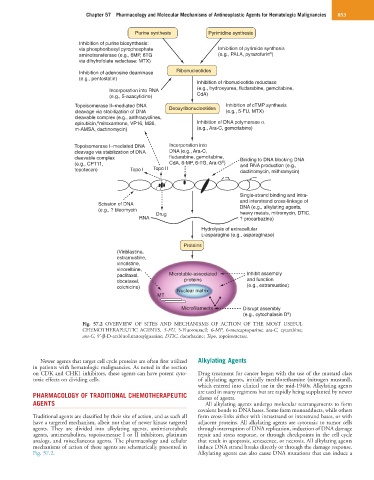
                            Fig.  57.2  OVERVIEW  OF  SITES  AND  MECHANISMS  OF  ACTION  OF  THE  MOST  USEFUL
                            CHEMOTHERAPEUTIC  AGENTS.  5-FU,  5-Fluorouracil;  6-MP,  6-mercaptopurine;  ara-C,  cytarabine;
                            ara-G, 9′-β-D-arabinofuranosylguanine; DTIC, dacarbazine; Topo, topoisomerase.


              Newer agents that target cell cycle proteins are often first utilized   Alkylating Agents
            in patients with hematologic malignancies. As noted in the section
            on CDK and CHK1 inhibitors, these agents can have potent cyto-  Drug treatment for cancer began with the use of the mustard class
            toxic effects on dividing cells.                      of alkylating agents, initially mechlorethamine (nitrogen mustard),
                                                                  which entered into clinical use in the mid-1940s. Alkylating agents
            PHARMACOLOGY OF TRADITIONAL CHEMOTHERAPEUTIC          are used in many regimens but are rapidly being supplanted by newer
                                                                  classes of agents.
            AGENTS                                                  All alkylating agents undergo molecular rearrangements to form
                                                                  covalent bonds to DNA bases. Some form monoadducts, while others
            Traditional agents are classified by their site of action, and as such all   form cross-links either with intrastrand or interstrand bases, or with
            have a targeted mechanism, albeit not that of newer kinase targeted   adjacent proteins. All alkylating agents are cytotoxic to tumor cells
            agents.  They  are  divided  into  alkylating  agents,  antimicrotubule   through interruption of DNA replication, induction of DNA damage
            agents,  antimetabolites,  topoisomerase  I  or  II  inhibitors,  platinum   repair and stress response, or through checkpoints in the cell cycle
            analogs,  and  miscellaneous  agents. The  pharmacology  and  cellular   that result in apoptosis, senescence, or necrosis. All alkylating agents
            mechanisms of action of these agents are schematically presented in   induce DNA strand breaks directly or through the damage response.
            Fig. 57.2.                                            Alkylating agents can also cause DNA mutations that can induce a

