


Page 971 - Hematology_ Basic Principles and Practice ( PDFDrive )
P. 971
854    Part VII  Hematologic Malignancies


        cytotoxic response or can alter proteins, leading to immune responses   Cyclophosphamide  is  a  nitrogen  mustard  with  a  ringed  struc-
        to novel protein sequences.                           ture  off  the  end-chloroethyl  backbone  that  decreases  spontaneous
                                                              decomposition  (see  Fig.  57.3).  Enzymatic  activation  is  required
                                                              through  multifunction  P450  enzymes  in  the  liver.  Phenobarbital
        Mechanisms of Resistance                              and  corticosteroids  may  alter  activation.  The  bioavailability  of
                                                              cyclophosphamide orally and intravenously is quite similar, although
        Efficient  removal  of  the  DNA  adducts  reduces  the  lesion  burden,   most use of the drug is by bolus IV injection. Cyclophosphamide is
        while loss of DNA damage recognition can invoke damage tolerance,   detoxified through oxidation to 4-keto-cyclophosphamide and car-
        as in the case of loss of MMR and temozolomide tolerance. Detoxify-  boxyphosphamide  by  aldehyde  dehydrogenase.  Cyclophosphamide
        ing enzymes can serve as acceptor molecules for alkylation, alter the   is  used  in  doses  as  small  as  50–100 mg/day  orally  (PO)  and  in
                                                                                                                2
                                                                                      2
        agent prior to DNA attack, or metabolize the parent compound. Loss   bolus  doses  of  400–700 mg/m   for  solid  tumors  and  750 mg/m
        of TP53 results in loss of cell cycle checkpoint induction of DNA   in combination with doxorubicin and vincristine and prednisone as
        repair signals. Increased AKT signaling promotes cell proliferation to   part of the CHOP regimen for NHLs, or alone or with bortezomib
        compensate for the DNA damage response-associated toxicity.  for patients with myeloma. It is also used at doses of up to 60 mg/
                                                              kg/day for 4 days in autologous and allogeneic bone marrow (BM)
                                                              transplantation  protocols.  Cyclophosphamide  is  used  in  numerous
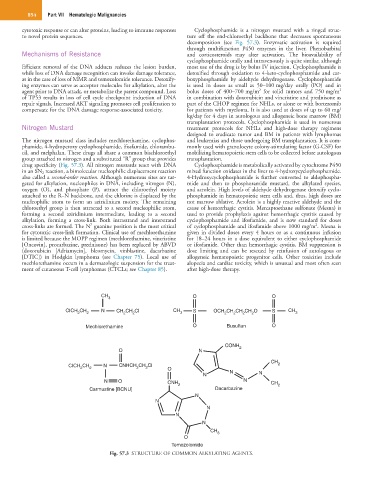
        Nitrogen Mustard                                      treatment  protocols  for  NHLs  and  high-dose  therapy  regimens
                                                              designed to eradicate tumor and BM in patients with lymphomas
        The  nitrogen  mustard  class  includes  mechlorethamine,  cyclophos-  and leukemias and those undergoing BM transplantation. It is com-
        phamide, 4-hydroperoxy cyclophosphamide, ifosfamide, chlorambu-  monly used with granulocyte colony-stimulating factor (G-CSF) for
        cil, and melphalan. These drugs all share a common bischloroethyl   mobilizing hematopoietic stem cells to be collected before autologous
        group attached to nitrogen and a substituted “R” group that provides   transplantation.
        drug specificity (Fig. 57.3). All nitrogen mustards react with DNA   Cyclophosphamide is metabolically activated by cytochrome P450
        in an SN 2  reaction, a bimolecular nucleophilic displacement reaction   mixed function oxidases in the liver to 4-hydroxycyclophosphamide.
        also called a second-order reaction. Although numerous sites are tar-  4-Hydroxycyclophosphamide  is  further  converted  to  aldophospha-
        geted for alkylation, nucleophiles in DNA, including nitrogen (N),   mide  and  then  to  phosphoramide  mustard,  the  alkylated  species,
        oxygen  (O),  and  phosphate  (P),  attract  the  chloroethyl  moiety   and acrolein. High levels of aldehyde dehydrogenase detoxify cyclo-
        attached to the R–N backbone, and the chlorine is displaced by the   phosphamide in hematopoietic stem cells and, thus, high doses are
        nucleophilic  atom  to  form  an  aziridinium  moiety. The  remaining   not marrow ablative. Acrolein is a highly reactive aldehyde and the
        chloroethyl group is then attracted to a second nucleophilic atom,   cause of hemorrhagic cystitis. Mercaptoethane sulfonate (Mesna) is
        forming  a  second  aziridinium  intermediate,  leading  to  a  second   used to provide prophylaxis against hemorrhagic cystitis caused by
        alkylation,  forming  a  cross-link.  Both  intrastrand  and  interstrand   cyclophosphamide  and  ifosfamide,  and  is  now  standard  for  doses
                                                                                                        2
                               7
        cross-links are formed. The N  guanine position is the most critical   of cyclophosphamide and ifosfamide above 1000 mg/m . Mesna is
        for cytotoxic cross-link formation. Clinical use of mechlorethamine   given  in  divided  doses  every  4  hours  or  as  a  continuous  infusion
        is limited because the MOPP regimen (mechlorethamine, vincristine   for  18–24  hours  in  a  dose  equivalent  to  either  cyclophosphamide
        [Oncovin], procarbazine, prednisone) has been replaced by ABVD   or ifosfamide. Other than hemorrhagic cystitis, BM suppression is
        (doxorubicin  [Adriamycin],  bleomycin,  vinblastine,  dacarbazine   dose  limiting  and  can  be  rescued  by  reinfusion  of  autologous  or
        [DTIC])  in  Hodgkin  lymphoma  (see  Chapter  75).  Local  use  of   allogeneic  hematopoietic  progenitor  cells.  Other  toxicities  include
        mechlorethamine occurs in a dermatologic suspension for the treat-  alopecia and cardiac toxicity, which is unusual and most often seen
        ment of cutaneous T-cell lymphomas (CTCLs; see Chapter 85).  after high-dose therapy.


                                  CH 3                          O                         O

                      CICH CH     N    CH CH CI           CH    S      OCH CH CH CH O     S    CH
                          2  2           2  2               3             2  2  2  2              3
                             Mechlorethamine                    O          Busulfan       O


                                                                           CONH 2
                                        O                         N
                                                                                          CH
                       CICH CH 2   N    CNHCH CH CI     O                                   2
                                                 2
                           2
                                              2
                                                                   N        N         N
                                   N    O               CNH 2                    N        CH 2
                              Carmustine [BCNU]                        Dacarbazine
                                                                 N
                                                    N
                                                                     N
                                                          N
                                                                   N
                                                                      CH 3
                                                             O
                                                         Temozolomide
                                     Fig. 57.3  STRUCTURE OF COMMON ALKYLATING AGENTS.

