


Page 967 - Hematology_ Basic Principles and Practice ( PDFDrive )
P. 967
850    Part VII  Hematologic Malignancies


        lymphocytic leukemia (CLL), or maneuvers to overcome resistance   applied to improve potency and specificity, solubility, kinetic profile,
        of  pretreated  disease  outside  of  cell-based  therapies.  However,  as   and tissue penetration and residence. For instance, to screen for a
        predicted by the model, administration of these or other intensive   kinase inhibitor, cells overexpressing an activated kinase may be used.
        regimens in patients with relapsed or late-stage disease generally fails   After an initial in vitro screen, human tumor cell activity is evaluated
        because  of  a  generalized  resistance  of  tumor  cells  to  all  classes  of    using a series of athymic mouse xenograft studies targeting tumors
        chemotherapeutic agents.                              from tissues that show promise in in vitro assays. More informative
                                                              data  is  generated  from  banks  of  patient-derived  tumor  cell  lines,
                                                              often  using  Rho-associated  kinase  (ROCK)  inhibition,  and  using
        DEVELOPMENT OF CHEMOTHERAPEUTIC AGENTS                patient-specific tumor xenografts for drug screening. These in vivo
                                                              models consist of primary malignancies grown in immunodeficient
        The quest for anticancer agents for hematologic malignancies began   mice, typically NSG mice. Some genetically engineer mice to express
        with  the  nitrogen  mustard  class  of  compounds  developed  from   needed  human  cytokines  that  promote  leukemic  cell  growth,  or
        the chemical warfare agent sulfur mustard gas used in World War   reconstitute mice with a human immune system to evaluate immu-
        I.  Since  that  time,  the  National  Cancer  Institute  (NCI)  and  the   nomodulatory  drugs  and  cell-based  immune  responses.  Another
        pharmaceutical industry have developed complex approaches to drug   model system mimics the human disease by establishing mice with
        development, screening, and evaluation. Initial screening consisted   specific chromosomal translocations and oncogene mutations found
        of  toxicity  assessment  against  murine  tumor  cell  lines.  Currently,   in human cancers. Drug efficacy endpoints are complex, since target
        screening is directed toward numerous cell targets, including receptor   effects may produce cell death, senescence, apoptosis, differentiation,
        and downstream signaling kinases; inducers of cell death pathways,   polyploidy,  inhibition  of  metastasis,  and  loss  of  cancer  stem  cell
        including those at the cell surface; mitochondrial enzymes; nuclear   populations. Drugs with promising efficacy and novel mechanisms
        DNA and DNA replication, processing and repair proteins, including   of action then go on to formulation and toxicology testing, and are
        base  excision  repair,  PARP,  CHK1,  topoisomerases,  and  telomer-  ultimately developed for  phase  I clinical  testing  through  academic
        ase;  and  inhibitors  of  histone  deacetylase  (HDAC)  and  histone   centers, industry, or the NCI Cancer Therapy Evaluation Program.
        methylation,  cell  cycle  proteins,  proteasomes,  and  the  mitosis  and   Effective drug screening includes evidence of target effect specificity
        spindle machinery. Therapeutic agents targeting microenvironment,   and  potency,  consideration  of  effects  across  tumor  types,  recogni-
        angiogenesis, and immune checkpoints round out the spectrum of   tion  of  predictors  of  sensitivity  and  resistance  that  depend  on  the
        therapeutic approaches. Whereas killing cells had been the backbone   mechanism of action and known pathways of resistance, character-
        of  chemotherapeutic  approaches  to  human  malignancies,  the  field   ization  of  genetic  changes  associated  with  resistance  and  acquired
        of  antineoplastic  agent  development,  which  in  the  first  decade  of   resistance, and pharmacokinetic preclinical analysis. In all instances,
        the  21st  century  was  at  a  tipping  point,  has  now  embraced  novel   animal  studies  often  fail  to  provide  accurate  prediction  of  thera-
        targeted and highly effective compounds that block the function of   peutic efficacy, pharmacokinetics, emergence of resistance, or even
        specific kinases with surprising efficacy, even at late stages of disease.   toxicities.
        Ultimately  a  balanced  approach  is  likely,  with  much  more  preci-  Variants of patient-specific tumor xenograft (PDX) models, which
        sion in drug selection, use of mechanism-based combinations, and   allow for direct passage of human tumors in mice, include orthotopic
        attention towards and anticipation of tumor heterogeneity, complex   models that assess the tissue microenvironment for tumor growth and
        subclonality,  and  emergence  of  predictable  resistance  patterns  that   drug efficacy, metastatic models that allow for removal of primary
        dictate proactive drug selection and utilization.     tumor  and  metastasis  to  the  brain,  lungs  and  bone,  and  direct
           Examples  include  Bruton  tyrosine  kinase  (Btk)  and  phosphati-  implantation  and  metastasis,  for  instance  into  colon,  spleen  or
        dylinositol 3-kinase (PI3K) inhibitors in lymphoid malignancies as   marrow sites.
        well as Janus kinase (JAK) inhibitors for treatment of myelofibrosis
        and polycythemia vera. A number of differentiating agents, kinase
        inhibitors, and immunomodulatory and cytostatic agents complete   Phase I Clinical Trial Design
        the antineoplastic armamentarium. The field of drug development
        also has to contend with much more complex assessments of toxicities   New anticancer agents are assessed through a series of clinical trials
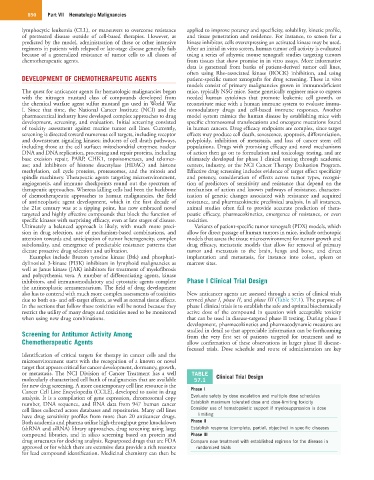
        due to both on- and off-target effects, as well as normal tissue effects.   termed phase I, phase II, and phase III (Table 57.1). The purpose of
        In the sections that follow these toxicities will be noted because they   phase I clinical trials is to establish the safe and optimal biochemically
        restrict the utility of many drugs and toxicities need to be monitored   active  dose  of  the  compound  in  question  with  acceptable  toxicity
        when using new drug combinations.                     that can be used in disease-targeted phase II testing. During phase I
                                                              development, pharmacokinetics and pharmacodynamic measures are
        Screening for Antitumor Activity Among                studied in detail so that appreciable information can be forthcoming
                                                              from  the  very  first  set  of  patients  targeted  for  treatment  and  to
        Chemotherapeutic Agents                               allow confirmation of these observations in larger phase II disease-
                                                              focused  trials.  Dose  schedule  and  route  of  administration  are  key
        Identification of critical targets for therapy in cancer cells and the
        microenvironment starts with the recognition of a known or novel
        target that appears critical for cancer development, dormancy, growth,
        or  metastasis. The  NCI  Division  of  Cancer Treatment  has  a  well   TABLE   Clinical Trial Design
        molecularly characterized cell bank of malignancies that are available   57.1
        for new drug screening. A more contemporary cell line resource is the
        Cancer Cell Line Encyclopedia (CCLE), developed to assist in drug   Phase I
        analysis. It is a compilation of gene expression, chromosomal copy   Evaluate safety by dose escalation and multiple dose schedules
        number,  DNA  sequence,  and  RNA  data  from  947  human  cancer   Establish maximum tolerated dose and dose-limiting toxicity
        cell lines collected across databases and repositories. Many cell lines   Consider use of hematopoietic support if myelosuppression is dose
        have drug sensitivity profiles from more than 20 anticancer drugs.   limiting
        Both academia and pharma utilize high-throughput gene knockdown   Phase II
        (shRNA and siRNA) library approaches, drug screening using large   Establish response (complete, partial, objective) in specific diseases
        compound  libraries,  and  in  silico  screening  based  on  protein  and   Phase III
        drug structures for docking analysis. Repurposed drugs that are FDA   Compare new treatment with established regimen for the disease in
        approved or for which there are extensive data provide a rich resource   randomized trials
        for lead compound identification. Medicinal chemistry can then be

