


Page 975 - Hematology_ Basic Principles and Practice ( PDFDrive )
P. 975
858    Part VII  Hematologic Malignancies


        cell transplantation. It is recognized for its immunosuppressive func-  totic proteins such as Bcl-X(L), Mcl-1, and Bax with dephosphoryla-
        tion and inducing tolerance to allografts transplantation. Fludarabine   tion of akt; and inhibits DNA synthesis.
        phosphate is the 2-fluoro, 5′-monophosphate derivative of vidarabine   It appears more active against B-cell than T-cell lymphomas, but
        (9′-β-D-arabinofuranosyladenine  [ara-A])  and  is  converted  to  the   also has activity in AML and myelodysplastic syndromes (MDS). It
        di- and triphosphate by intracellular kinases, as are gemcitabine and   is well tolerated. Recent studies show its significant efficacy in ara-C–
        ara-C. It has greater potency because it confers resistance to deamina-  refractory AML. Reversible liver toxicity and myelosuppression can
        tion by adenosine deaminase (ADA) and improved solubility. It is   be dose limiting (see Chapter 59).
        incorporated into DNA as a nucleotide and causes chain termination.
        It  is  a  potent  inhibitor  of  cytosolic  5′-nucleotidase  II.  It  is  also  a   Nelarabine
        substrate for uracil glycosylase, causing abasic sites as the first stem   Nelarabine  (9-β-D-arabinofuranosylguanine)  is  another  FDA-
        in BER and has recently been used in combination with TRC102,   approved purine analog for the treatment of refractory T-cell leuke-
        which  binds  to  these  sites  and  prevents  their  repair.  Like  other   mias and lymphomas (Chapter 85).
        nucleoside  analogues,  it  causes  replication  fork  collapse,  double-  As a nucleotide analogue, it preferentially accumulates in T cells
        strand breaks, and induction of P53, leading to apoptotic signaling.   and  is  incorporated  into  DNA,  causing  chain  termination  and
        Its efficacy against normal lymphoid T and B cells appears linked to   inhibiting DNA synthesis. The FDA approved this drug after analyz-
        both cytotoxicity against proliferating cells and resting cells; the latter   ing the results of two phase II clinical trials, one in pediatric T-cell
        effect  is  mediated  by  interference  with  the  normal  activity  of  the   acute  lymphoblastic  leukemia  (ALL)  and  the  other  in  adults  with
        nucleotide excision repair pathway.                   T-cell lymphoblastic lymphoma. In both cases, patients had relapsed
           Fludarabine  is  a  complex  agent.  Resistance  is  multifactorial   after at least two induction regimens. Because CRs were seen in 13%
        including active transport, decreased cytosolic 5′-nucleotidase II and   of the 39% of pediatric patients and in 18% of the 28 adult patients,
        deoxycytokine kinase, and Ku80 binding to telomerase. Other non-  the FDA granted approval. Neurologic toxicity is dose limiting. Good
        specific mechanisms include mutations in p53 or loss due to chromo-  response rates, including CRs, have been seen in patients with refrac-
        some deletion, which is important in many cases of CLL, and other   tory T-cell leukemias.
        proliferation-associated genes such as NOTCH1, SF3B1, and BIRC3.   Reduced  ara-G  incorporation  into  DNA  is  likely  due  to  both
        Low-level miR-34a is also associated with fludarabine resistance.  altered nucleotide transport, increased nucleotidase activity, reduced
                                             2
           Fludarabine,  at  a  standard  dose  of  25 mg/m   for  5  days  and   nucleoside kinase activity, and nonspecific resistance mechanisms as
        rituximab with or without cyclophosphamide were the mainstay of   described earlier for this class of agent.
        primary treatment for CLL (Chapter 77). Fludarabine has also been
        used  in  refractory  leukemias,  marginal  cell  and  other  low-grade
        lymphomas.  Recognition  of  the  appearance  of  lymphopenia  after   Inhibitors of DNA Topoisomerase I and II
        treatment led to studies establishing fludarabine as part of the non-
        myelosuppressive preparative regimens for allogeneic transplantation,   Inhibitors  of  DNA  topoisomerases  I  and  II  include  such  drugs  as
        used particularly for older individual recipients. This is most often at   doxorubicin, daunorubicin, mitoxantrone, etoposide, and topotecan.
                          2
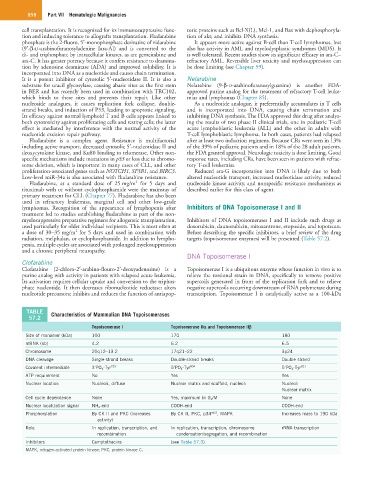
        a dose of 30–35 mg/m  for 5 days and used in combination with   Before describing the specific inhibitors, a brief review of the drug
        radiation, melphalan, or cyclophosphamide. In addition to lympho-  targets (topoisomerase enzymes) will be presented (Table 57.2).
        penia, multiple cycles are associated with prolonged myelosuppression
        and a chronic peripheral neuropathy.
                                                              DNA Topoisomerase I
        Clofarabine
        Clofarabine  (2-chloro-2′-arabino-flouro-2′-deoxyadenosine)  is  a   Topoisomerase I is a ubiquitous enzyme whose function in vivo is to
        purine analog with activity in patients with relapsed acute leukemia.   relieve the torsional strain in DNA, specifically to remove positive
        Its activation requires cellular uptake and conversion to the triphos-  supercoils generated in front of the replication fork and to relieve
        phate  nucleotide.  It  then  decreases  ribonucleotide  reductase;  alters   negative supercoils occurring downstream of RNA polymerase during
        nucleotide precursors; inhibits and reduces the function of antiapop-  transcription. Topoisomerase  I  is  catalytically  active  as  a  100-kDa


          TABLE   Characteristics of Mammalian DNA Topoisomerases
          57.2
                               Topoisomerase I           Topoisomerase IIα and Topoisomerase IIβ
         Size of monomer (kDa)  100                      170                                 180
         mRNA (kb)             4.2                       6.2                                 6.5
         Chromosome            20q12–13.2                17q21–22                            3p24
         DNA cleavage          Single-strand breaks      Double-strand breaks                Double strand
         Covalent intermediate  3′PO 4 -Tyr 723          5′PO 4 -Tyr 804                     5′PO 4 -Tyr 821
         ATP requirement       No                        Yes                                 Yes
         Nuclear location      Nucleoli, diffuse         Nuclear matrix and scaffold, nucleoli  Nucleoli
                                                                                             Nuclear matrix
         Cell cycle dependence  None                     Yes, maximum in G 2 /M              None
         Nuclear localization signal  NH 2 -end          COOH-end                            COOH-end
         Phosphorylation       By CK II and PKC (increases   By CK II, PKC, p34 odc2 , MAPK  Increases mass to 190 kDa
                                 activity)
         Role                  In replication, transcription, and   In replication, transcription, chromosome   rRNA transcription
                                 recombination             condensation/segregation, and recombination
         Inhibitors            Camptothecins             (see Table 57.3)
         MAPK, mitogen-activated protein kinase; PKC, protein kinase C.

