


Page 976 - Hematology_ Basic Principles and Practice ( PDFDrive )
P. 976
Chapter 57  Pharmacology and Molecular Mechanisms of Antineoplastic Agents for Hematologic Malignancies  859


            monomer and is concentrated in nucleoli, although smaller amounts   recognition and binding (curved and supercoiled DNA, as well as
            are found in a diffuse nuclear distribution. The gene for this enzyme   DNA crossovers, are preferred), the sequential cleavage of the two
            is located on human chromosome 20q12–13.2. Topoisomerase I does   strands  of  DNA  with  covalent  attachment  of  a  monomer  to  each
            not require ATP for catalytic activity. It binds double-strand DNA   5′-end of the cleaved DNA, passage of another DNA duplex through
            over  15–25 bp  (with  a  preference  for  supercoiled  or  bent  DNA)   the  break  site  (e.g.,  to  relieve  DNA  torsional  strain  or  decatenate
            followed  by  cleavage  of  one  DNA  strand  and  forming  a  transient   daughter chromosomes at the end of replication), religation of the
            covalent phosphotyrosyl bond at the 3′-end of DNA. DNA torsional   cleaved  DNA,  and  ATP  hydrolysis-dependent  enzyme  turnover.
            strain is then relieved by a “controlled rotation” mechanism (see Fig.   The binding of ATP by topoisomerase II is required for the strand
            57.1), subsequent to which the cleaved DNA is religated. The three-  passage  reaction.  Again,  the  association  between  topoisomerase  II
            dimensional  crystal  structure  of  human  topoisomerase  I,  both  in   monomers and the 5′-end of the cleaved DNA has been termed the
            covalent  and  noncovalent  complexes  with  DNA,  has  defined  the   cleavable complex, the stabilization of which generally correlates with
            structural elements of the enzyme that contacts DNA. The associa-  the cytotoxic activity of specific topoisomerase II inhibitors.
            tion between topoisomerase I and the 3′-end of cleaved DNA has   Because topoisomerase I and II inhibitors convert their respective
            been termed the cleavable complex, which is stabilized by topoisom-  enzymes into DNA-damaging agents, it is usually true that the more
            erase I inhibitors.                                   enzyme target a cell contains (provided it is in the nucleus), the more
                                                                  cytotoxic is the specific inhibitor. An exception to this generalization
                                                                  is CLL cells, which have abundant topoisomerase I but are not very
            DNA Topoisomerase II                                  sensitive  to  topoisomerase  I  inhibitors  because  topoisomerase  I
                                                                  inhibitors are S-phase specific and CLL cells have very few cells in S
            Two isoforms of human topoisomerase II (α and β) exist. They act as   phase. Finally, in addition to topoisomerase I and II, a mammalian
            homodimers to cleave double-stranded DNA and require ATP for full   DNA topoisomerase III has been described and found to be essential
            activity. Their role in vivo is to relieve torsional strain in DNA, and   for early embryogenesis in the mouse. In addition to the presumed
            their cellular distribution is determined by nuclear localization signals   lethality  of  a  homozygous  deletion  of  the  topoisomerase  II  gene,
            contained in the C-terminal domain. These isoforms are distinct in   topoisomerases I and III appear to be essential for cell growth and
            that they have different-size monomers (see Table 57.2), their genes   division  in  mammals.  The  specific  role  of  topoisomerase  III  in
            are located on separate chromosomes, their nuclear distribution is dif-  humans is unknown at present.
            ferent, and only the α-isoform shows cell cycle variations in amount
            and activity (with maximal activity being in G 2 /M). The mechanism
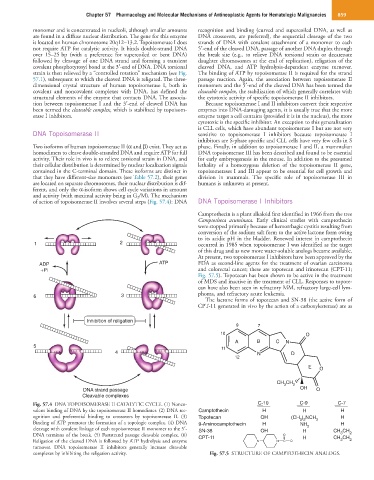
            of action of topoisomerase II involves several steps (Fig. 57.4): DNA   DNA Topoisomerase I Inhibitors

                                                                  Camptothecin is a plant alkaloid first identified in 1966 from the tree
                                                                  Camptotheca  acuminata.  Early  clinical  studies  with  camptothecin
                                                                  were stopped primarily because of hemorrhagic cystitis resulting from
                                                                  conversion of the sodium salt form to the active lactone form owing
                                                                  to its acidic pH in the bladder. Renewed interest in camptothecin
            1                           2                         occurred in 1985 when topoisomerase I was identified as the target
                                                                  of this drug and as new more water-soluble analogs became available.
                                                                  At present, two topoisomerase I inhibitors have been approved by the
              ADP                                    ATP          FDA as second-line agents for the treatment of ovarian carcinoma
              +Pi                                                 and colorectal cancer; these are topotecan and irinotecan (CPT-11;
                                                                  Fig. 57.5). Topotecan has been shown to be active in the treatment
                                                                  of MDS and inactive in the treatment of CLL. Responses to topote-
                                                                  can have also been seen in refractory MM, refractory large-cell lym-
            6                            3                        phoma, and refractory acute leukemia.
                                                                    The lactone forms of topotecan and SN-38 (the active form of
                                                                  CPT-11 generated in vivo by the action of a carboxylesterase) are as

                             Inhibition of religation
                                                                              9      7
                                                                         10                          O
                                                                              A      B     C  N
            5                                                            11
                                       4                                             N          D
                                                                              12
                                                                                                      E   O

                                                                                            CH CH
                                                                                              3  2
                            DNA strand passage                                                     OH   O
                            Cleavable complexes
            Fig. 57.4  DNA TOPOISOMERASE II CATALYTIC CYCLE. (1) Nonco-              C-10          C-9          C-7
            valent binding of DNA by the topoisomerase II homodimer. (2) DNA rec-  Camptothecin  H  H           H
            ognition  and  preferential  binding  to  crossovers  by  topoisomerase  II.  (3)   Topotecan  OH  (CH ) NCH 2  H
                                                                                                   3 2
            Binding of ATP promotes the formation of a topologic complex. (4) DNA   9-Aminocamptothecin  H  NH 2  H
            cleavage with covalent linkage of each topoisomerase II monomer to the 5′-  SN-38  OH   H         CH CH
                                                                                                                3
            DNA terminus of the break. (5) Poststrand passage cleavable complex. (6)   CPT-11  O    H         CH CH 2
            Religation of the cleaved DNA is followed by ATP hydrolysis and enzyme   N     N  C  O              3  2
            turnover.  DNA  topoisomerase  II  inhibitors  generally  increase  cleavable
            complexes by inhibiting the religation activity.          Fig. 57.5  STRUCTURE OF CAMPTOTHECIN ANALOGS.

