


Page 1071 - Williams Hematology ( PDFDrive )
P. 1071
1046           Part VIII:  Monocytes and Macrophages                                                                                   Chapter 67:  Structure, Receptors, and Functions of Monocytes and Macrophages             1047


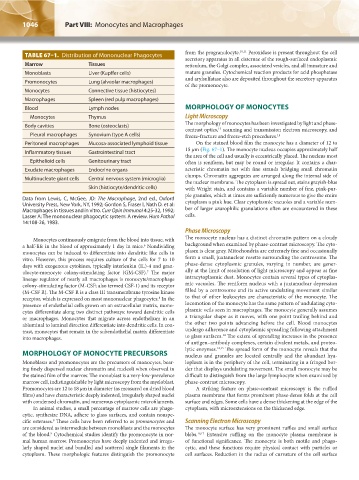
                TABLE 67–1.  Distribution of Mononuclear Phagocytes   from the progranulocyte. 10,11  Peroxidase is present throughout the cell
                                                                      secretory apparatus in all cisternae of the rough-surfaced endoplasmic
                Marrow                Tissues                         reticulum, the Golgi complex, associated vesicles, and all immature and
                Monoblasts            Liver (Kupffer cells)           mature granules. Cytochemical reaction products for acid phosphatase
                                                                      and arylsulfatase also are deposited throughout the secretory apparatus
                Promonocytes          Lung (alveolar macrophages)
                                                                      of the promonocyte.
                Monocytes             Connective tissue (histiocytes)
                Macrophages           Spleen (red pulp macrophages)
                Blood                 Lymph nodes                     MORPHOLOGY OF MONOCYTES
                  Monocytes           Thymus                          Light Microscopy
                                                                      The morphology of monocytes has been investigated by light and phase-
                Body cavities         Bone (osteoclasts)
                                                                      contrast optics,  scanning and transmission electron microscopy, and
                                                                                 12
                  Pleural macrophages  Synovium (type A cells)        freeze-fracture and freeze-etch procedures. 13
                Peritoneal macrophages  Mucosa-associated lymphoid tissue  On the stained blood film the monocyte has a diameter of 12 to
                                                                      15 μm (Fig. 67–1). The monocyte nucleus occupies approximately half
                Inflammatory tissues  Gastrointestinal tract
                                                                      the area of the cell and usually is eccentrically placed. The nucleus most
                  Epithelioid cells   Genitourinary tract             often is reniform, but may be round or irregular. It contains a char-
                Exudate macrophages   Endocrine organs                acteristic  chromatin  net  with  fine  strands  bridging  small  chromatin
                                                                      clumps. Chromatin aggregates are arranged along the internal side of
                Multinucleate giant cells  Central nervous system (microglia)
                                                                      the nuclear membrane. The cytoplasm is spread out, stains grayish-blue
                                      Skin (histiocyte/dendritic cells)  with Wright stain, and contains a variable number of fine, pink-pur-
                                                                      ple granules, which at times are sufficiently numerous to give the entire
               Data from Lewis, C, McGee, JD:  The Macrophage, 2nd ed., Oxford   cytoplasm a pink hue. Clear cytoplasmic vacuoles and a variable num-
               University Press, New York, NY, 1992; Gordon S, Fraser I, Nath D. et al:
               Macrophages in tissues and in vitro. Curr Opin Immunol 4:25-32, 1992;   ber of larger azurophilic granulations often are encountered in these
               Lasser A: The mononuclear phagocytic system: A review. Hum Pathol   cells.
               14:108-26, 1983.
                                                                      Phase Microscopy
                   Monocytes continuously emigrate from the blood into tissue, with   The monocyte nucleus has a distinct chromatin pattern on a cloudy
               a half-life in the blood of approximately 1 day in mice.  Nondividing   background when examined by phase-contrast microscopy. The cyto-
                                                        6
               monocytes can be induced to differentiate into dendritic like cells in   plasm is clear gray. Mitochondria are extremely fine and occasionally
               vitro. However, this process requires culture of the cells for 7 to 10   form a small, juxtanuclear rosette surrounding the centrosome. The
               days with exogenous cytokines, typically interleukin (IL)-4 and gran-  phase-dense cytoplasmic  granules,  varying  in  number,  are gener-
                                                         7
               ulocyte-monocyte colony-stimulating factor (GM-CSF).  The major   ally at the limit of resolution of light microscopy and appear as fine
               lineage regulator of nearly all macrophages is monocyte/macrophage   intracytoplasmic dust. Monocytes contain several types of cytoplas-
               colony-stimulating factor (M-CSF; also termed CSF-1) and its receptor   mic vacuoles. The reniform nucleus with a juxtanuclear depression
               (M-CSF R). The M-CSF R is a class III transmembrane tyrosine kinase   filled by a centrosome and its active undulating movement similar
                                                             8
               receptor, which is expressed on most mononuclear phagocytes.  In the   to that of other leukocytes are characteristic of the monocyte. The
               presence of endothelial cells grown on an extracellular matrix, mono-  locomotion of the monocyte has the same pattern of undulating cyto-
               cytes differentiate along two distinct pathways: toward dendritic cells   plasmic veils seen in macrophages. The monocyte generally assumes
               or macrophages. Monocytes that migrate across endothelium in an   a triangular shape as it moves, with one point trailing behind and
               abluminal to luminal direction differentiate into dendritic cells. In con-  the other two points advancing before the cell. Blood monocytes
               trast, monocytes that remain in the subendothelial matrix differentiate   undergo adherence and cytoplasmic spreading following attachment
                                                                                   14
               into macrophages.                                      to glass surfaces.  The extent of spreading increases in the presence
                                                                      of antigen–antibody complexes, certain divalent metals, and proteo-
                                                                      lytic enzymes. 14,15  The spread form of the monocyte reveals that the
               MORPHOLOGY OF MONOCYTE PRECURSORS                      nucleus and granules are located centrally and the abundant hya-
               Monoblasts and promonocytes are the precursors of monocytes, bear-  loplasm is in the periphery of the cell, terminating in a fringed bor-
               ing finely dispersed nuclear chromatin and nucleoli when observed in   der that displays undulating movement. The small monocyte may be
               the stained film of the marrow. The monoblast is a very-low-prevalence   difficult to distinguish from the large lymphocyte when examined by
               marrow cell, indistinguishable by light microscopy from the myeloblast.   phase-contrast microscopy.
               Promonocytes are 12 to 18 μm in diameter (as measured on dried blood   A striking feature on phase-contrast microscopy is the ruffled
               films) and have characteristic deeply indented, irregularly shaped nuclei   plasma membrane that forms prominent phase-dense folds at the cell
               with condensed chromatin, and numerous cytoplasmic microfilaments.  surface and edges. Some cells have a dense thickening at the edge of the
                   In animal studies, a small percentage of marrow cells are phago-  cytoplasm, with microextensions on the thickened edge.
               cytic, synthesize DNA, adhere to glass surfaces, and contain nonspe-
               cific esterases.  These cells have been referred to as promonocytes and   Scanning Electron Microscopy
                          9
               are considered as intermediate between monoblasts and the monocytes   The monocyte surface has very prominent ruffles and small surface
               of the blood.  Cytochemical studies identify the promonocyte in nor-  blebs. 16,17  Extensive ruffling on the monocyte plasma membrane is
                         9
               mal human marrow. Promonocytes have deeply indented and irregu-  of functional significance. The monocyte is both motile and phago-
               larly shaped nuclei and bundled and scattered single filaments in the   cytic, and these functions require physical contact with particles or
               cytoplasm.  These morphologic features distinguish the promonocyte   cell surfaces. Reduction in the radius of curvature of the cell surface


          Kaushansky_chapter 67_p1043-1074.indd   1046                                                                  9/21/15   10:42 AM

