


Page 1073 - Williams Hematology ( PDFDrive )
P. 1073
1048           Part VIII:  Monocytes and Macrophages                                                                                   Chapter 67:  Structure, Receptors, and Functions of Monocytes and Macrophages             1049


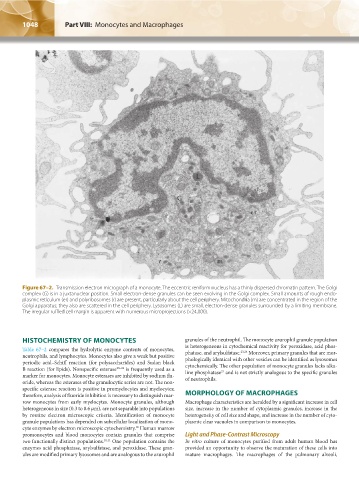
               Figure 67–2.  Transmission electron micrograph of a monocyte. The eccentric reniform nucleus has a thinly dispersed chromatin pattern. The Golgi
               complex (G) is in a juxtanuclear position. Small electron-dense granules can be seen evolving in the Golgi complex. Small amounts of rough endo-
               plasmic reticulum (er) and polyribosomes (r) are present, particularly about the cell periphery. Mitochondria (m) are concentrated in the region of the
               Golgi apparatus; they also are scattered in the cell periphery. Lysosomes (L) are small, electron-dense granules surrounded by a limiting membrane.
               The irregular ruffled cell margin is apparent with numerous microprojections (×24,000).


               HISTOCHEMISTRY OF MONOCYTES                            granules of the neutrophil. The monocyte azurophil granule population
                                                                      is heterogeneous in cytochemical reactivity for peroxidase, acid phos-
               Table 67–2 compares the hydrolytic enzyme contents of monocytes,   phatase, and arylsulfatase. 23,24  Moreover, primary granules that are mor-
               neutrophils, and lymphocytes. Monocytes also give a weak but positive   phologically identical with other vesicles can be identified as lysosomes
               periodic acid–Schiff reaction (for polysaccharides) and Sudan black   cytochemically. The other population of monocyte granules lacks alka-
               B reaction (for lipids). Nonspecific esterase 20–22  is frequently used as a   line phosphatase  and is not strictly analogous to the specific granules
                                                                                  23
               marker for monocytes. Monocyte esterases are inhibited by sodium flu-  of neutrophils.
               oride, whereas the esterases of the granulocytic series are not. The non-
               specific esterase reaction is positive in promyelocytes and myelocytes;
               therefore, analysis of fluoride inhibition is necessary to distinguish mar-  MORPHOLOGY OF MACROPHAGES
               row monocytes from early myelocytes. Monocyte granules, although   Macrophage characteristics are heralded by a significant increase in cell
               heterogeneous in size (0.3 to 0.6 μm), are not separable into populations   size, increase in the number of cytoplasmic granules, increase in the
               by routine electron microscopic criteria. Identification of monocyte   heterogeneity of cell size and shape, and increase in the number of cyto-
               granule populations has depended on subcellular localization of mono-  plasmic clear vacuoles in comparison to monocytes.
                                                     10
               cyte enzymes by electron microscopic cytochemistry.  Human marrow
               promonocytes and blood monocytes contain granules that comprise   Light and Phase-Contrast Microscopy
               two functionally distinct populations. 10,11  One population contains the   In vitro culture of monocytes purified from adult human blood has
               enzymes acid phosphatase, arylsulfatase, and peroxidase. These gran-  provided an opportunity to observe the maturation of these cells into
               ules are modified primary lysosomes and are analogous to the azurophil   mature macrophages. The macrophages of the pulmonary alveoli,


          Kaushansky_chapter 67_p1043-1074.indd   1048                                                                  9/21/15   10:42 AM

