


Page 1072 - Williams Hematology ( PDFDrive )
P. 1072
1046  Part VIII:  Monocytes and Macrophages  Chapter 67:  Structure, Receptors, and Functions of Monocytes and Macrophages  1047


                             A                                         B


                            C                                          D
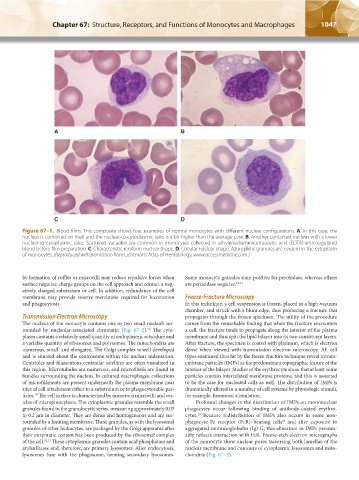
                  Figure 67–1.  Blood films. This composite shows four examples of normal monocytes with different nuclear configurations. A. In this case, the
                  nucleus is contorted on itself and the nuclear-to-cytoplasmic ratio is a bit higher than the average case. B. Another contorted nucleus with a lower
                  nuclear-to-cytoplasmic ratio. Scattered vacuoles are common in monocytes collected in ethylenediaminetetraacetic acid (EDTA)-anticoagulated
                  blood before film preparation. C. Characteristic reniform nuclear shape. D. Circular nuclear shape. Azurophilic granules are evident in the cytoplasm
                  of monocytes. (Reproduced with permission from Lichtman’s Atlas of Hematology, www.accessmedicine.com.)


                  by formation of ruffles or microvilli may reduce repulsive forces when   Some monocyte granules stain positive for peroxidase, whereas others
                  surface negative-charge groups on the cell approach and contact a neg-  are peroxidase negative. 10,11
                  atively charged substratum or cell. In addition, redundancy of the cell
                  membrane may provide reserve membrane required for locomotion   Freeze-Fracture Microscopy
                  and phagocytosis.                                     In this technique, a cell suspension is frozen, placed in a high-vacuum
                                                                        chamber, and struck with a blunt edge, thus producing a fracture that
                  Transmission Electron Microscopy                      propagates through the frozen specimen. The utility of the procedure
                  The nucleus of the monocyte contains one or two small nucleoli sur-  comes from the remarkable finding that when the fracture encounters
                  rounded by nucleolar-associated chromatin (Fig. 67–2).  The cyto-  a cell, the fracture tends to propagate along the interior of the plasma
                                                            18
                  plasm contains a relatively small quantity of endoplasmic reticulum and   membrane and thus split the lipid bilayer into its two constituent layers.
                  a variable quantity of ribosomes and polysomes. The mitochondria are   After fracture, the specimen is coated with platinum, which is electron
                  numerous, small, and elongated. The Golgi complex is well developed   dense when viewed with transmission electron microscopy. All cell
                  and is situated about the centrosome within the nuclear indentation.   types examined thus far by the freeze-fracture technique reveal intram-
                  Centrioles and filamentous centriolar satellites are often visualized in   embrane particles (IMPs) as the predominant topographic feature of the
                  this region. Microtubules are numerous, and microfibrils are found in   interior of the bilayer. Studies of the erythrocyte show that at least some
                  bundles surrounding the nucleus. In cultured macrophages, collections   particles contain intercalated membrane proteins, and this is assumed
                  of microfilaments are present underneath the plasma membrane near   to be the case for nucleated cells as well. The distribution of IMPs is
                  sites of cell attachment either to a substratum or to phagocytosable par-  dramatically altered in a number of cell systems by physiologic stimuli,
                  ticles.  The cell surface is characterized by numerous microvilli and ves-  for example, hormonal stimulation.
                      19
                  icles of micropinocytosis. The cytoplasmic granules resemble the small   Profound changes in the distribution of IMPs on mononuclear
                  granules found in the granulocytic series, measuring approximately 0.05   phagocytes occur following binding of antibody-coated erythro-
                  to 0.2 μm in diameter. They are dense and homogeneous and are sur-  cytes.   Because  redistribution  of  IMPs  also  occurs  in  some  non-
                                                                             13
                  rounded by a limiting membrane. These granules, as with the lysosomal   phagocyte Fc receptor (FcR)–bearing cells  and after exposure to
                                                                                                         13
                  granules of other leukocytes, are packaged by the Golgi apparatus after   aggregated immunoglobulin (Ig) G, this alteration in IMPs presum-
                  their enzymatic content has been produced by the ribosomal complex   ably reflects interaction with FcR. Freeze-etch electron micrographs
                  of the cell. 10,11  These cytoplasmic granules contain acid phosphatase and   of the monocyte show nuclear pores traversing both lamellae of the
                  arylsulfatase and, therefore, are primary lysosomes. After endocytosis,   nuclear membrane and contours of cytoplasmic lysosomes and mito-
                  lysosomes fuse with the phagosome, forming secondary lysosomes.   chondria (Fig. 67–3).


          Kaushansky_chapter 67_p1043-1074.indd   1047                                                                  9/21/15   10:42 AM

