


Page 1169 - Williams Hematology ( PDFDrive )
P. 1169
1144           Part IX:  Lymphocytes and Plasma Cells


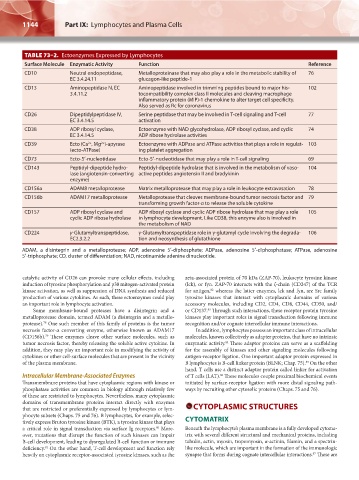
                TABLE 73–2.  Ectoenzymes Expressed by Lymphocytes
                Surface Molecule  Enzymatic Activity  Function                                                 Reference
                CD10           Neutral endopeptidase,    Metalloproteinase that may also play a role in the metabolic stability of   76
                               EC 3.4.24.11           glucagon-like peptide-1
                CD13           Aminopeptidase N, EC   Aminopeptidase involved in trimming peptides bound to major his-  102
                               3.4.11.2               tocompatibility complex class II molecules and cleaving macrophage
                                                      inflammatory protein (MIP)-1 chemokine to alter target cell specificity.
                                                      Also served as Rc for coronavirus
                CD26           Dipeptidylpeptidase IV,    Serine peptidase that may be involved in T-cell signaling and T-cell   77
                               EC 3.4.14.5            activation
                CD38           ADP ribosyl cyclase,    Ectoenzyme with NAD glycohydrolase, ADP ribosyl cyclase, and cyclic   74
                               EC 3.4.14.5            ADP ribose hydrolase activities
                CD39           Ecto (Ca , Mg )-apyrase   Ectoenzyme with ADPase and ATPase activities that plays a role in regulat- 103
                                     2+
                                          2+
                               (ecto-ATPase)          ing platelet aggregation
                CD73           Ecto-5′-nucleotidase   Ecto-5′-nucleotidase that may play a role in T-cell signaling  69
                CD143          Peptidyl-dipeptide hydro-  Peptidyl-dipeptide hydrolase that is involved in the metabolism of vaso-  104
                               lase (angiotensin-converting  active peptides angiotensin II and bradykinin
                               enzyme)
                CD156a         ADAM8 metalloprotease  Matrix metalloprotease that may play a role in leukocyte extravasation  78
                CD156b         ADAM17 metalloprotease  Metalloprotease that cleaves membrane-bound tumor necrosis factor and  79
                                                      transforming growth factor-α to release the soluble cytokine
                CD157          ADP ribosyl cyclase and   ADP ribosyl cyclase and cyclic ADP ribose hydrolase that may play a role   105
                               cyclic ADP ribose hydrolase  in lymphocyte development. Like CD38, this enzyme also is involved in
                                                      the metabolism of NAD
                CD224          γ-Glutamyltranspeptidase,   γ-Glutamyltranspeptidase role in γ-glutamyl cycle involving the degrada-  106
                               EC2.3.2.2              tion and neosynthesis of glutathione
               ADAM, a disintegrin and a metalloprotease;  ADP, adenosine 5′-diphosphate; ADPase, adenosine 5′-diphosphatase; ATPase, adenosine
               5′-triphosphate; CD, cluster of differentiation; NAD, nicotinamide adenine dinucleotide.


               catalytic activity of CD26 can provoke many cellular effects, including   zeta-associated protein of 70 kDa (ZAP-70), leukocyte tyrosine kinase
               induction of tyrosine phosphorylation and p38 mitogen- activated protein   (lck), or fyn. ZAP-70 interacts with the ζ-chain (CD247) of the TCR
               kinase activation, as well as suppression of DNA synthesis and reduced   for antigen,  whereas the latter enzymes, lck and fyn, are Src family
                                                                              82
               production of various cytokines. As such, these ectoenzymes could play   tyrosine kinases that interact with cytoplasmic domains of various
               an important role in lymphocyte activation.            accessory molecules, including CD2, CD4, CD8, CD44, CD50, and/
                   Some membrane-bound proteases have a disintegrin and a   or CD137.  Through such interactions, these receptor protein tyrosine
                                                                              83
               metalloprotease domain, termed ADAM (a disintegrin and a metallo-  kinases play important roles in signal transduction following immune
               protease).  One such member of this family of proteins is the tumor   recognition and/or cognate intercellular immune interactions.
                      78
               necrosis  factor-α  converting  enzyme, otherwise  known  as  ADAM17   In addition, lymphocytes possess an important class of intracellular
               (CD156b).  These enzymes cleave other surface molecules, such as   molecules, known collectively as adapter proteins, that have no intrinsic
                       79
               tumor necrosis factor, thereby releasing the soluble active cytokine. In   enzymatic activity.  These adaptor proteins can serve as a scaffolding
                                                                                   84
               addition, they may play an important role in modifying the activity of   for the assembly of kinases and other signaling molecules following
               cytokines or other cell-surface molecules that are present in the vicinity   antigen-receptor ligation. One important adaptor protein expressed in
               of the plasma membrane.                                B lymphocytes is B-cell linker protein (BLNK; Chap. 75).  On the other
                                                                                                              85
                                                                      hand, T cells use a distinct adaptor protein called linker for activation
               Intracellular Membrane-Associated Enzymes              of T cells (LAT).  These molecules couple proximal biochemical events
                                                                                  86
               Transmembrane proteins that have cytoplasmic regions with kinase or   initiated by surface-receptor ligation with more distal signaling path-
               phosphatase activities are common in biology although relatively few   ways by recruiting other cytosolic proteins (Chaps. 75 and 76).
               of these are restricted to lymphocytes. Nevertheless, many cytoplasmic
               domains of transmembrane proteins interact directly with enzymes
               that are restricted or preferentially expressed by lymphocytes or lym-  CYTOPLASMIC STRUCTURES
               phocyte subsets (Chaps. 75 and 76). B lymphocytes, for example, selec-
               tively express Bruton tyrosine kinase (BTK), a tyrosine kinase that plays   CYTOMATRIX
               a critical role in signal transduction via surface Ig receptors.  More-  Beneath the lymphocyte’s plasma membrane is a fully developed cytoma-
                                                            80
               over, mutations that disrupt the function of such kinases can impair   trix with several different structural and mechanical proteins, including
               B-cell development, leading to dysregulated B-cell function or immune   tubulin, actin, myosin, tropomyosin, α-actinin, filamin, and a spectrin-
               deficiency.  On the other hand, T-cell development and function rely   like molecule, which are important in the formation of the immunologic
                       81
                                                                                                                 87
               heavily on cytoplasmic receptor-associated tyrosine kinases, such as the   synapse that forms during cognate intercellular interactions.  These are


          Kaushansky_chapter 73_p1135-1148.indd   1144                                                                  9/21/15   4:45 PM

