


Page 1185 - Williams Hematology ( PDFDrive )
P. 1185
1160 Part IX: Lymphocytes and Plasma Cells Chapter 75: Functions of B Lymphocytes and Plasma Cells in Immunoglobulin Production 1161
of the heavy chain. The Fc-regions also contain a binding epitope for
the neonatal Fc receptor (FcRn), responsible for the extended half-life,
placental transport, and bidirectional transport of IgG to mucosal sur-
faces. As such, IgG molecules effectively penetrate extravascular spaces
7
and readily cross the placental barrier to provide passive immunity to
the newborn.
IgG is the predominant antibody produced during the secondary
immune response to antigen. The average half-life of circulating IgG
molecules is approximately 21 days, although the exact value varies
among the IgG subclasses (Table 75–3). Within the IgG class are four
major subclasses, designated IgG , IgG , IgG , and IgG . The most
7
3
4
1
2
abundant subclass is IgG , which constitutes 60 percent of the total IgG
1
in plasma. All IgG subclasses have a similar molecular mass except for
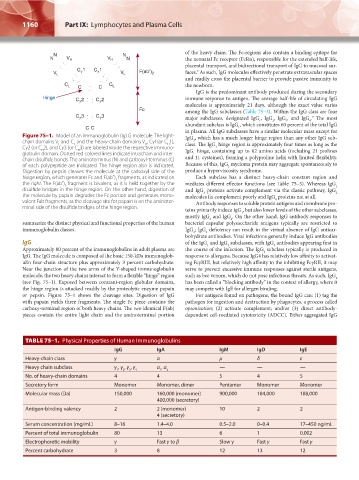
Figure 75–1. Model of an immunoglobulin (Ig) G molecule. The light- IgG , which has a much longer hinge region than any other IgG sub-
3
chain domains V and C and the heavy-chain domains V , Cγ1(or C 1), class. The IgG hinge region is approximately four times as long as the
L
L
H
H
3
Cγ2 (or C 2), and Cγ3 (or C 3) are labeled inside the respective immuno- IgG hinge, containing up to 62 amino acids (including 21 prolines
H
H
globulin domain. Dotted red colored lines indicate intrachain and inter- 1
chain disulfide bonds. The aminoterminus (N) and carboxyl-terminus (C) and 11 cysteines), forming a polyproline helix with limited flexibility.
of each polypeptide are indicated. The hinge region also is indicated. Because of this, IgG myeloma protein may aggregate spontaneously to
3
Digestion by pepsin cleaves the molecule at the carboxyl side of the produce a hyperviscosity syndrome.
hinge region, which generates Fc and F(ab′) fragments, as indicated on Each subclass has a distinct heavy-chain constant region and
2
the right. The F(ab′) fragment is bivalent, as it is held together by the mediates different effector functions (see Table 75–3). Whereas IgG
2
1
disulfide bridges in the hinge region. On the other hand, digestion of and IgG proteins activate complement via the classic pathway, IgG
3
the molecule by papain degrades the Fc portion and generates mono- molecules fix complement poorly and IgG proteins not at all. 2
4
valent Fab fragments, as the cleavage site for papain is on the aminoter- Antibody responses to soluble protein antigens and membrane pro-
minal side of the disulfide bridges of the hinge region.
teins primarily induce IgG , but also lower levels of the other subclasses,
1
mostly IgG and IgG . On the other hand, IgG antibody responses to
3
4
summarize the distinct physical and functional properties of the human bacterial capsular polysaccharide antigens typically are restricted to
immunoglobulin classes. IgG ; IgG deficiency can result in the virtual absence of IgG anticar-
2
2
bohydrate antibodies. Viral infections generally induce IgG antibodies
IgG of the IgG and IgG subclasses, with IgG antibodies appearing first in
1
3
3
Approximately 80 percent of the immunoglobulins in adult plasma are the course of the infection. The IgG subclass typically is produced in
4
IgG. The IgG molecule is composed of the basic 150-kDa immunoglob- response to allergens. Because IgG4 has relatively low affinity to activat-
ulin four-chain structure plus approximately 3 percent carbohydrate. ing FcγRIII, but relatively high affinity to the inhibiting FcγRII, it may
Near the junction of the two arms of the Y-shaped immunoglobulin serve to prevent excessive immune responses against sterile antigens,
molecule, the two heavy chains interact to form a flexible “hinge” region such as bee venom, which do not pose infectious threats. As such, IgG
4
(see Fig. 75–1). Exposed between constant-region globular domains, has been called a “blocking antibody” in the context of allergy, where it
the hinge region is attacked readily by the proteolytic enzyme papain may compete with IgE for allergen binding.
or pepsin. Figure 75–1 shows the cleavage sites. Digestion of IgG For antigens found on pathogens, the bound IgG can: (1) tag the
with papain yields three fragments. The single Fc piece contains the pathogen for ingestion and destruction by phagocytes, a process called
carboxy-terminal region of both heavy chains. The two identical F(ab) opsonization; (2) activate complement; and/or (3) direct antibody-
pieces contain the entire light chain and the aminoterminal portion dependent cell-mediated cytotoxicity (ADCC). Either aggregated IgG
TABLE 75–1. Physical Properties of Human Immunoglobulins
IgG IgA IgM IgD IgE
Heavy-chain class γ α μ δ ε
Heavy chain subclass γ , γ , γ , γ α , α — — —
1 2 3 4 1 2
No. of heavy-chain domains 4 4 5 4 5
Secretory form Monomer Monomer, dimer Pentamer Monomer Monomer
Molecular mass (Da) 150,000 160,000 (monomer) 900,000 184,000 188,000
400,000 (secretory)
Antigen-binding valency 2 2 (monomer) 10 2 2
4 (secretory)
Serum concentration (mg/mL) 8–16 1.4–4.0 0.5–2.0 0–0.4 17–450 ng/mL
Percent of total immunoglobulin 80 13 6 1 0.002
Electrophoretic mobility γ Fast γ to β Slow γ Fast γ Fast γ
Percent carbohydrate 3 8 12 13 12
Kaushansky_chapter 75_p1159-1174.indd 1160 9/21/15 12:10 PM

