


Page 1186 - Williams Hematology ( PDFDrive )
P. 1186
1160  Part IX:  Lymphocytes and Plasma Cells  Chapter 75:  Functions of B Lymphocytes and Plasma Cells in Immunoglobulin Production     1161


                   TABLE 75–2.  Biologic Properties of Human             TABLE 75–3.  Characteristics of Major IgG Subclasses
                   Immunoglobulins                                                             IgG    IgG      IgG     IgG
                                                                                                  1      2       3       4
                                          IgG   IgA  IgM   IgD   IgE     Heavy chain subclass   γ      γ        γ       γ
                                                                                                                         4
                                                                                                 1
                                                                                                        2
                                                                                                                3
                   Percent of body pool in   45  42   76    75   51      Molecular mass (kDa)  146    146      170     146
                   intravascular space
                                                                         Serum concentration    7      4       0.5     0.6
                   Percent of intravascular pool   6.7  25  18  37  89   (mg/mL)
                   catabolized per day
                                                                         Relative abundance (%)  60    32       4       4
                   Normal synthetic rate    33  24    6.7  0.4  0.02
                   (mg/kg per day)                                       Serum half-life (days)  21    21     7-21 a   21
                   Serum half-life (days)  21   5.8   10   2.8   2.3     Placental Transfer   ++++     ++   ++/++++ *  +++
                   Placental transfer     Yes   No    No   No    No      Complement fixation    ++     +       +++      –
                                                                         (C1q binding)
                   Cytophilic for mast cells and   No  No  No  No  Yes
                   basophils                                             FcR Binding
                   Binding to macrophages   Yes  No   No   No    Yes     FcγRI (CD64)          +++     –      ++++     ++
                   and other phagocytes                                  FcγRIIa   (CD32) †    +++     ++     ++++     ++
                                                                              H131
                   Reactivity with        Yes   No    No   No    No      FcγRIIa   (CD32) †    +++     +      ++++     ++
                     staphylococcal protein A                                 R131
                                                                         FcγRIIb/c (CD32)       +      –       ++       +
                   Antibody-dependent     Yes   No    No   No    No
                     cell-mediated cytotoxicity                          FcγRIIIa F158  (CD16) ‡  ++   –      ++++      –
                   Complement fixation                                   FcγRIIIa V158  (CD16) ‡  +++  +      ++++      –
                     Classic pathway      Yes   No    Yes  No    No      FcγRIIIb (CD16)       +++     –      ++++     ++
                     Alternative pathway  No    Yes   No   No    No      FcγRn (at pH <6.5)    +++     –      ++++      –
                                                                         Antibody-              +      –        +       –
                                                                         dependent cell-
                                                                         mediated cytotoxicity
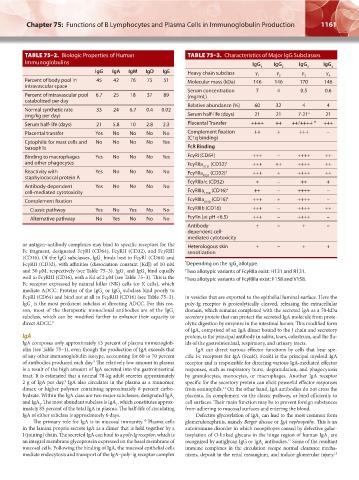
                  or antigen–antibody complexes may bind to specific receptors for the   Heterologous skin   +  –  +    +
                  Fc fragment, designated FcγRI (CD64), FcγRII (CD32), and FcγRIII   sensitization
                  (CD16). Of the IgG subclasses, IgG  binds best to FcγRI (CD64) and
                                            1
                  FcγRII (CD32), with affinities (dissociation constant [Kd]) of 10 nM   * Depending on the IgG  allotype.
                                                                                          3
                  and 50 μM, respectively (see Table  75–3). IgG  and IgG  bind equally   † Two allotypic variants of FcγRIIa exist: H131 and R131.
                                                           3
                                                    1
                  well to FcγRIII (CD16), with a Kd of 2 μM (see Table  75–3). This is the   ‡ Two allotypic variants of FcγRIIIa exist: F158 and V158.
                  Fc receptor expressed by natural killer (NK) cells (or K cells), which
                  mediate ADCC. Proteins of the IgG  or IgG  subclass bind poorly to
                                            4
                                                   2
                  FcγRI (CD64) and bind not at all to FcγRIII (CD16) (see Table  75–3).   in vesicles that are exported to the epithelial luminal surface. Here the
                  IgG  is the most proficient subclass at directing ADCC. For this rea-  poly-Ig receptor is proteolytically cleaved, releasing the extracellular
                     1
                  son, most of the therapeutic monoclonal antibodies are of the IgG     domain, which remains complexed with the secreted IgA as a 70-kDa
                                                                    1
                  subclass, which can be modified further to enhance their capacity to   secretory protein that can protect the secreted IgA molecule from prote-
                  direct ADCC. 8                                        olytic digestion by enzymes in the intestinal lumen. This modified form
                                                                        of IgA, comprised of an IgA dimer bound to the J chain and secretory
                  IgA                                                   protein, is the principal antibody in saliva, tears, colostrum, and the flu-
                  IgA composes only approximately 13 percent of plasma immunoglob-  ids of the gastrointestinal, respiratory, and urinary tracts.
                  ulin (see Table  75–1), even though the production of IgA exceeds that   IgA can direct various effector functions by cells that bear spe-
                  of any other immunoglobulin isotype, accounting for 60 to 70 percent   cific Fc receptors for IgA (FcαR). FcαRI is the principal myeloid IgA
                                          9
                  of antibodies produced each day.  The relatively low amount in plasma   receptor and is responsible for directing various IgA-mediated effector
                  is a result of the high amount of IgA secreted into the gastrointestinal   responses, such as respiratory burst, degranulation, and phagocytosis
                  tract. It is estimated that a normal 70-kg adult secretes approximately     by granulocytes, monocytes, or macrophages. Another IgA receptor
                                9
                  2 g of IgA per day.  IgA also circulates in the plasma as a monomer,   specific for the secretory protein can elicit powerful effector responses
                  dimer, or higher polymer containing approximately 8 percent carbo-  from eosinophils.  On the other hand, IgA antibodies do not cross the
                                                                                     11
                  hydrate. Within the IgA class are two major subclasses, designated IgA   1  placenta, fix complement via the classic pathway, or bind efficiently to
                  and IgA . The most abundant subclass is IgA , which constitutes approx-  cell surfaces. Their main function may be to prevent foreign substances
                        2
                                                 1
                  imately 85 percent of the total IgA in plasma. The half-life of circulating   from adhering to mucosal surfaces and entering the blood.
                  IgA of either subclass is approximately 6 days.           Defective glycosylation of IgA  can lead to the most common form
                                                                                                 1
                     The primary role for IgA is in mucosal immunity.  Plasma cells   glomerulonephritis, namely Berger disease or IgA nephropathy. This is an
                                                          10
                  in the lamina propria secrete IgA as a dimer that is held together by a    autoimmune disorder in which neoepitopes caused by defective galac-
                  J (joining) chain. The secreted IgA can bind to a poly-Ig receptor, which is   tosylation of O-linked glycans in the hinge region of human IgA  are
                                                                                                                        1
                  an integral membrane glycoprotein expressed on the basal membrane of   recognized by antiglycan IgG or IgA  antibodies.  Some of the resultant
                                                                                                           12
                                                                                                  1
                  mucosal cells. Following the binding of IgA, the mucosal epithelial cells   immune complexes in the circulation escape normal clearance mecha-
                  mediate endocytosis and transport of the IgA–poly-Ig receptor complex   nisms, deposit in the renal mesangium, and induce glomerular injury.
                                                                                                                          13
          Kaushansky_chapter 75_p1159-1174.indd   1161                                                                  9/21/15   12:10 PM

