


Page 124 - Williams Hematology ( PDFDrive )
P. 124
100            Part III:  Epochal Hematology                                                                                                                          Chapter 7:  Hematology of the Fetus and Newborn              101


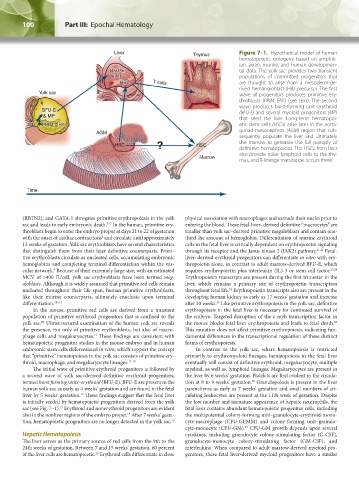
                                              Liver                      Thymus         Figure 7–1.  Hypothetical model of human
                                                                                        hematopoietic ontogeny based on amphib-
                                                                                        ian, avian, murine, and human developmen-
                                             BFU-E                                      tal data. The yolk sac provides two transient
                                             & MP                                       populations of committed progenitors that
                                                HSC        T cells                      are  thought  to  arise  from  a  mesoderm-de-
                                                                                        rived hemangioblast (HB) precursor. The first
                     Yolk sac                                                           wave  of progenitors produces  primitive ery-
                                                                                        throblasts  (PRIM. ERY.)  (see  text). The  second
                                                                                        wave produces burst-forming  unit–erythroid
                      BFU-E                                                             (BFU-E) and several myeloid progenitors (MP)
                      & MP                                                              that seed the liver. Long-term hematopoi-
                 HB   PRIM. ERY.                                                        etic stem cells (HSCs) arise later in the aorta-
                                        AGM                                             gonad-mesonephros  (AGM) region that sub-
                                                                                        sequently  populate the  liver and  ultimately
                                                            ?                           the marrow to generate the full panoply of
                                              HSC                         HSC           definitive hematopoiesis. The HSCs from liver
                                                                                        also provide naïve lymphoid cells to the thy-
                                                                           Marrow
                                                                                        mus, and T-lineage maturation occurs there.


                 Time


               (RBTN2), and GATA-1 abrogates primitive erythropoiesis in the yolk   physical association with macrophages and extrude their nuclei prior to
               sac and leads to early embryonic death.  In the human, primitive ery-  entering the blood. These fetal-liver–derived definitive “macrocytes” are
                                            5–7
               throblasts begin to enter the embryo proper at days 21 to 22 of gestation   smaller than yolk sac–derived primitive megaloblasts and contain one-
               with the onset of cardiac contractions  and circulate until approximately   third the amount of hemoglobin. Differentiation of murine erythroid
                                          8
               12 weeks of gestation. Yolk sac erythroblasts have several characteristics   cells in the fetal liver is critically dependent on erythropoietin signaling
               that distinguish them from their later definitive counterparts. Primi-  through its receptor and the Janus kinase 2 (JAK2) pathway. 21,22  Fetal-
               tive erythroblasts circulate as nucleated cells, accumulating embryonic   liver–derived erythroid progenitors can differentiate in vitro with ery-
               hemoglobins and completing terminal differentiation within the vas-  thropoietin alone, in contrast to adult marrow-derived BFU-E, which
               cular network.  Because of their extremely large size, with an estimated   requires erythropoietin plus interleukin (IL)-3 or stem cell factor. 23,24
                          9
               MCV of >400 fL/cell, yolk sac erythroblasts have been termed  meg-  Erythropoietin transcripts are present during the first trimester in the
               aloblasts. Although it is widely assumed that primitive red cells remain   liver, which remains a primary site of erythropoietin transcription
               nucleated throughout their life span, human primitive erythroblasts,   throughout fetal life.  Erythropoietin transcripts also are present in the
                                                                                     25
               like their murine counterparts, ultimately enucleate upon terminal   developing human kidney as early as 17 weeks’ gestation and increase
               differentiation. 10–12                                 after 30 weeks.  Like primitive erythropoiesis in the yolk sac, definitive
                                                                                 25
                   In the mouse, primitive red cells are derived from a transient   erythropoiesis in the fetal liver is necessary for continued survival of
               population of primitive erythroid progenitors that is confined to the   the embryo. Targeted disruption of the c-myb transcription factor in
               yolk sac.  Ultrastructural examination of the human yolk sac reveals   the mouse blocks fetal liver erythropoiesis and leads to fetal death.
                                                                                                                        26
                      13
               the presence, not only of primitive erythroblasts, but also of macro-  This mutation does not affect primitive erythropoiesis, indicating fun-
               phage cells and megakaryocytes.  These findings are consistent with   damental differences in the transcriptional regulation of these distinct
                                       11
               hematopoietic progenitor studies in the mouse embryo and in human   forms of erythropoiesis.
               embryonic stem cells differentiated in vitro, which support the concept   In contrast to the yolk sac, where hematopoiesis is restricted
               that “primitive” hematopoiesis in the yolk sac consists of primitive ery-  primarily to erythromyeloid lineages, hematopoiesis in the fetal liver
               throid, macrophage, and megakaryocyte lineages. 13-15  eventually will consist of definitive erythroid, megakaryocyte, multiple
                   The initial wave of primitive erythroid progenitors is followed by   myeloid, as well as, lymphoid lineages. Megakaryocytes are present in
               a second wave of yolk sac–derived definitive erythroid progenitors,   the liver by 6 weeks’ gestation. Platelets are first evident in the circula-
               termed burst forming units–erythroid (BFU-E). BFU-E are present in the   tion at 8 to 9 weeks’ gestation.  Granulopoiesis is present in the liver
                                                                                            20
               human yolk sac as early as 4 weeks’ gestation and are found in the fetal   parenchyma as early as 7 weeks’ gestation and small numbers of cir-
               liver by 5 weeks’ gestation.  These findings suggest that the fetal liver   culating leukocytes are present at the 11th week of gestation. Despite
                                   16
               is initially seeded by hematopoietic progenitors derived from the yolk   the low number and immature appearance of hepatic neutrophils, the
               sac (see Fig. 7–1).  Erythroid and nonerythroid progenitors are evident   fetal liver contains abundant hematopoietic progenitor cells, including
                            17
               also in the nonliver regions of the embryo proper.  After 7 weeks’ gesta-  the multipotential colony-forming unit–granulocyte-erythroid-mono-
                                                   18
               tion, hematopoietic progenitors are no longer detected in the yolk sac. 19  cyte-macrophage (CFU-GEMM) and colony-forming unit–granulo-
                                                                      cyte-monocyte (CFU-GM).  CFU-GM growth depends upon several
                                                                                          27
               Hepatic Hematopoiesis                                  cytokines, including granulocyte colony-stimulating factor (G-CSF),
               The liver serves as the primary source of red cells from the 9th to the   granulocyte-monocyte colony-stimulating factor (GM-CSF), and
               24th weeks of gestation. Between 7 and 15 weeks’ gestation, 60 percent   interleukins. When compared to adult marrow-derived myeloid pro-
               of the liver cells are hematopoietic.  Erythroid cells differentiate in close   genitors, these fetal liver-derived myeloid progenitors have a similar
                                        20


          Kaushansky_chapter 07_p0097-0118.indd   100                                                                   9/18/15   10:13 PM

