


Page 129 - Williams Hematology ( PDFDrive )
P. 129
104  Part III:  Epochal Hematology                       Chapter 7:  Hematology of the Fetus and Newborn              105


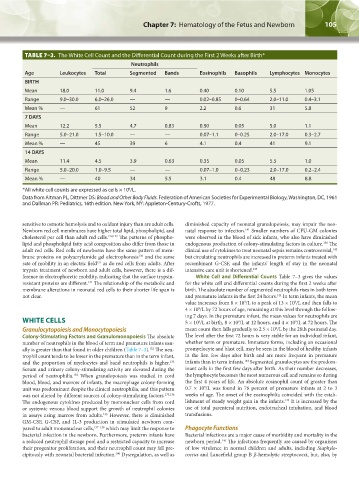
                   TABLE 7–3.  The White Cell Count and the Differential Count during the First 2 Weeks after Birth*
                                                      Neutrophils
                   Age        Leukocytes  Total       Segmented   Bands      Eosinophils  Basophils  Lymphocytes Monocytes
                   BIRTH
                   Mean       18.0        11.0        9.4         1.6        0.40        0.10        5.5        1.05
                   Range      9.0–30.0    6.0–26.0    —           —          0.02–0.85   0–0.64      2.0–11.0   0.4–3.1
                   Mean %     —           61          52          9          2.2         0.6         31         5.8
                   7 DAYS
                   Mean       12.2        5.5         4.7         0.83       0.50        0.05        5.0         1.1
                   Range      5.0–21.0    1.5–10.0    —           —          0.07–1.1    0–0.25      2.0–17.0    0.3–2.7
                   Mean %     —           45          39          6          4.1         0.4         41          9.1
                   14 DAYS
                   Mean       11.4        4.5         3.9         0.63       0.35        0.05        5.5         1.0
                   Range      5.0–20.0    1.0–9.5     —           —          0.07–1.0    0–0.23      2.0–17.0    0.2–2.4
                   Mean %     —           40          34          5.5        3.1         0.4         48          8.8
                  *All white cell counts are expressed as cells × 10 /L.
                                                     9
                  Data from Altman PL, Dittmer DS: Blood and Other Body Fluids. Federation of American Societies for Experimental Biology, Washington, DC, 1961
                  and Dallman PR: Pediatrics, 16th edition. New York, NY: Appleton-Century-Crofts, 1977.


                  sensitive to osmotic hemolysis and to oxidant injury than are adult cells.   diminished capacity of neonatal granulopoiesis, may impair the neo-
                  Newborn red cell membranes have higher total lipid, phospholipid, and   natal response to infection.  Smaller numbers of CFU-GM colonies
                                                                                             141
                  cholesterol per cell than adult red cells. 128,129  The patterns of phospho-  were observed in the blood of sick infants, who also have diminished
                  lipid and phospholipid fatty acid composition also differ from those in   endogenous production of colony-stimulating factors in culture.  The
                                                                                                                       136
                  adult red cells. Red cells of newborns have the same pattern of mem-  clinical use of cytokines to treat neonatal sepsis remains controversial,
                                                                                                                          142
                  brane proteins on polyacrylamide gel electrophoresis  and the same   but circulating neutrophils are increased in preterm infants treated with
                                                         130
                  rate of mobility in an electric field  as do red cells from adults. After   recombinant G-CSF, and the infants’ length of stay in the neonatal
                                           131
                  trypsin treatment of newborn and adult cells, however, there is a dif-  intensive care unit is shortened. 143
                  ference in electrophoretic mobility, indicating that the surface trypsin-   White Cell and Differential Counts Table  7–3 gives the values
                  resistant proteins are different.  The relationship of the metabolic and   for the white cell and differential counts during the first 2 weeks after
                                        131
                  membrane alterations in neonatal red cells to their shorter life span is   birth. The absolute number of segmented neutrophils rises in both term
                  not clear.                                            and premature infants in the first 24 hours.  In term infants, the mean
                                                                                                       144
                                                                        value increases from 8 × 10 /L to a peak of 13 × 10 /L and then falls to
                                                                                                             9
                                                                                            9
                                                                        4 × 10 /L by 72 hours of age, remaining at this level through the follow-
                                                                             9
                                                                        ing 7 days. In the premature infant, the mean values for neutrophils are
                  WHITE CELLS                                           5 × 10 /L at birth, 8 × 10 /L at 12 hours, and 4 × 10 /L at 72 hours. The
                                                                                          9
                                                                             9
                                                                                                             9
                  Granulocytopoiesis and Monocytopoiesis                mean count then falls gradually to 2.5 × 10 /L by the 28th postnatal day.
                                                                                                       9
                  Colony-Stimulating Factors and Granulomonopoiesis The absolute   The level after the first 72 hours is very stable for an individual infant,
                  number of neutrophils in the blood of term and premature infants usu-  whether term or premature. Immature forms, including an occasional
                  ally is greater than that found in older children (Table 7–3).  The neu-  promyelocyte and blast cell, may be seen in the blood of healthy infants
                                                            132
                  trophil count tends to be lower in the premature than in the term infant,   in the first few days after birth and are more frequent in premature
                                                                                            144
                  and the proportion of myelocytes and band neutrophils is higher.    infants than in term infants.  Segmented granulocytes are the predom-
                                                                   133
                  Serum and urinary colony-stimulating activity are elevated during the   inant cells in the first few days after birth. As their number decreases,
                  period of neutrophilia.  When granulopoiesis was studied in cord   the lymphocyte becomes the most numerous cell and remains so during
                                   134
                  blood, blood, and marrow of infants, the macrophage colony-forming   the first 4 years of life. An absolute eosinophil count of greater than
                                                                               9
                  unit was predominant despite the clinical neutrophilia, and this pattern   0.7 × 10 /L was found in 76 percent of premature infants at 2 to 3
                  was not altered by different sources of colony-stimulating factors. 135,136    weeks of age. The onset of the eosinophilia coincided with the estab-
                                                                                                          145
                  The endogenous cytokines produced by mononuclear cells from cord   lishment of steady weight gain in the infants.  It is increased by the
                  or systemic venous blood support the growth of neutrophil colonies   use of total parenteral nutrition, endotracheal intubation, and blood
                  in assays using marrow from adults.  However, there is diminished   transfusions.
                                             135
                  GM-CSF, G-CSF,  and  IL-3 production in stimulated newborn com-
                  pared to adult mononuclear cells, 137–139  which may limit the response to   Phagocyte Functions
                  bacterial infection in the newborn. Furthermore, preterm infants have   Bacterial infections are a major cause of morbidity and mortality in the
                  a reduced neutrophil storage pool and a restricted capacity to increase   newborn period.  The infections frequently are caused by organisms
                                                                                     146
                  their progenitor proliferation, and their neutrophil count may fall pre-  of low virulence in normal children and adults, including  Staphylo-
                  cipitously with neonatal bacterial infection.  Dysregulation, as well as   coccus and Lancefield group B β-hemolytic streptococci, but, also, by
                                                 140
          Kaushansky_chapter 07_p0097-0118.indd   105                                                                   9/18/15   10:13 PM

