


Page 126 - Williams Hematology ( PDFDrive )
P. 126
102            Part III:  Epochal Hematology                                                                                                                          Chapter 7:  Hematology of the Fetus and Newborn              103


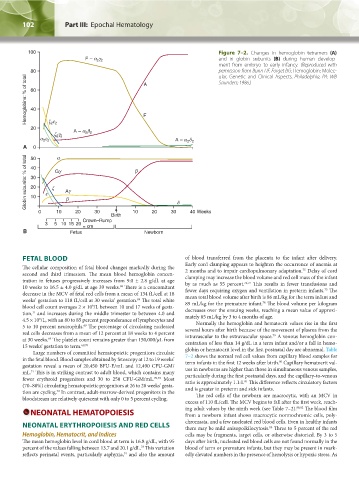
                                                                                 Figure 7–2.  Changes in hemoglobin tetramers  (A)
                                                                                 and in globin subunits  (B) during human develop-
                                                                                 ment from embryo to early infancy.  (Reproduced with
                                                                                 permission from Bunn HF, Forget BG: Hemoglobin: Molec-
                                                                                 ular,  Genetic  and  Clinical  Aspects. Philadelphia, PA: WB
                                                                                 Saunders; 1986.)


               FETAL BLOOD                                            of  blood  transferred  from  the  placenta  to  the  infant  after  delivery.

               The cellular composition of fetal blood changes markedly during the   Early cord clamping appears to heighten the occurrence of anemia at
                                                                                                             75
               second and third trimesters. The mean blood hemoglobin concen-  2 months and to impair cardiopulmonary adaptation.  Delay of cord
               tration in fetuses progressively increases from 9.0 ± 2.8 g/dL at age   clamping may increase the blood volume and red cell mass of the infant
                                                                                          76,77
               10 weeks to 16.5 ± 4.0 g/dL at age 39 weeks.  There is a concomitant   by as much as 55 percent.   This results in fewer transfusions and
                                                68
                                                                                                                     75
               decrease in the MCV of fetal red cells from a mean of 134 fL/cell at 18   fewer days requiring oxygen and ventilation in preterm infants.  The
               weeks’ gestation to 118 fL/cell at 30 weeks’ gestation.  The total white   mean total blood volume after birth is 86 mL/kg for the term infant and
                                                      69
                                                                                                78
               blood cell count averages 2 × 10 /L between 10 and 17 weeks of gesta-  89 mL/kg for the premature infant.  The blood volume per kilogram
                                       9
               tion,  and increases during the middle trimester to between 4.0 and    decreases over the ensuing weeks, reaching a mean value of approxi-
                   31
               4.5 × 10 /L, with an 80 to 85 percent preponderance of lymphocytes and   mately 65 mL/kg by 3 to 4 months of age.
                     9
               5 to 10 percent neutrophils.  The percentage of circulating nucleated   Normally the hemoglobin and hematocrit values rise in the first
                                    69
               red cells decreases from a mean of 12 percent at 18 weeks to 4 percent   several hours after birth because of the movement of plasma from the
                                                                                                   79
               at 30 weeks.  The platelet count remains greater than 150,000/μL from    intravascular to the extravascular space.  A venous hemoglobin con-
                        69
               15 weeks’ gestation to term. 69,70                     centration of less than 14 g/dL in a term infant and/or a fall in hemo-
                   Large numbers of committed hematopoietic progenitors circulate   globin or hematocrit level in the first postnatal day are abnormal. Table
               in the fetal blood. Blood samples obtained by fetoscopy at 12 to 19 weeks’   7–2 shows the normal red cell values from capillary blood samples for
                                                                                                      80
               gestation reveal a mean of 20,450 BFU-E/mL  and 12,490 CFU-GM/  term infants in the first 12 weeks after birth.  Capillary hematocrit val-
               mL.  This is in striking contrast to adult blood, which contains many   ues in newborns are higher than those in simultaneous venous samples,
                  71
               fewer erythroid progenitors and 30 to 250 CFU-GM/mL. 70,72  Most     particularly during the first postnatal days, and the capillary-to-venous
                                                                                          81
               (70–80%) circulating hematopoietic progenitors at 26 to 28 weeks’ gesta-  ratio is approximately 1.1:1.  This difference reflects circulatory factors
               tion are cycling.  In contrast, adult-marrow-derived progenitors in the   and is greater in preterm and sick infants.
                           72
               bloodstream are relatively quiescent with only 0 to 5 percent cycling.  The red cells of the newborn are macrocytic, with an MCV in
                                                                      excess of 110 fL/cell. The MCV begins to fall after the first week, reach-
                  NEONATAL HEMATOPOIESIS                              ing adult values by the ninth week (see Table  7–2). 80,82  The blood film
                                                                      from a newborn infant shows macrocytic normochromic cells, poly-
               NEONATAL ERYTHROPOIESIS AND RED CELLS                  chromasia, and a few nucleated red blood cells. Even in healthy infants
                                                                                                  83
                                                                      there may be mild anisopoikilocytosis.  Three to 5 percent of the red
               Hemoglobin, Hematocrit, and Indices                    cells may be fragments, target cells, or otherwise distorted. By 3 to 5
               The mean hemoglobin level in cord blood at term is 16.8 g/dL, with 95   days after birth, nucleated red blood cells are not found normally in the
                                                       73
               percent of the values falling between 13.7 and 20.1 g/dL.  This variation   blood of term or premature infants, but they may be present in mark-
                                                 74
               reflects perinatal events, particularly asphyxia,  and also the amount   edly elevated numbers in the presence of hemolysis or hypoxic stress. As
          Kaushansky_chapter 07_p0097-0118.indd   102                                                                   9/18/15   10:13 PM

