


Page 127 - Williams Hematology ( PDFDrive )
P. 127
102  Part III:  Epochal Hematology                       Chapter 7:  Hematology of the Fetus and Newborn              103


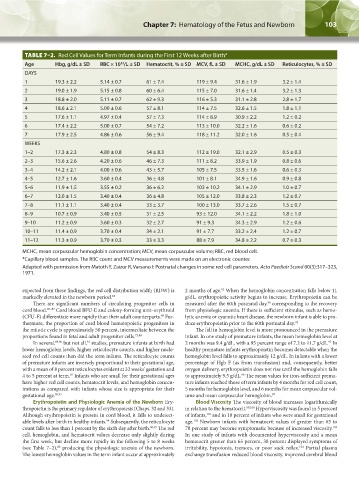
                   TABLE 7–2.  Red Cell Values for Term Infants during the First 12 Weeks after Birth*
                   Age       Hbg, g/dL ± SD  RBC × 10 /L ± SD  Hematocrit, % ± SD MCV, fL ± SD  MCHC, g/dL ± SD  Reticulocytes, % ± SD
                                                   12
                   DAYS
                   1         19.3 ± 2.2     5.14 ± 0.7     61 ± 7.4         119 ± 9.4    31.6 ± 1.9      3.2 ± 1.4
                   2         19.0 ± 1.9     5.15 ± 0.8     60 ± 6.4         115 ± 7.0    31.6 ± 1.4      3.2 ± 1.3
                   3         18.8 ± 2.0     5.11 ± 0.7     62 ± 9.3         116 ± 5.3    31.1 ± 2.8      2.8 ± 1.7
                   4         18.6 ± 2.1     5.00 ± 0.6     57 ± 8.1         114 ± 7.5    32.6 ± 1.5      1.8 ± 1.1
                   5         17.6 ± 1.1     4.97 ± 0.4     57 ± 7.3         114 ± 8.9    30.9 ± 2.2      1.2 ± 0.2
                   6         17.4 ± 2.2     5.00 ± 0.7     54 ± 7.2         113 ± 10.0   32.2 ± 1.6      0.6 ± 0.2
                   7         17.9 ± 2.5     4.86 ± 0.6     56 ± 9.4         118 ± 11.2   32.0 ± 1.6      0.5 ± 0.4
                   WEEKS
                   1–2       17.3 ± 2.3     4.80 ± 0.8     54 ± 8.3         112 ± 19.0   32.1 ± 2.9      0.5 ± 0.3
                   2–3       15.6 ± 2.6     4.20 ± 0.6     46 ± 7.3         111 ± 8.2    33.9 ± 1.9      0.8 ± 0.6
                   3–4       14.2 ± 2.1     4.00 ± 0.6     43 ± 5.7         105 ± 7.5    33.5 ± 1.6      0.6 ± 0.3
                   4–5       12.7 ± 1.6     3.60 ± 0.4     36 ± 4.8         101 ± 8.1    34.9 ± 1.6      0.9 ± 0.8
                   5–6       11.9 ± 1.5     3.55 ± 0.2     36 ± 6.2         102 ± 10.2   34.1 ± 2.9      1.0 ± 0.7
                   6–7       12.0 ± 1.5     3.40 ± 0.4     36 ± 4.8         105 ± 12.0   33.8 ± 2.3      1.2 ± 0.7
                   7–8       11.1 ± 1.1     3.40 ± 0.4     33 ± 3.7         100 ± 13.0   33.7 ± 2.6      1.5 ± 0.7
                   8–9       10.7 ± 0.9     3.40 ± 0.5     31 ± 2.5         93 ± 12.0    34.1 ± 2.2      1.8 ± 1.0
                   9–10      11.2 ± 0.9     3.60 ± 0.3     32 ± 2.7         91 ± 9.3     34.3 ± 2.9      1.2 ± 0.6
                   10–11     11.4 ± 0.9     3.70 ± 0.4     34 ± 2.1         91 ± 7.7     33.2 ± 2.4      1.2 ± 0.7
                   11–12     11.3 ± 0.9     3.70 ± 0.3     33 ± 3.3         88 ± 7.9     34.8 ± 2.2      0.7 ± 0.3
                  MCHC, mean corpuscular hemoglobin concentration; MCV, mean corpuscular volume; RBC, red blood cell.
                  *Capillary blood samples. The RBC count and MCV measurements were made on an electronic counter.
                  Adapted with permission from Matoth Y, Zaizor R, Varsano I: Postnatal changes in some red cell parameters. Acta Paediatr Scand 60(3):317–323,
                  1971.

                  expected from these findings, the red cell distribution width (RDW) is   2 months of age.  When the hemoglobin concentration falls below 11
                                                                                    82
                  markedly elevated in the newborn period. 84           g/dL, erythropoietic activity begins to increase. Erythropoietin can be
                     There are significant numbers of circulating  progenitor cells in   measured after the 60th postnatal day,  corresponding to the recovery
                                                                                                    96
                  cord blood. 85–87  Cord blood BFU-E and colony-forming unit–erythroid   from physiologic anemia. If there is sufficient stimulus, such as hemo-
                  (CFU-E) differentiate more rapidly than their adult counterparts.  Fur-  lytic anemia or cyanotic heart disease, the newborn infant is able to pro-
                                                                88
                  thermore, the proportion of cord blood hematopoietic progenitors in   duce erythropoietin prior to the 60th postnatal day. 94
                  the mitotic cycle is approximately 50 percent, intermediate between the   The fall in hemoglobin level is more pronounced in the premature
                  proportions found in fetal and adult progenitor cells. 72,86  infant. In one study of premature infants, the mean hemoglobin level at
                                                                                                                        97
                                       91
                     In several, 89,90  but not all,  studies, premature infants at birth had   2 months was 9.4 g/dL, with a 95 percent range of 7.2 to 11.7 g/dL.  In
                  lower hemoglobin levels, higher reticulocyte counts, and higher nucle-  healthy premature infants erythropoietin becomes detectable when the
                  ated red cell counts than did the term infants. The reticulocyte counts   hemoglobin level falls to approximately 12 g/dL. In infants with a lower
                  of premature infants are inversely proportional to their gestational age,   percentage of Hgb F (as from transfusion) and, consequently, better
                  with a mean of 8 percent reticulocytes evident at 32 weeks’ gestation and   oxygen delivery, erythropoietin does not rise until the hemoglobin falls
                                  92
                                                                                           98
                  4 to 5 percent at term.  Infants who are small for their gestational ages   to approximately 9.5 g/dL.  The mean values for iron-sufficient prema-
                  have higher red cell counts, hematocrit levels, and hemoglobin concen-  ture infants reached those of term infants by 4 months for red cell count,
                  trations as compared with infants whose size is appropriate for their   5 months for hemoglobin level, and 6 months for mean corpuscular vol-
                  gestational age. 90,93                                ume and mean corpuscular hemoglobin. 97
                     Erythropoietin and Physiologic Anemia of the Newborn Ery-  Blood Viscosity The viscosity of blood increases logarithmically
                  thropoietin is the primary regulator of erythropoiesis (Chaps. 32 and 33).   in relation to the hematocrit. 99,100  Hyperviscosity was found in 5 percent
                  Although erythropoietin is present in cord blood, it falls to undetect-  of infants,  and in 18 percent of infants who were small for gestational
                                                                                101
                                                                           102
                                              94
                  able levels after birth in healthy infants.  Subsequently, the reticulocyte   age.  Newborn infants with hematocrit values of greater than 65 to
                                                                                                                          103
                  count falls to less than 1 percent by the sixth day after birth. 80,95  The red   70 percent may become symptomatic because of increased viscosity.
                  cell, hemoglobin, and hematocrit values decrease only slightly during   In one study of infants with documented hyperviscosity and a mean
                  the first week, but decline more rapidly in the following 5 to 8 weeks   hematocrit greater than 65 percent, 38 percent displayed symptoms of
                                                                                                               104
                  (see Table  7–2),  producing the physiologic anemia of the newborn.   irritability, hypotonia, tremors, or poor suck reflex.  Partial plasma
                              80
                  The lowest hemoglobin values in the term infant occur at approximately   exchange transfusion reduced blood viscosity, improved cerebral blood


          Kaushansky_chapter 07_p0097-0118.indd   103                                                                   9/18/15   10:13 PM

