


Page 128 - Williams Hematology ( PDFDrive )
P. 128
104            Part III:  Epochal Hematology                                                                                                                          Chapter 7:  Hematology of the Fetus and Newborn              105


               flow, and relieved the symptoms. However, cerebral blood flow was nor-  O 2  content in newborn and adult blood
               mal in the asymptomatic infants with hyperviscosity, and, consequently,   O   O
                                                                                              2
                                                                                      2
                                                  104
               there was no benefit from exchange transfusion.  Studies of neurode-  20  Available  Released
               velopmental status do not show any clear long-term benefits for the use
               of partial exchange transfusions in asymptomatic neonates. 105          Newborn
                                                                                         Adult
                   Red Cell Antigens The blood group antigens on neonatal red cells   16  Newborn
               differ from those of the older child and adult. The i antigen is expressed   Adult  Adult blood p50 = 27 mm
               strongly, whereas the I antigen and the A and B antigens are expressed   12
               only weakly on neonatal red cells. The i antigen is a straight-chain car-          Newborn blood p50 = 19 mm
               bohydrate that is replaced by the branched-chain derivative, I antigen,   Blood O 2  content (mL/dL)
                                                                 106
               as a result of the developmental acquisition of a glycosyltransferase.    8            O 2  Released (mL/dL)
               By 1 year of age the i antigen is undetectable, and the ABH antigens             Hemoglobin  13g/dL  15g/dL  17g/dL
               increase to adult levels by age 3 years (Chap. 136). The ABH, Kell, Duffy,         Adult  3.9   4.5
               and Vel antigens can be detected on the cells of the fetus in the first   4       Newborn  2.6  3.0  3.4
                                                     b
                                               a
               trimester and are present at birth.  The Lu  and Lu  antigens also are
                                        107
               detectable on fetal red cells and are more weakly expressed at birth,   0
               increasing to adult levels by age 15 years.  The Xg antigen is variably   0  20  40   60      80       100
                                             107
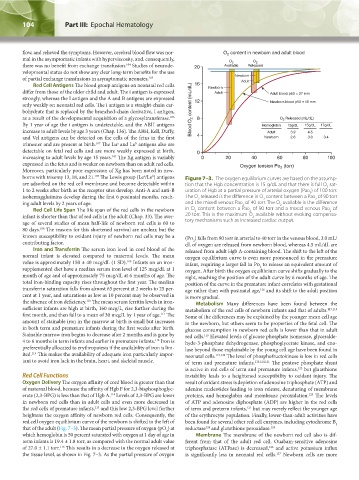
               expressed in the fetus and is weaker on newborn than on adult red cells.   Oxygen tension Po  (torr)
               Moreover, particularly poor expression of Xg has been noted in new-                    2
                                        107
                                                           b
                                                        a
               borns with trisomy 13, 18, and 21.  The Lewis group (Le /Le ) antigens   Figure 7–3.  The oxygen equilibrium curves are based on the assump-
               are adsorbed on the red cell membrane and become detectable within   tion that the Hgb concentration is 15 g/dL and that there is full O  sat-
                                                                                                                     2
               1 to 2 weeks after birth as the receptor sites develop. Anti-A and anti-B   uration of Hgb at a partial pressure of arterial oxygen (Pao ) of 100 torr.
                                                                                                                2
               isohemagglutinins develop during the first 6 postnatal months, reach-  The O  released is the difference in O  content between a Pao  of 90 torr
                                                                                                2
                                                                                                                  2
                                                                          2
               ing adult levels by 2 years of age.                    and the mixed venous Pao  of 40 torr. The O  available is the difference
                                                                                                      2
                                                                                         2
                   Red Cell Life Span The life span of the red cells in the newborn   in O  content between a Pao  of 90 torr and a mixed venous Pao  of
                                                                                            2
                                                                                                                      2
                                                                         2
               infant is shorter than that of red cells in the adult (Chap. 33). The aver-  20 torr. This is the maximum O  available without evoking compensa-
                                                                                             2
               age of several studies of mean half-life of newborn red cells is 60 to   tory mechanisms such as increased cardiac output.
               80 days.  The reasons for this shortened survival are unclear, but the
                     108
               known susceptibility to oxidant injury of newborn red cells may be a   (Po ) falls from 90 torr in arterial to 40 torr in the venous blood, 3.0 mL/
                                                                         2
               contributing factor.                                   dL of oxygen are released from newborn blood, whereas 4.5 mL/dL are
                   Iron and Transferrin The serum iron level in cord blood of the   released from adult Hgb A-containing blood. The shift to the left of the
               normal infant is elevated compared to maternal levels. The mean   oxygen equilibrium curve is even more pronounced in the premature
               value is approximately 150 ± 40 mcg/dL (1 SD).  Infants on an iron-   infant, requiring a larger fall in Po  to release an equivalent amount of
                                                  109
                                                                                               2
               supplemented diet have a median serum iron level of 125 mcg/dL at 1   oxygen. After birth the oxygen equilibrium curve shifts gradually to the
               month of age and of approximately 75 mcg/dL at 6 months of age. The   right, reaching the position of the adult curve by 6 months of age. The
               total iron-binding capacity rises throughout the first year. The median   position of the curve in the premature infant correlates with gestational
               transferrin saturation falls from almost 65 percent at 2 weeks to 25 per-  age rather than with postnatal age,  and its shift to the adult position
                                                                                               116
               cent at 1 year, and saturations as low as 10 percent may be observed in   is more gradual.
               the absence of iron deficiency.  The mean serum ferritin levels in iron-  Metabolism Many differences have been found between the
                                     110
               sufficient infants are high at birth, 160 mcg/L, rise further during the   metabolism of the red cells of newborn infants and that of adults. 117,118
                                                              111
               first month, and then fall to a mean of 30 mcg/L by 1 year of age.  The   Some of the differences may be explained by the younger mean cell age
               amount of stainable iron in the marrow at birth is small but increases   in the newborn, but others seem to be properties of the fetal cell. The
               in both term and premature infants during the first weeks after birth.   glucose consumption in newborn red cells is lower than that in adult
               Stainable marrow iron begins to decrease after 2 months and is gone by   red cells.  Elevated levels of glucose phosphate isomerase, glyceralde-
                                                                            119
                                                            112
               4 to 6 months in term infants and earlier in premature infants.  Iron is   hyde-3-phosphate dehydrogenase, phosphoglycerate kinase, and eno-
               preferentially allocated to erythropoiesis if the availability of iron is lim-  lase beyond those explainable by the young cell age have been found in
                   113
               ited.  This makes the availability of adequate iron particularly impor-  neonatal cells. 115,120  The level of phosphofructokinase is low in red cells
               tant to avoid iron lack in the brain, heart, and skeletal muscle.  of term and premature infants. 115,120,121  The pentose phosphate shunt
                                                                      is active in red cells of term and premature infants,  but glutathione
                                                                                                            122
               Red Cell Functions                                     instability leads to a heightened susceptibility to oxidant injury. The
               Oxygen Delivery The oxygen affinity of cord blood is greater than that   result of oxidant stress is depletion of adenosine triphosphate (ATP) and
               of maternal blood, because the affinity of Hgb F for 2,3-bisphosphoglyc-  adenine nucleotides leading to iron release, denaturing of membrane
               erate (2,3-BPG) is less than that of Hgb A.  Levels of 2,3-BPG are lower   proteins, and hemoglobin and membrane peroxidation.  The levels
                                             114
                                                                                                               123
               in newborn red cells than in adult cells and even more decreased in   of ATP and adenosine diphosphate (ADP) are higher in the red cells
               the red cells of premature infants,  and this low 2,3-BPG level further   of term and preterm infants,  but may merely reflect the younger age
                                        115
                                                                                           121
               heightens the oxygen affinity of newborn red cells. Consequently, the   of the erythrocyte population. Finally, lower-than-adult activities have
               red cell oxygen equilibrium curve of the newborn is shifted to the left of   been found for several other red cell enzymes, including cytochrome B
                                                                                                                        5
               that of the adult (Fig. 7–3). The mean partial pressure of oxygen (pO ) at   reductase  and glutathione peroxidase. 125
                                                                             124
                                                                2
               which hemoglobin is 50 percent saturated with oxygen at 1 day of age in   Membrane The membrane of the newborn red cell also is dif-
               term infants is 19.4 ± 1.8 torr, as compared with the normal adult value   ferent from that of the adult red cell. Ouabain-sensitive adenosine
                            116
               of 27.0 ± 1.1 torr.  This results in a decrease in the oxygen released at   triphosphatase (ATPase) is decreased,  and active potassium influx
                                                                                                  126
               the tissue level, as shown in Fig. 7–3. As the partial pressure of oxygen   is significantly less in neonatal red cells.  Newborn cells are more
                                                                                                     127
          Kaushansky_chapter 07_p0097-0118.indd   104                                                                   9/18/15   10:13 PM

