


Page 125 - Williams Hematology ( PDFDrive )
P. 125
100  Part III:  Epochal Hematology                       Chapter 7:  Hematology of the Fetus and Newborn              101


                                         28
                  dose–response in vitro to G-CSF.  G-CSF is expressed by hepatocytes at   the brain, are ultimately derived from the yolk sac of the embryo and
                  14 weeks’ gestation. 29                               undergo limited maintenance after birth from hematopoietic stem
                                                                        cells. 49,50
                  Lymphopoiesis
                  Lymphopoiesis is present in the lymph plexuses and the thymus begin-  SYNTHESIS OF FETAL HEMOGLOBINS
                                    20
                  ning at 9 weeks’ gestation.  B cells with surface immunoglobulin (Ig) M
                  are present in the liver, and circulating lymphocytes also are seen at 9   Human hemoglobin (Hgb) is a tetramer composed of two α-type and
                  weeks’ gestation. T lymphocytes are found only rarely before 12 weeks’   two  β-type globin chains (Table 7–1). The  α-globin gene cluster is
                  gestation.  Lymphocyte subpopulations are detected by 13 weeks’ ges-  located on chromosome 16 and contains the ζ gene 5′ to the pair of
                         30
                                31
                  tation in fetal liver.  Absolute numbers of major lymphoid subsets in   α-globin genes. The β-globin gene cluster is located on chromosome 11
                                                                                                              A
                                                                                                                 G
                                                                                                                     51
                  20- to 26-week-old fetuses, as defined by the antigens CD2, CD3, CD4,   and contains five globin genes oriented 5′ to 3′ as ε-γ  -γ  -δ-β.  During
                  CD8, CD16, CD19, and CD20, are similar to those in newborns (see   embryogenesis the genes on both chromosomes are activated sequen-
                  “Neonatal Lymphopoiesis” below). 32,33                tially from the 5′ to the 3′ end. This globin “switching” is related not
                                                                        only to the relative positions of the globin genes within their respective
                  Marrow Hematopoiesis                                  chromosomal clusters, but also to interacting upstream “locus control
                  Hematopoietic cells are first seen in the marrow of the 10- to 11-week   regions.” 52
                  embryo,  and they remain confined to the diaphyseal regions of long   Hgb Gower-1 (ζ ε ) is the major hemoglobin in embryos younger
                        1
                                                                                        2 2
                  bones until 15 weeks’ gestation.  Initially, there are approximately equal   than 5 weeks’ gestation (see Table  7–1).  Hgb Gower-2 (α ε ) has been
                                        34
                                                                                                     53
                                                                                                                  2 2
                  numbers of myeloid and erythroid cells in the fetal marrow. However,   found in embryos with a gestational age as young as 4 weeks and is
                  myeloid cells predominate by 12 weeks’ gestation, and the myeloid-to-  absent in embryos older than 13 weeks.  Hgb Portland (ζ γ ) is found in
                                                                                                    54
                                                                                                                 2 2
                  erythroid ratio approaches the adult level of 3:1 by 21 weeks’ gestation.    young embryos, but persists in infants with homozygous α-thalassemia
                                                                    20
                  Macrophage cells in the fetal marrow, but not in the fetal liver, express   (Chap. 48). Synthesis of the ζ and ε chains decreases as those of the α
                                               29
                  the lipopolysaccharide receptor CD14.  The marrow becomes the   and γ chains increase (Fig. 7–2). The ζ-to-α-globin switch precedes the
                  major site of hematopoiesis after the 24th week of gestation and remains   ε-to-γ-globin switch as the liver replaces the yolk sac as the main site of
                  so throughout the remainder of fetal life.            erythropoiesis. 9,55
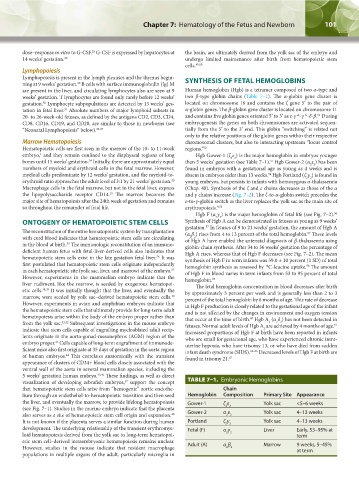
                                                                            Hgb F (α γ ) is the major hemoglobin of fetal life (see Fig. 7–2).
                                                                                                                          56
                                                                                   2 2
                  ONTOGENY OF HEMATOPOIETIC STEM CELLS                  Synthesis of Hgb A can be demonstrated in fetuses as young as 9 weeks’
                                                                               57
                  The reconstitution of the entire hematopoietic system by transplantation   gestation.  In fetuses of 9 to 21 weeks’ gestation, the amount of Hgb A
                                                                        (α β ) rises from 4 to 13 percent of the total hemoglobin.  These levels
                                                                                                                 57
                  with cord blood indicates that hematopoietic stem cells are circulating   of Hgb A have enabled the antenatal diagnosis of β-thalassemia using
                                                                          2 2
                                 35
                  in the blood at birth.  The immunologic reconstitution of an immuno-  globin-chain synthesis. After 34 to 36 weeks’ gestation the percentage of
                  deficient human fetus with fetal-liver-derived cells also indicates that   Hgb A rises, whereas that of Hgb F decreases (see Fig. 7–2). The mean
                                                               36
                  hematopoietic stem cells exist in the late gestation fetal liver.  It was   synthesis of Hgb F in term infants was 59.0 ± 10 percent (1 SD) of total
                  first postulated that hematopoietic stem cells originate independently   hemoglobin synthesis as assessed by  C-leucine uptake.  The amount
                                                                                                   14
                                                                                                                 58
                  in each hematopoietic site (yolk sac, liver, and marrow) of the embryo.    of Hgb F in blood varies in term infants from 53 to 95 percent of total
                                                                    37
                  However, experiments in the mammalian embryo indicate that the   hemoglobin. 59
                  liver rudiment, like the marrow, is seeded by exogenous hematopoi-  The fetal hemoglobin concentration in blood decreases after birth
                  etic cells. 38,39  It was initially thought that the liver, and eventually the   by approximately 3 percent per week and is generally less than 2 to 3
                  marrow, were seeded by yolk sac–derived hematopoietic stem cells.    percent of the total hemoglobin by 6 months of age. This rate of decrease
                                                                    40
                  However, experiments in avian and amphibian embryos indicate that   in Hgb F production is closely related to the gestational age of the infant
                  the hematopoietic stem cells that ultimately provide for long-term adult   and is not affected by the changes in environment and oxygen tension
                  hematopoiesis arise within the body of the embryo proper rather than   that occur at the time of birth.  Hgb A  (α δ ) has not been detected in
                                                                                              60
                  from the yolk sac. 41,42  Subsequent investigations in the mouse embryo   fetuses. Normal adult levels of Hgb A  are achieved by 4 months of age.
                                                                                                    2
                                                                                                       2 2
                                                                                                                          61
                  indicate that stem cells capable of engrafting myeloablated adult recip-  Increased proportions of Hgb F at birth have been reported in infants
                                                                                                   2
                  ients originate in the aorta-gonad-mesonephros (AGM) region of the   who are small for gestational age, who have experienced chronic intra-
                             43
                  embryo proper.  Cells capable of long-term engraftment of immunode-  uterine hypoxia, who have trisomy 13, or who have died from sudden
                  ficient mice also first originate at 35 days of gestation in the aorta region   infant death syndrome (SIDS). 62–66  Decreased levels of Hgb F at birth are
                  of human embryos.  This correlates anatomically with the transient   found in trisomy 21. 67
                                44
                  appearance of clusters of CD34+ blood cells closely associated with the
                  ventral wall of the aorta in several mammalian species, including the
                  5 weeks’ gestation human embryo. 45,46  These findings, as well as direct
                                                    47
                  visualization of developing zebrafish embryos,  support the concept   TABLE 7–1.  Embryonic Hemoglobins
                  that hematopoietic stem cells arise from “hemogenic” aortic endothe-  Chain
                  lium through an endothelial-to-hematopoietic transition and then seed   Hemoglobin  Composition  Primary Site Appearance
                  the liver, and eventually the marrow, to provide lifelong hematopoiesis   Gower-1  ζ ε  Yolk sac  <5–6 weeks
                  (see Fig. 7–1). Studies in the murine embryo indicate that the placenta   2 2
                                                                    48
                  also serves as a site of hematopoietic stem cell origin and expansion.    Gower-2  α ε  Yolk sac  4–13 weeks
                                                                                      2 2
                  It is not known if the placenta serves a similar function during human   Portland  ζ γ  Yolk sac  4–13 weeks
                                                                                      2 2
                  development. The underlying relationship of the transient erythromye-  Fetal (F)  α γ  Liver  Early, 53–95% at
                  loid hematopoiesis derived from the yolk sac to long-term hematopoi-  2 2                   term
                  etic stem cell–derived intraembryonic hematopoiesis remains unclear.   Adult (A)  α β  Marrow  9 weeks, 5–45%
                  However, studies in the mouse indicate that resident macrophage     2 2                     at term
                  populations in multiple organs of the adult, particularly microglia in
          Kaushansky_chapter 07_p0097-0118.indd   101                                                                   9/18/15   10:13 PM

