


Page 1339 - Williams Hematology ( PDFDrive )
P. 1339
1314           Part X:  Malignant Myeloid Diseases                                                                                                                              Chapter 85:  Essential Thrombocythemia           1315


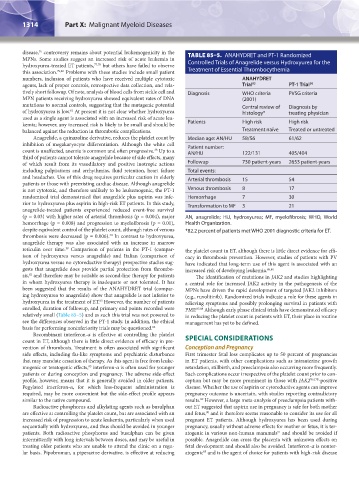
               disease,  controversy remains about potential leukemogenicity in the   TABLE 85–5.  ANAHYDRET and PT-1 Randomized
                     76
               MPNs. Some studies suggest an increased risk of acute leukemia in
               hydroxyurea-treated ET patients, 77,78  but others have failed to observe   Controlled Trials of Anagrelide versus Hydroxyurea for the
               this association. 79,80  Problems with these studies include small patient   Treatment of Essential Thrombocythemia
               numbers, inclusion of  patients  who have received  multiple  cytotoxic   ANAHYDRET
               agents, lack of proper controls, retrospective data collection, and rela-  Trial 83       PT-1 Trial 30
               tively short followup. Of note, analysis of blood cells from sickle cell and   Diagnosis  WHO criteria   PVSG criteria
               MPN patients receiving hydroxyurea showed equivalent rates of DNA         (2001)
               mutations to normal controls, suggesting that the mutagenic potential     Central review of   Diagnosis by
                               81
               of hydroxyurea is low.  At present it is not clear whether hydroxyurea    histology*        treating physician
               used as a single agent is associated with an increased risk of acute leu-
               kemia; however, any increased risk is likely to be small and should be   Patients  High risk  High risk
               balanced against the reduction in thrombotic complications.               Treatment naïve  Treated or untreated
                   Anagrelide, a quinazoline derivative, reduces the platelet count by   Median age: AN/HU  58/56  61/62
               inhibition of megakaryocyte differentiation. Although the white cell   Patient number:
               count is unaffected, anemia is common and often progressive.  Up to a   AN/HU  122/131    405/404
                                                            38
               third of patients cannot tolerate anagrelide because of side effects, many
               of  which  result  from  its  vasodilatory  and  positive  inotropic  actions   Followup  730 patient-years  2653 patient-years
               including  palpitations  and  arrhythmias,  fluid  retention,  heart  failure   Total events:
               and headaches. Use of this drug requires particular caution in elderly   Arterial thrombosis  15  54
               patients or those with preexisting cardiac disease. Although anagrelide
               is not cytotoxic, and therefore unlikely to be leukemogenic, the PT-1   Venous thrombosis  8  17
               randomized trial demonstrated that anagrelide plus aspirin was infe-  Hemorrhage  7       30
               rior to hydroxyurea plus aspirin in high-risk ET patients. In this study,   Transformation to MF  3  21
               anagrelide- treated patients experienced reduced event-free survival
               (p = 0.03) with higher rates of arterial thrombosis (p = 0.004), major   AN, anagrelide; HU, hydroxyurea; MF, myelofibrosis;  WHO,  World
               hemorrhage (p = 0.008) and progression to myelofibrosis (p = 0.01),   Health Organization.
               despite equivalent control of the platelet count, although rates of venous   *82.2 percent of patients met WHO 2001 diagnostic criteria for ET.
               thrombosis were decreased (p = 0.006).  In contrast to hydroxyurea,
                                             30
               anagrelide  therapy  was  also  associated  with  an  increase  in  marrow
               reticulin over time.  Comparison of patients in the PT-1 (compar-  the platelet count in ET, although there is little direct evidence for effi-
                              38
               ison  of  hydroxyurea  versus  anagrelide)  and  Italian  (comparison  of   cacy in thrombosis prevention. However, studies of patients with PV
               hydroxyurea versus no cytoreductive therapy) prospective studies sug-  have indicated that long-term use of this agent is associated with an
               gests that anagrelide does provide partial protection from  thrombo-  increased risk of developing leukemia. 80,86
                  82
               sis,  and therefore may be suitable as second-line therapy for patients   The identification of mutations in JAK2 and studies highlighting
               in whom hydroxyurea therapy is inadequate or not tolerated. It has   a central role for increased JAK2 activity in the pathogenesis of the
               been suggested that the results of the ANAHYDRET trial (compar-  MPNs have driven the rapid development of targeted JAK2 inhibitors
               ing hydroxyurea to anagrelide) show that anagrelide is not inferior to   (e.g., ruxolitinib). Randomized trials indicate a role for these agents in
               hydroxyurea in the treatment of ET.  However, the number of patients   relieving symptoms and possibly prolonging survival in patients with
                                         83
               enrolled, duration of followup, and primary end points recorded were   PMF. 87,88  Although early phase clinical trials have demonstrated efficacy
               relatively small (Table 85–5) and as such this trial was not powered to   in reducing the platelet count in patients with ET, their place in routine
               see the differences observed in the PT-1 study. In addition, the ethical   management has yet to be defined.
               basis for performing noninferiority trials may be questioned. 84
                   Recombinant interferon-α is effective at controlling the platelet
               count in ET, although there is little direct evidence of efficacy in pre-  SPECIAL CONSIDERATIONS
               vention of thrombosis. Treatment is often associated with significant   Conception and Pregnancy
               side effects, including flu-like symptoms and psychiatric disturbance   First trimester fetal loss complicates up to 50 percent of pregnancies
               that may mandate cessation of therapy. As this agent is free from leuke-  in ET patients, with other complications such as intrauterine growth
               mogenic or teratogenic effects,  interferon-α is often used for younger   retardation, stillbirth, and preeclampsia also occurring more frequently.
                                      85
               patients or during conception and pregnancy. The adverse side-effect   Such complications occur irrespective of the platelet count prior to con-
               profile, however, means that it is generally avoided in older patients.   ception but may be more prominent in those with JAK2 V617F -positive
               Pegylated interferon-α, for which less-frequent administration is   disease. Whether the use of aspirin or cytoreductive agents can improve
               required, may be more convenient but the side-effect profile appears   pregnancy outcome is uncertain, with studies reporting contradictory
               similar to the native compound.                        results.  However, a large meta-analysis of preeclampsia patients with-
                                                                           89
                   Radioactive phosphorus and alkylating agents such as busulphan   out ET suggested that aspirin use in pregnancy is safe for both mother
               are effective at controlling the platelet count, but are associated with an   and fetus,  and it therefore seems reasonable to consider its use for all
                                                                             90
               increased risk of progression to acute leukemia, particularly when used   pregnant ET patients. Although hydroxyurea has been used during
               sequentially with hydroxyurea, and thus should be avoided in younger   pregnancy, usually without adverse effects for mother or fetus, it is ter-
               patients. Both radioactive phosphorus and busulphan can be given   atogenic in various non-human mammals  and should be avoided if
                                                                                                     91
               intermittently with long intervals between doses, and may be useful in   possible. Anagrelide can cross the placenta with unknown effects on
               treating older patients who are unable to attend the clinic on a regu-  fetal development and should also be avoided. Interferon-α is nonter-
               lar basis. Pipobroman, a piperazine derivative, is effective at reducing   atogenic  and is the agent of choice for patients with high-risk disease
                                                                            85


          Kaushansky_chapter 85_p1307-1318.indd   1314                                                                  9/21/15   11:09 AM

