


Page 1340 - Williams Hematology ( PDFDrive )
P. 1340
1314  Part X:  Malignant Myeloid Diseases                          Chapter 85:  Essential Thrombocythemia            1315


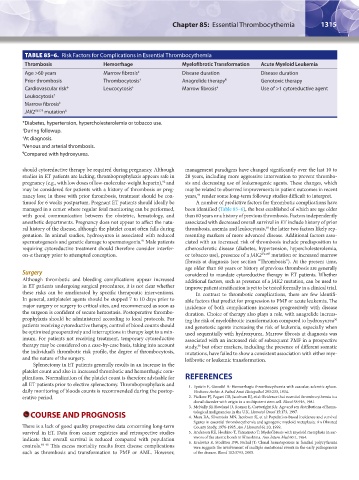
                   TABLE 85–6.  Risk Factors for Complications in Essential Thrombocythemia
                   Thrombosis                Hemorrhage                Myelofibrotic Transformation  Acute Myeloid Leukemia
                   Age >60 years             Marrow fibrosis ‡         Disease duration           Disease duration
                   Prior thrombosis          Thrombocytosis †          Anagrelide therapy ¶       Genotoxic therapy
                   Cardiovascular risk*      Leucocytosis †            Marrow fibrosis ‡          Use of >1 cytoreductive agent
                   Leukocytosis †
                   Marrow fibrosis ‡
                   JAK2 V617F  mutation §
                  *Diabetes, hypertension, hypercholesterolemia or tobacco use.
                  † During followup.
                  ‡ At diagnosis.
                  § Venous and arterial thrombosis.
                  ¶ Compared with hydroxyurea.

                  should cytoreductive therapy be required during pregnancy. Although   management paradigms have changed significantly over the last 10 to
                  studies in ET patients are lacking, thromboprophylaxis appears safe in   20 years, including more aggressive intervention to prevent thrombo-
                  pregnancy (e.g., with low doses of low-molecular-weight heparin),  and   sis and decreasing use of leukemogenic agents. These changes, which
                                                                 92
                  may be considered for patients with a history of thrombosis or preg-  may be related to observed improvements in patient outcomes in recent
                  nancy loss; in those with prior thrombosis, treatment should be con-  years,  render some long-term followup studies difficult to interpret.
                                                                            94
                  tinued for 6 weeks postpartum. Pregnant ET patients should ideally be   A number of predictive factors for thrombotic complications have
                  managed in a center where regular fetal monitoring can be performed,   been identified (Table 85–6), the best established of which are age older
                  with good communication between the obstetric, hematology, and   than 60 years or a history of previous thrombosis. Factors independently
                  anesthetic departments. Pregnancy does not appear to affect the natu-  associated with decreased overall survival in ET include history of prior
                  ral history of the disease, although the platelet count often falls during   thrombosis, anemia and leukocytosis,  the latter two factors likely rep-
                                                                                                   93
                  gestation. In animal studies, hydroxyurea is associated with reduced   resenting markers of more advanced disease. Additional factors asso-
                  spermatogenesis and genetic damage to spermatogonia.  Male patients   ciated with an increased risk of thrombosis include predisposition to
                                                          91
                  requiring cytoreductive treatment should therefore consider interfer-  atherosclerotic disease (diabetes, hypertension, hypercholesterolemia,
                  on-α therapy prior to attempted conception.           or tobacco use), presence of a JAK2 V617F  mutation or increased marrow
                                                                        fibrosis at diagnosis (see section “Thrombosis”). At the present time,
                                                                        age older than 60 years or history of previous thrombosis are generally
                  Surgery                                               considered to mandate cytoreductive therapy in ET patients. Whether
                  Although  thrombotic  and  bleeding  complications  appear  increased   additional factors, such as presence of a JAK2 mutation, can be used to
                  in ET patients undergoing surgical procedures, it is not clear whether   improve patient stratification is yet to be tested formally in a clinical trial.
                  these  risks  can  be  ameliorated  by  specific  therapeutic  interventions.   In contrast to thrombotic complications, there are few identifi-
                  In general, antiplatelet agents should be stopped 7 to 10 days prior to   able factors that predict for progression to PMF or acute leukemia. The
                  major surgery or surgery to critical sites, and recommenced as soon as   incidence of both complications increases progressively with disease
                  the surgeon is confident of secure hemostasis. Postoperative thrombo-  duration. Choice of therapy also plays a role, with anagrelide increas-
                  prophylaxis should be administered according to local protocols. For   ing the risk of myelofibrotic transformation compared to hydroxyurea
                                                                                                                          30
                  patients receiving cytoreductive therapy, control of blood counts should   and genotoxic agents increasing the risk of leukemia, especially when
                  be optimized preoperatively and interruptions in therapy kept to a min-  used sequentially with hydroxyurea. Marrow fibrosis at diagnosis was
                  imum. For patients not receiving treatment, temporary cytoreductive   associated with an increased risk of subsequent PMF in a prospective
                  therapy may be considered on a case-by-case basis, taking into account   study,  but other markers, including the presence of different somatic
                                                                             38
                  the individual’s thrombotic risk profile, the degree of thrombocytosis,   mutations, have failed to show a consistent association with either mye-
                  and the nature of the surgery.                        lofibrotic or leukemic transformation.
                     Splenectomy in ET patients generally results in an increase in the
                  platelet count and also in increased thrombotic and hemorrhagic com-
                  plications. Normalization of the platelet count is therefore advisable for   REFERENCES
                  all ET patients prior to elective splenectomy. Thromboprophylaxis and     1.  Epstein E, Geoedel A: Hemorrhagic thrombocythemia with cascular, sclerotic spleen.
                  daily monitoring of bloods counts is recommended during the postop-  Virchows Archiv A Pathol Anat Histopathol 293:233, 1934.
                  erative period.                                         2.  Fialkow PJ, Faguet GB, Jacobson RJ, et al: Evidence that essential thrombocythemia is a
                                                                           clonal disorder with origin in a multipotent stem cell. Blood 58:916, 1981.
                                                                          3.  McNally RJ, Rowland D, Roman E, Cartwright RA: Age and sex distributions of hema-
                     COURSE AND PROGNOSIS                                 4.  Mesa RA, Silverstein MN, Jacobsen SJ, et al: Population-based incidence and survival
                                                                           tological malignancies in the U.K. Hematol Oncol 15:173, 1997.
                                                                           figures in essential thrombocythemia and agnogenic myeloid metaplasia: An Olmsted
                  There is a lack of good quality prospective data concerning long-term   County Study, 1976-1995. Am J Hematol 61:10, 1999.
                  survival in ET. Data from cancer registries and retrospective studies     5.  Anderson RE, Hoshino T, Yamamoto T: Myelofibrosis with myeloid metaplasia in sur-
                  indicate that overall survival is reduced compared with population   vivors of the atomic bomb in Hiroshima. Ann Intern Med 60:1, 1964.
                  controls. 93–95  This excess mortality results from disease complications     6.  Kralovics R, Stockton DW, Prchal JT: Clonal hematopoiesis in familial polycythemia
                                                                           vera suggests the involvement of multiple mutational events in the early pathogenesis
                  such as thrombosis and transformation to PMF or AML. However,   of the disease. Blood 102:3793, 2003.


          Kaushansky_chapter 85_p1307-1318.indd   1315                                                                  9/21/15   11:09 AM

