


Page 1470 - Williams Hematology ( PDFDrive )
P. 1470
1444  Part X:  Malignant Myeloid Diseases  Chapter 89:  Chronic Myelogenous Leukemia and Related Disorders           1445


                  CML. Telomerase activity is increased in the accelerated phase.  When   100
                                                              244
                  therapy permits restoration of Ph chromosome–negative cells in the   90
                  blood, these cells have telomere length comparable to that in matched   80
                  healthy controls. 245                                      70

                     CLINICAL FEATURES                                     Cumulative % of patients  60  White cell count
                                                                             50
                                                                             40
                  SIGNS AND SYMPTOMS                                         30                          Platelet count
                  In the 70 percent of patients who are symptomatic at diagnosis, the   20
                  most frequent complaints include easy fatigability, loss of sense of well-   10
                  being, decreased tolerance to exertion, anorexia, abdominal discomfort,   0
                  early satiety (related to splenic enlargement), weight loss, and excessive   0  100 200 300 400 500 600 700 8001000  5000
                                                                                                        9
                  sweating. 246–248   The  symptoms  are  vague,  nonspecific,  and  gradual  in   Cell count (x 10 /L)
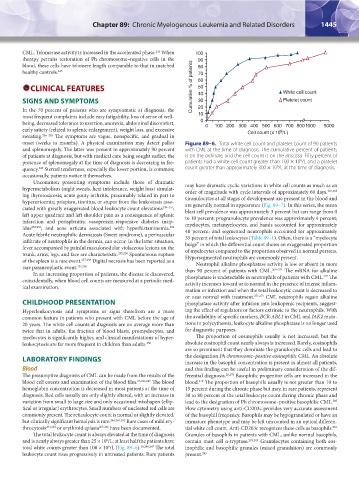
                  onset (weeks to months). A physical examination may detect pallor   Figure 89–6.  Total white cell count and platelet count of 90 patients
                  and splenomegaly. The latter was present in approximately 90 percent   with CML at the time of diagnosis. The cumulative percent of patients
                  of patients at diagnosis, but with medical care being sought earlier, the   is on the ordinate, and the cell count is on the abscissa. Fifty percent of
                                                                                                               9
                  presence of splenomegaly at the time of diagnosis is decreasing in fre-  patients had a white cell count greater than 100 × 10 /L and a platelet
                                                                                                       9
                  quency.  Sternal tenderness, especially the lower portion, is common;   count greater than approximately 300 × 10 /L at the time of diagnosis.
                       247
                  occasionally, patients notice it themselves.
                     Uncommon presenting symptoms include those of dramatic   may have dramatic cyclic variations in white cell counts as much as an
                  hypermetabolism (night sweats, heat intolerance, weight loss) simulat-  order of magnitude with cycle intervals of approximately 60 days. 267,268
                  ing thyrotoxicosis; acute gouty arthritis, presumably related in part to   Granulocytes at all stages of development are present in the blood and
                  hyperuricemia; priapism, tinnitus, or stupor from the leukostasis asso-  are generally normal in appearance (Fig. 89–7). In this series, the mean
                  ciated with greatly exaggerated blood leukocyte count elevations 249–251 ;   blast cell prevalence was approximately 3 percent but can range from 0
                  left upper quadrant and left shoulder pain as a consequence of splenic   to 10 percent; progranulocyte prevalence was approximately 4 percent;
                  infarction and perisplenitis; vasopressin-responsive diabetes insip-  myelocytes, metamyelocytes, and bands accounted for approximately
                  idus 252,253 ; and acne urticata associated with hyperhistaminemia.    40 percent; and segmented neutrophils accounted for approximately
                                                                   254
                  Acute febrile neutrophilic dermatosis (Sweet syndrome), a perivascular   35 percent of total leukocytes (Table 89–1). Often, there is a “myelocyte
                  infiltrate of neutrophils in the dermis, can occur. In the latter situation,   bulge” in which the differential count shows an exaggerated proportion
                  fever accompanied by painful maculonodular violaceous lesions on the   of myelocytes compared to the proportion observed in normal persons.
                  trunk, arms, legs, and face are characteristic. 255,256  Spontaneous rupture   Hypersegmented neutrophils are commonly present.
                  of the spleen is a rare event. 257,258  Digital necrosis has been reported as a   Neutrophil alkaline phosphatase activity is low or absent in more
                  rare paraneoplastic event. 259,260                    than 90 percent of patients with CML. 269–271  The mRNA for alkaline
                     In an increasing proportion of patients, the disease is discovered,   phosphatase is undetectable in neutrophils of patients with CML.  The
                                                                                                                       272
                  coincidentally, when blood cell counts are measured at a periodic med-  activity increases toward or to normal in the presence of intense inflam-
                  ical examination.
                                                                        mation or infection and when the total leukocytic count is decreased to
                                                                        or near normal with treatment. 271,273  CML neutrophils regain alkaline
                  CHILDHOOD PRESENTATION                                phosphatase activity after infusion into leukopenic recipients, suggest-
                  Hyperleukocytosis  and  symptoms  or  signs  therefrom  are  a  more   ing the effect of regulators or factors extrinsic to the neutrophils. With
                  common feature in patients who present with CML before the age of    the availability of specific markers, BCR-ABL1 in CML and JAK2 muta-
                  20 years. The white cell counts at diagnosis are on average more than   tions in polycythemia, leukocyte alkaline phosphatase is no longer used
                  twice that in adults, the fraction of blood blasts, promyelocytes, and   for diagnostic purposes.
                  myelocytes is significantly higher, and clinical manifestations of hyper-  The proportion of eosinophils usually is not increased, but the
                  leukocytosis are far more frequent in children than adults. 250  absolute eosinophil count nearly always is increased. Rarely, eosinophils
                                                                        are so prominent that they dominate the granulocytic cells and lead to
                  LABORATORY FINDINGS                                   the designation Ph chromosome–positive eosinophilic CML. An absolute
                                                                        increase in the basophil concentration is present in almost all patients,
                  Blood                                                 and this finding can be useful in preliminary consideration of the dif-
                  The presumptive diagnosis of CML can be made from the results of the   ferential diagnosis. 26,278  Basophilic progenitor cells are increased in the
                  blood cell counts and examination of the blood film. 26,246,247  The blood   blood.  The proportion of basophils usually is not greater than 10 to
                                                                             279
                  hemoglobin concentration is decreased in most patients at the time of   15 percent during the chronic phase but may, in rare patients, represent
                  diagnosis. Red cells usually are only slightly altered, with an increase in   30 to 80 percent of the total leukocyte count during chronic phase and
                  variation from small to large size and only occasional misshapen (ellip-  lead to the designation of Ph chromosome–positive basophilic CML.
                                                                                                                          280
                  tical or irregular) erythrocytes. Small numbers of nucleated red cells are   Flow cytometry using anti-CD203c provides very accurate assessment
                  commonly present. The reticulocyte count is normal or slightly elevated,   of the basophil frequency. Basophils may be hypogranulated or have an
                  but clinically significant hemolysis is rare. 246,261,262  Rare cases of mild ery-  immature phenotype and may be left uncounted in an optical differen-
                  throcytosis 263,264  or erythroid aplasia 265,266  have been documented.  tial white cell count. Anti-CD203c recognizes these cells as basophils.
                                                                                                                          281
                     The total leukocyte count is always elevated at the time of diagnosis   Granules of basophils in patients with CML, unlike normal basophils,
                  and is nearly always greater than 25 × 10 /L; at least half the patients have   contain mast cell  α-tryptase. 281,282  Granulocytes containing both eos-
                                              9
                  total white counts greater than 100 × 10 /L (Fig. 89–6). 26,246,247  The total   inophilic and basophilic granules (mixed granulation) are commonly
                                               9
                  leukocyte count rises progressively in untreated patients. Rare patients   present. 283


          Kaushansky_chapter 89_p1437-1490.indd   1445                                                                  9/18/15   3:41 PM

