


Page 1531 - Williams Hematology ( PDFDrive )
P. 1531
1506           Part XI:  Malignant Lymphoid Diseases                                                                                                                        Chapter 91:  Acute Lymphoblastic Leukemia            1507


                      1                                                 10
                    0.9        85.6% ± 2.9% XV (n = 498) 2000–2007      9                                        Male
                    0.8        78.9% ± 1.9% XIII–XIV (n = 465) 1991–1999  8                                      Total
                    0.7        70.6% ± 1.9% XI–XII (n = 546) 1984–1991  7                                        Female
                   Probability  0.5  53.5% ± 2.4% X (n = 428) 1979–1983  Rate per 100,000  6
                    0.6

                                                                        5
                    0.4
                    0.3        35.5% ± 1.7% V–IX (n = 828) 1967–1979    4
                    0.2                                                 3
                    0.1        8.9% ± 2.8% I–IV (n = 90) 1962–1966      2
                      0
                       0    5   10  15  20   25  30  35   40  45        1
                                    Years from diagnosis                0
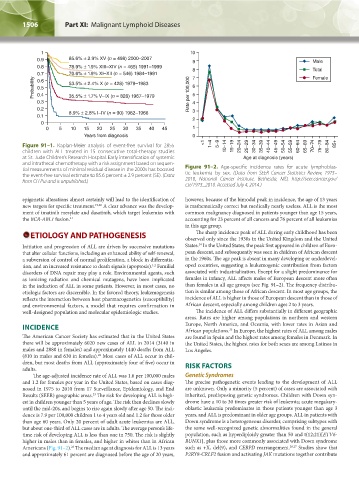
               Figure 91–1.  Kaplan-Meier analysis of event-free survival for 2855   <1  1–4  5–9  10–14  15–19  20–24  25–29  30–34  35–39  40–44  45–49  50–54  55–59  60–64  65–69  70–74  75–79  80–84  85+
               children with ALL treated in 15 consecutive total-therapy studies
               at St. Jude Children’s Research Hospital. Early intensification of systemic   Age at diagnosis (years)
               and intrathecal chemotherapy with a risk assignment based on sequen-
               tial measurements of minimal residual disease in the 2000s has boosted   Figure 91–2.  Age-specific incidence rates for acute lymphoblas-
               the event-free survival estimate to 85.6 percent ± 2.9 percent (SE). (Data   tic leukemia by sex.  (Data  from  SEER  Cancer  Statistics  Review,  1975–
               from CH Pui and is unpublished.)                       2010, National  Cancer Institute. Bethesda,  MD, http://seer.cancer.gov/
                                                                      csr/1975_2010. Accessed July 4, 2014.)
               epigenetic alterations almost certainly will lead to the identification of   however, because of the bimodal peak in incidence, the age of 13 years
               new targets for specific treatment. 19,20  A clear advance was the develop-  is mathematically correct but medically nearly useless. ALL is the most
               ment of imatinib mesylate and dasatinib, which target leukemias with   common malignancy diagnosed in patients younger than age 15 years,
               the BCR-ABL1 fusion. 21                                accounting for 23 percent of all cancers and 76 percent of all leukemias
                                                                      in this age group.
                                                                          The sharp incidence peak of ALL during early childhood has been
                  ETIOLOGY AND PATHOGENESIS                           observed only since the 1930s in the United Kingdom and the United
                                                                           24
               Initiation and progression of ALL are driven by successive mutations   States.  In the United States, the peak first appeared in children of Euro-
               that alter cellular functions, including an enhanced ability of self-renewal,   pean descent, and subsequently was seen in children of African descent
               a subversion of control of normal proliferation, a block in differentia-  in the 1960s. The age peak is absent in many developing or underdevel-
               tion, and an increased resistance to death signals (apoptosis).  Familial   oped countries, suggesting a leukemogenic contribution from factors
                                                           1,2
               disorders of DNA repair may play a role. Environmental agents, such   associated with industrialization. Except for a slight predominance for
               as ionizing  radiation and chemical mutagens,  have been implicated   females in infancy, ALL affects males of European descent more often
               in the induction of ALL in some patients. However, in most cases, no   than females in all age groups (see Fig. 91–2). The frequency distribu-
               etiologic factors are discernible. In the favored theory, leukemogenesis   tion is similar among those of African descent. In most age groups, the
               reflects the interaction between host pharmacogenetics (susceptibility)   incidence of ALL is higher in those of European descent than in those of
               and environmental factors, a model that requires confirmation in   African descent, especially among children ages 2 to 3 years.
               well-designed population and molecular epidemiologic studies.  The incidence of ALL differs substantially in different geographic
                                                                      areas. Rates are higher among populations in northern and western
               INCIDENCE                                              Europe, North America, and Oceania, with lower rates in Asian and
                                                                      African populations.  In Europe, the highest rates of ALL among males
                                                                                     25
               The American Cancer Society has estimated that in the United States   are found in Spain and the highest rates among females in Denmark. In
               there will be approximately 6020 new cases of ALL in 2014 (3140 in   the United States, the highest rates for both sexes are among Latinos in
               males and 2880 in females) and approximately 1440 deaths from ALL   Los Angeles.
                                         22
               (810 in males and 630 in females).  Most cases of ALL occur in chil-
               dren, but most deaths from ALL (approximately four of five) occur in   RISK FACTORS
               adults.
                   The age-adjusted incidence rate of ALL was 1.6 per 100,000 males   Genetic Syndromes
               and 1.2 for females per year in the United States, based on cases diag-  The precise pathogenetic events leading to the development of ALL
               nosed in 1975 to 2010 from 17 Surveillance, Epidemiology, and End   are unknown. Only a minority (5 percent) of cases are associated with
               Results (SEER) geographic areas.  The risk for developing ALL is high-  inherited, predisposing genetic syndromes. Children with Down syn-
                                       23
               est in children younger than 5 years of age. The risk then declines slowly   drome have a 10 to 30 times greater risk of leukemia; acute megakary-
               until the mid-20s, and begins to rise again slowly after age 50. The inci-  oblastic leukemia predominates in those patients younger than age 3
               dence is 7.9 per 100,000 children 1 to 4 years old and 1.2 for those older   years, and ALL is predominant in older age groups. ALL in patients with
               than age 60 years. Only 20 percent of adult acute leukemias are ALL,   Down syndrome is a heterogeneous disorder, comprising subtypes with
               but about one-third of ALL cases are in adults. The average person’s life-  the same well-recognized genetic abnormalities found in the general
               time risk of developing ALL is less than one in 750. The risk is slightly   population, such as hyperdiploidy greater than 50 and t(12;21)[ETV6-
               higher in males than in females, and higher in whites than in African   RUNX1], plus those more commonly associated with Down syndrome
                                23
               Americans (Fig. 91–2).  The median age at diagnosis for ALL is 13 years   such as +X, del(9), and CEBPD rearrangement. 26,27  Studies show that
               and approximately 61 percent are diagnosed before the age of 20 years,   P2RY8-CRLF2 fusion and activating JAK mutations together contribute


          Kaushansky_chapter 91_p1505-1526.indd   1506                                                                  9/21/15   12:19 PM

