


Page 1536 - Williams Hematology ( PDFDrive )
P. 1536
1510  Part XI:  Malignant Lymphoid Diseases                     Chapter 91:  Acute Lymphoblastic Leukemia            1511


                  are better than blood cells for genetic studies. Fibrosis or tightly packed   Cytochemical stains (Sudan black stain and the stains for myelop-
                  marrow can lead to difficulties with marrow aspiration that necessitate   eroxidase and the nonspecific esterases) distinguish ALL from acute
                  biopsy. In patients with marrow necrosis, multiple marrow aspirations   myeloid leukemia but are now less commonly used for diagnosis than
                  are sometimes needed to obtain diagnostic tissue.     immunophenotyping.
                                                                        Immunologic Classification
                  Morphologic and Cytochemical Analysis                 Immunophenotyping is an essential part of the diagnostic evaluation.
                  Diagnosis of ALL begins with morphologic analysis of Romanowsky-   Antibodies distinguish clusters of differentiation (CD) groups, but
                  stained (Wright-Giemsa or May-Grünwald-Giemsa) marrow films.   most leukocyte antigens lack specificity. Hence, a panel of antibodies is
                  Lymphoblasts tend to be relatively small (ranging from the same size   needed to establish the diagnosis and to distinguish among the different
                  to twice the size of small lymphocytes) with scanty, often light-blue   immunologic subclasses of leukemic cells. Typical panels include anti-
                  cytoplasm; a round or slightly indented nucleus; fine to slightly coarse   bodies to at least one highly sensitive marker (CD19 for B-cell lin-
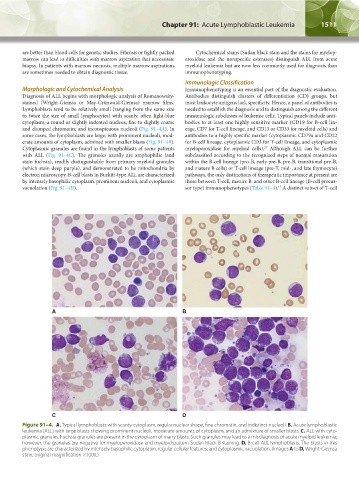
                  and clumped chromatin; and inconspicuous nucleoli (Fig. 91–4A). In   eage, CD7 for T-cell lineage, and CD13 or CD33 for myeloid cells) and
                  some cases, the lymphoblasts are large, with prominent nucleoli, mod-  antibodies to a highly specific marker (cytoplasmic CD79a and CD22
                  erate amounts of cytoplasm, admixed with smaller blasts (Fig. 91–4B).   for B-cell lineage, cytoplasmic CD3 for T-cell lineage, and cytoplasmic
                                                                                                   17
                  Cytoplasmic granules are found in the lymphoblasts of some patients   myeloperoxidase for myeloid cells).  Although ALL can be further
                  with ALL (Fig. 91–4C). The granules usually are amphophilic (and   subclassified according to the recognized steps of normal maturation
                  stain fuchsia), readily distinguishable from primary myeloid granules   within the B-cell lineage (pro-B, early pre-B, pre-B, transitional pre-B,
                  (which stain deep purple), and demonstrated to be mitochondria by   and mature B cells) or T-cell lineage (pre-T, mid-, and late thymocyte)
                  electron microscopy. B-cell blasts in Burkitt-type ALL are characterized   pathways, the only distinctions of therapeutic importance at present are
                  by intensely basophilic cytoplasm, prominent nucleoli, and cytoplasmic   those between T-cell, mature B, and other B-cell lineage (B-cell precur-
                                                                                                        17
                  vacuolation (Fig. 91–4D).                             sor type) immunophenotypes (Table 91–4).  A distinct subset of T-cell


                            A                                          B


                            C                                          D

                  Figure 91–4.  A. Typical lymphoblasts with scanty cytoplasm, regular nuclear shape, fine chromatin, and indistinct nucleoli. B. Acute lymphoblastic
                  leukemia (ALL) with large blasts showing prominent nucleoli, moderate amounts of cytoplasm, and an admixture of smaller blasts. C. ALL with cyto-
                  plasmic granules. Fuchsia granules are present in the cytoplasm of many blasts. Such granules may lead to a misdiagnosis of acute myeloid leukemia;
                  however, the granules are negative for myeloperoxidase and myeloid-pattern Sudan black B staining. D. B-cell ALL lymphoblasts. The blasts in this
                  phenotype are characterized by intensely basophilic cytoplasm, regular cellular features, and cytoplasmic vacuolation. (Images A to D, Wright-Giemsa
                  stain; original magnification ×1000.)


          Kaushansky_chapter 91_p1505-1526.indd   1511                                                                  9/21/15   12:19 PM

