


Page 1534 - Williams Hematology ( PDFDrive )
P. 1534
1508  Part XI:  Malignant Lymphoid Diseases                     Chapter 91:  Acute Lymphoblastic Leukemia            1509


                   TABLE 91–2.  Presenting Clinical Features in Children and
                   Adults with Acute Lymphoblastic Leukemia
                   Feature                  Children (%)  Adult (%)
                   Age (years)
                     <1                     2             —
                     1–9                    72–78         —
                     10–19                  20–26         —
                     20–39                  —             40
                     40–59                  —             40
                     ≥60                    —             20
                   Male                     56–57         62
                   Symptoms
                     Fever                  57            33–56
                     Fatigue                50            Common
                     Bleeding               43            33
                     Bone or joint pain     25            25
                   Lymphadenopathy
                     None                   30            51
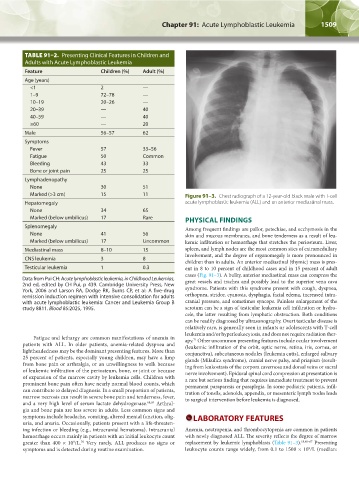
                     Marked (>3 cm)         15            11            Figure 91–3.  Chest radiograph of a 12-year-old black male with T-cell
                   Hepatomegaly                                         acute lymphoblastic leukemia (ALL) and an anterior mediastinal mass.
                     None                   34            65
                     Marked (below umbilicus)  17         Rare          PHYSICAL FINDINGS
                   Splenomegaly                                         Among frequent findings are pallor, petechiae, and ecchymosis in the
                     None                   41            56            skin and mucous membranes, and bone tenderness as a result of leu-
                     Marked (below umbilicus)  17         Uncommon      kemic infiltration or hemorrhage that stretches the periosteum. Liver,
                   Mediastinal mass         8–10          15            spleen, and lymph nodes are the most common sites of extramedullary
                                                                        involvement, and the degree of organomegaly is more pronounced in
                   CNS leukemia             3             8
                                                                        children than in adults. An anterior mediastinal (thymic) mass is pres-
                   Testicular leukemia      1             0.3           ent in 8 to 10 percent of childhood cases and in 15 percent of adult
                                                                        cases (Fig. 91–3). A bulky, anterior mediastinal mass can compress the
                  Data from Pui CH: Acute lymphoblastic leukemia, in Childhood Leukemias,   great vessels and trachea and possibly lead to the superior vena cava
                  2nd ed, edited by CH Pui, p 439. Cambridge University Press, New
                  York, 2006 and Larson RA, Dodge RK, Burns CP, et al: A five-drug   syndrome. Patients with this syndrome present with cough, dyspnea,
                  remission induction regimen with intensive consolidation for adults   orthopnea, stridor, cyanosis, dysphagia, facial edema, increased intra-
                  with acute lymphoblastic leukemia: Cancer and Leukemia Group B   cranial pressure, and sometimes syncope. Painless enlargement of the
                  study 8811. Blood 85:2025, 1995.                      scrotum can be a sign of testicular leukemia cell infiltration or hydro-
                                                                        cele, the latter resulting from lymphatic obstruction. Both conditions
                                                                        can be readily diagnosed by ultrasonography. Overt testicular disease is
                                                                        relatively rare, is generally seen in infants or adolescents with T-cell
                                                                        leukemia and/or hyperleukocytosis, and does not require radiation ther-
                      Fatigue and lethargy are common manifestations of anemia in   apy.  Other uncommon presenting features include ocular involvement
                                                                           71
                  patients with ALL. In older patients, anemia-related dyspnea and   (leukemic infiltration of the orbit, optic nerve, retina, iris, cornea, or
                  lightheadedness may be the dominant presenting features. More than   conjunctiva), subcutaneous nodules (leukemia cutis), enlarged salivary
                  25 percent of patients, especially young children, may have a limp   glands (Mikulicz syndrome), cranial nerve palsy, and priapism (result-
                  from bone pain or arthralgia, or an unwillingness to walk because   ing from leukostasis of the corpora cavernosa and dorsal veins or sacral
                  of leukemic infiltration of the periosteum, bone, or joint or because   nerve involvement). Epidural spinal cord compression at presentation is
                  of expansion of the marrow cavity by leukemia cells. Children with   a rare but serious finding that requires immediate treatment to prevent
                  prominent bone pain often have nearly normal blood counts, which   permanent paraparesis or paraplegia. In some pediatric patients, infil-
                  can contribute to delayed diagnosis. In a small proportion of patients,   tration of tonsils, adenoids, appendix, or mesenteric lymph nodes leads
                  marrow necrosis can result in severe bone pain and tenderness, fever,   to surgical intervention before leukemia is diagnosed.
                  and a very high level of serum lactate dehydrogenase. 68,69  Arthral-
                  gia and bone pain are less severe in adults. Less common signs and
                  symptoms include headache, vomiting, altered mental function, olig-  LABORATORY FEATURES
                  uria, and anuria. Occasionally, patients present with a life-threaten-
                  ing infection or bleeding (e.g., intracranial hematoma). Intracranial   Anemia, neutropenia, and thrombocytopenia are common in patients
                  hemorrhage occurs mainly in patients with an initial leukocyte count   with newly diagnosed ALL. The severity reflects the degree of marrow
                  greater  than  400  ×  10 /L.   Very  rarely,  ALL  produces  no  signs  or   replacement by leukemic lymphoblasts (Table 91–3). 18,65–67  Presenting
                                   9
                                     70
                  symptoms and is detected during routine examination.  leukocyte counts range widely, from 0.1 to 1500 × 10 /L (median:
                                                                                                                  9


          Kaushansky_chapter 91_p1505-1526.indd   1509                                                                  9/21/15   12:19 PM

