


Page 1537 - Williams Hematology ( PDFDrive )
P. 1537
1512           Part XI:  Malignant Lymphoid Diseases                                                                                                                        Chapter 91:  Acute Lymphoblastic Leukemia            1513


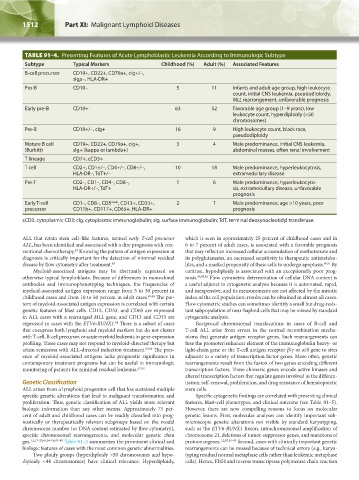
                TABLE 91–4.  Presenting Features of Acute Lymphoblastic Leukemia According to Immunologic Subtype
                Subtype         Typical Markers               Childhood (%)  Adult (%)  Associated Features
                B-cell precursor  CD19+, CD22+, CD79a+, cIg+/–,
                                sIgμ–, HLA-DR+
                Pro-B           CD10–                              5           11     Infants and adult age group, high leukocyte
                                                                                      count, initial CNS leukemia, pseudodiploidy,
                                                                                      MLL rearrangement, unfavorable prognosis
                Early pre-B     CD10+                              63          52     Favorable age group (1–9 years), low
                                                                                      leukocyte count, hyperdiploidy (>50
                                                                                      chromosomes)
                Pre-B           CD10+/–, cIg+                      16          9      High leukocyte count, black race,
                                                                                      pseudodiploidy
                Mature B cell   CD19+, CD22+, CD79a+, cIg+,        3           4      Male predominance, initial CNS leukemia,
                (Burkitt)       sIg+ (kappa or lambda+)                               abdominal masses, often renal involvement
                T lineage       CD7+, cCD3+
                T cell          CD2+, CD1+/–, CD4+/–, CD8+/–,      10          18     Male predominance, hyperleukocytosis,
                                HLA-DR–, TdT+/–                                       extramedullary disease
                Pre-T           CD2–, CD1–, CD4–, CD8–,            1           6      Male predominance, hyperleukocyto-
                                HLA-DR+/–, TdT+                                       sis, extramedullary disease, unfavorable
                                                                                      prognosis
                Early T-cell    CD1–, CD8–, CD5 weak , CD13+, CD33+,   2       ?      Male predominance, age >10 years, poor
                precursor       CD11b+, CD117+, CD65+, HLA-DR+                        prognosis

               cCD3, cytoplasmic CD3; cIg, cytoplasmic immunoglobulin; sIg, surface immunoglobulin; TdT, terminal deoxynucleotidyl transferase.

               ALL that retain stem cell–like features, termed  early T-cell precursor   which is seen in approximately 25 percent of childhood cases and in
               ALL, has been identified and associated with a dire prognosis with con-  6 to 7 percent of adult cases, is associated with a favorable prognosis
               ventional chemotherapy.  Knowing the pattern of antigen expression at   that may reflect an increased cellular accumulation of methotrexate and
                                 82
               diagnosis is critically important for the detection of minimal residual   its polyglutamates, an increased sensitivity to therapeutic antimetabo-
               disease by flow cytometry after treatment. 83          lites, and a marked propensity of these cells to undergo apoptosis. 90,91  By
                   Myeloid-associated  antigens  may  be  aberrantly  expressed  on   contrast, hypodiploidy is associated with an exceptionally poor prog-
               otherwise typical lymphoblasts. Because of differences in monoclonal   nosis. 88,89,92  Flow cytometric determination of cellular DNA content is
               antibodies and immunophenotyping techniques, the frequencies of   a useful adjunct to cytogenetic analysis because it is automated, rapid,
               myeloid-associated antigen expression range from 5 to 30 percent in   and inexpensive, and its measurements are not affected by the mitotic
               childhood cases and from 10 to 50 percent in adult cases. 67,84  The pat-  index of the cell population; results can be obtained in almost all cases.
               tern of myeloid-associated antigen expression is correlated with certain   Flow cytometric studies can sometimes identify a small but drug-resis-
               genetic features of blast cells. CD15, CD33, and CD65 are expressed   tant subpopulation of near-haploid cells that may be missed by standard
               in ALL cases with a rearranged MLL gene, and CD13 and CD33 are   cytogenetic analysis.
               expressed in cases with the ETV6-RUNX1.  There is a subset of cases   Reciprocal chromosomal translocations in cases of B-cell and
                                              84
               that coexpress both lymphoid and myeloid markers but do not cluster   T-cell ALL arise from errors in the normal recombination mecha-
               with T-cell, B-cell precursor, or acute myeloid leukemia in gene-expression   nisms that generate antigen receptor genes. Such rearrangements can
               profiling. These cases may not respond to myeloid-directed therapy but   fuse the promoter/enhancer element of the immunoglobulin heavy- or
               attain remission with ALL-directed induction treatment. 85,86  The pres-  light-chain gene or the T-cell antigen receptor β/γ or α/δ gene to sites
               ence of myeloid-associated antigens lacks prognostic significance in   adjacent to a variety of transcription factor genes. More often, genetic
               contemporary treatment programs but can be useful in immunologic   rearrangements result from the fusion of two genes encoding different
               monitoring of patients for minimal residual leukemia. 67,83  transcription factors. These chimeric genes encode active kinases and
                                                                      altered transcription factors that regulate genes involved in the differen-
               Genetic Classification                                 tiation, self-renewal, proliferation, and drug resistance of hematopoietic
               ALL arises from a lymphoid progenitor cell that has sustained multiple   stem cells.
               specific genetic alterations that lead to malignant transformation and   Specific cytogenetic findings are correlated with presenting clinical
               proliferation. Thus, genetic classification of ALL yields more relevant   features, blast-cell phenotypes, and clinical outcome (see Table  91–5).
               biologic information than any other means. Approximately 75 per-  However, there are now compelling reasons to focus on molecular
               cent of adult and childhood cases can be readily classified into prog-  genetic lesions. First, molecular analyses can identify important sub-
               nostically or therapeutically relevant subgroups based on the modal   microscopic genetic alterations not visible by standard karyotyping,
               chromosome number (or DNA content estimated by flow cytometry),   such as the ETV6-RUNX1 fusion, intrachromosomal amplification of
               specific chromosomal rearrangements, and molecular genetic chan  chromosome 21, deletions of tumor-suppressor genes, and mutations of
               ges. 1,2,17–20,41,54–56,87–89  Table 91–5 summarizes the prominent clinical and   protooncogenes. 1,2,87,93–95  Second, cases with clinically important genetic
               biologic features of cases with the most common genetic abnormalities.  rearrangements can be missed because of technical errors (e.g., karyo-
                   Two ploidy groups (hyperdiploidy >50 chromosomes and hypo-  typing residual normal metaphase cells rather than leukemic metaphase
               diploidy <44 chromosomes) have clinical relevance. Hyperdiploidy,   cells). Hence, FISH and reverse transcriptase polymerase chain reaction


          Kaushansky_chapter 91_p1505-1526.indd   1512                                                                  9/21/15   12:19 PM

