


Page 1538 - Williams Hematology ( PDFDrive )
P. 1538
1512  Part XI:  Malignant Lymphoid Diseases                     Chapter 91:  Acute Lymphoblastic Leukemia            1513


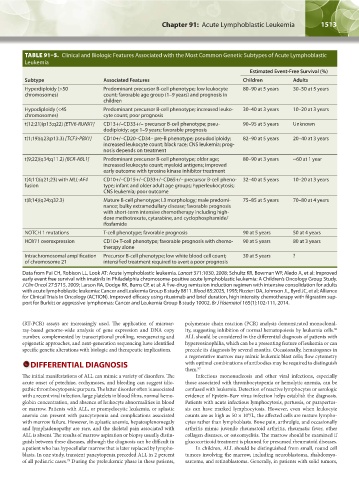
                   TABLE 91–5.  Clinical and Biologic Features Associated with the Most Common Genetic Subtypes of Acute Lymphoblastic
                   Leukemia
                                                                                              Estimated Event-Free Survival (%)
                   Subtype                   Associated Features                            Children         Adults
                   Hyperdiploidy (>50        Predominant precursor B-cell phenotype; low leukocyte   80–90 at 5 years  30–50 at 5 years
                   chromosomes)              count; favorable age group (1–9 years) and prognosis in
                                             children
                   Hypodiploidy (<45         Predominant precursor B-cell phenotype; increased leuko-  30–40 at 3 years  10–20 at 3 years
                   chromosomes)              cyte count; poor prognosis
                   t(12;21)(p13;q22) [ETV6-RUNX1]  CD13+/–CD33+/– precursor B-cell phenotype; pseu-  90–95 at 5 years  Unknown
                                             dodiploidy; age 1–9 years; favorable prognosis
                   t(1;19)(q23;p13.3) [TCF3-PBX1]  CD10+/–CD20–CD34– pre-B phenotype; pseudodiploidy;   82–90 at 5 years  20–40 at 3 years
                                             increased leukocyte count; black race; CNS leukemia; prog-
                                             nosis depends on treatment
                   t(9;22)(q34;q11.2) [BCR-ABL1]  Predominant precursor B-cell phenotype; older age;   80–90 at 3 years  ~60 at 1 year
                                             increased leukocyte count; myeloid antigens; improved
                                             early outcome with tyrosine kinase inhibitor treatment
                   t(4;11)(q21;23) with MLL-AF4   CD10+/–CD15+/–CD33+/–CD65+/– precursor B-cell pheno-  32–40 at 5 years  10–20 at 3 years
                   fusion                    type; infant and older adult age groups; hyperleukocytosis;
                                             CNS leukemia; poor outcome
                   t(8;14)(q24;q32.3)        Mature B-cell phenotype; L3 morphology; male predomi-  75–85 at 5 years  70–80 at 4 years
                                             nance; bulky extramedullary disease; favorable prognosis
                                             with short-term intensive chemotherapy including high-
                                             dose methotrexate, cytarabine, and cyclophosphamide/
                                             ifosfamide
                   NOTCH 1 mutations         T-cell phenotype; favorable prognosis          90 at 5 years    50 at 4 years
                   HOX11 overexpression      CD10+ T-cell phenotype; favorable prognosis with chemo-  90 at 5 years  80 at 3 years
                                             therapy alone
                   Intrachromosomal amplification   Precursor B-cell phenotype; low white blood cell count;   30 at 5 years  ?
                   of chromosome 21          intensified treatment required to avert a poor prognosis

                  Data from Pui CH, Robison LL, Look AT: Acute lymphoblastic leukemia. Lancet 371:1030, 2008; Schultz KR, Bowman WP, Aledo A, et al: Improved
                  early event free survival with imatinib in Philadelphia chromosome-positive acute lymphoblastic leukemia: A Children’s Oncology Group Study.
                  J Clin Oncol 27:5715, 2009; Larson RA, Dodge RK, Burns CP, et al: A five-drug remission induction regimen with intensive consolidation for adults
                  with acute lymphoblastic leukemia: Cancer and Leukemia Group B study 8811. Blood 85:2025, 1995; Rizzieri DA, Johnson JL, Byrd JC, et al; Alliance
                  for Clinical Trials In Oncology (ACTION). Improved efficacy using rituximab and brief duration, high intensity chemotherapy with filgrastim sup-
                  port for Burkitt or aggressive lymphomas: Cancer and Leukemia Group B study 10002. Br J Haematol 165(1):102-111, 2014.


                  (RT-PCR) assays are increasingly used. The application of microar-  polymerase chain reaction (PCR) analysis demonstrated monoclonal-
                  ray-based genome-wide analysis of gene expression and DNA copy   ity, suggesting inhibition of normal hematopoiesis by leukemia cells.
                                                                                                                          96
                  number, complemented by transcriptional profiling, resequencing and   ALL should be considered in the differential diagnosis of patients with
                  epigenetic approaches, and next-generation sequencing have identified   hypereosinophilia, which can be a presenting feature of leukemia or can
                  specific genetic alterations with biologic and therapeutic implications.  precede its diagnosis by several months. Occasionally, hematogones in
                                                                        a regenerative marrow may mimic leukemic blast cells; flow cytometry
                     DIFFERENTIAL DIAGNOSIS                             with optimal combinations of antibodies may be required to distinguish
                                                                        them. 97
                  The initial manifestations of ALL can mimic a variety of disorders. The   Infectious  mononucleosis  and  other  viral  infections,  especially
                  acute onset of petechiae, ecchymoses, and bleeding can suggest idio-  those associated with thrombocytopenia or hemolytic anemia, can be
                  pathic thrombocytopenic purpura. The latter disorder often is associated   confused with leukemia. Detection of reactive lymphocytes or serologic
                  with a recent viral infection, large platelets in blood films, normal hemo-  evidence of Epstein-Barr virus infection helps establish the diagnosis.
                  globin concentration, and absence of leukocyte abnormalities in blood   Patients with acute infectious lymphocytosis, pertussis, or parapertus-
                  or marrow. Patients with ALL, or promyelocytic leukemia, or aplastic   sis can have marked lymphocytosis. However, even when leukocyte
                  anemia can present with pancytopenia and complications associated   counts are as high as 50 × 10 /L, the affected cells are mature lympho-
                                                                                              9
                  with marrow failure. However, in aplastic anemia, hepatosplenomegaly   cytes rather than lymphoblasts. Bone pain, arthralgia, and occasionally
                  and lymphadenopathy are rare, and the skeletal pain associated with   arthritis mimic juvenile rheumatoid arthritis, rheumatic fever, other
                  ALL is absent. The results of marrow aspiration or biopsy usually distin-  collagen diseases, or osteomyelitis. The marrow should be examined if
                  guish between these diseases, although the diagnosis can be difficult in   glucocorticoid treatment is planned for presumed rheumatoid diseases.
                  a patient who has hypocellular marrow that is later replaced by lympho-  In children, ALL should be distinguished from small, round cell
                  blasts. In one study, transient pancytopenia preceded ALL in 2 percent   tumors involving the marrow, including neuroblastoma, rhabdomyo-
                  of all pediatric cases.  During the preleukemic phase in these patients,   sarcoma, and retinoblastoma. Generally, in patients with solid tumors,
                                 75


          Kaushansky_chapter 91_p1505-1526.indd   1513                                                                  9/21/15   12:20 PM

