


Page 1596 - Williams Hematology ( PDFDrive )
P. 1596
1570  Part XI:  Malignant Lymphoid Diseases            Chapter 95:  General Considerations for Lymphomas             1571


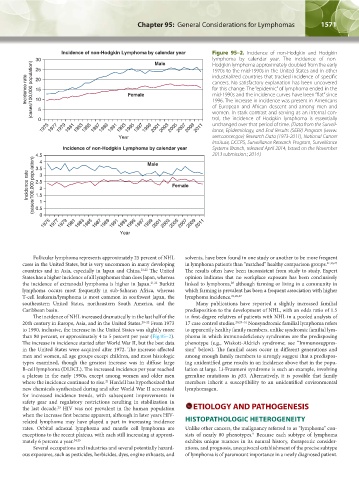
                               Incidence of non-Hodgkin Lymphoma by calendar year  Figure 95–2.  Incidence of non-Hodgkin  and  Hodgkin
                      30                                      Male               lymphoma  by  calendar  year.  The  incidence  of  non-
                                                                                 Hodgkin lymphoma approximately doubled from the early
                      25
                                                                                 1970s to the mid-1990s in the United States and in other
                   Incidence rate (cases/100,000 population)  20  Female         industrialized countries that tracked incidence of specific
                                                                                 cancers. No satisfactory explanation has been uncovered
                                                                                 for this change. The “epidemic” of lymphoma ended in the
                      15
                                                                                 mid-1990s and the incidence curves have been “flat” since
                      10
                                                                                 1996. The increase in incidence was present in Americans
                                                                                 women. In stark contrast and serving as an internal con-
                                                                                 trol, the incidence of Hodgkin lymphoma is essentially
                       0 5                                                       of European and African descent and among men and
                        1975  1977  1979  1981  1983  1985  1987  1989  1991  1993  1995  1997  1999  2001  2003  2005  2007  2009  2011  unchanged over that period of time. (Data from the Surveil-
                                                                                 lance, Epidemiology, and End Results (SEER) Program (www.
                                                  Year                           seer.cancer.gov) Research Data (1973-2011), National Cancer
                                                                                 Institute, DCCPS, Surveillance Research Program, Surveillance
                               Incidence of non-Hodgkin Lymphoma by calendar year  Systems Branch, released April 2014, based on the November
                      4.5 4                                 Male                 2013 submission.; 2014.)

                      3.5
                    Incidence rate (cases/100,000 population)  2.5 3 2  Female


                      1.5

                      0.5
                        0 1
                         1975  1977  1979  1981  1983  1985  1987  1989  1991  1993  1995  1997  1999  2001  2003  2005  2007  2009  2011
                                                   Year


                     Follicular lymphoma represents approximately 25 percent of NHL   solvents, have been found in one study or another to be more frequent
                  cases in the United States, but is very uncommon in many developing   in lymphoma patients than “matched” healthy comparison groups. 21,26,27
                  countries and in Asia, especially in Japan and China. 21,22  The United   The results often have been inconsistent from study to study. Expert
                  States has a higher incidence of all lymphomas than does Japan, whereas   opinion indicates that no workplace exposure has been conclusively
                  the incidence of extranodal lymphoma is higher in Japan. 21,22  Burkitt   linked to lymphoma,  although farming or living in a community in
                                                                                        28
                  lymphoma occurs most frequently in sub-Saharan Africa, whereas   which farming is prevalent has been a frequent association with higher
                  T-cell leukemia/lymphoma is most common in southwest Japan, the   lymphoma incidence. 21,26,27
                  southeastern United  States,  northeastern South  America,  and  the   Many publications have reported a slightly increased familial
                  Caribbean basin.                                      predisposition to the development of NHL, with an odds ratio of 1.5
                     The incidence of NHL increased dramatically in the last half of the   in first-degree relatives of patients with NHL in a pooled analysis of
                  20th century in Europe, Asia, and in the United States. 20–22  From 1973   17 case control studies. 20,29–31  Nonsyndromic familial lymphoma refers
                  to 1990, inclusive, the increase in the United States was slightly more   to apparently healthy family members, unlike syndromic familial lym-
                  than 80 percent, or approximately 4 to 5 percent per year (Fig.95–2).   phoma in which immunodeficiency syndromes are the predisposing
                  The increase in incidence started after World War II, but the best data   phenotype (e.g., Wiskott-Aldrich syndrome; see “Immunosuppres-
                  in the United States were acquired after 1972. The increase affected   sion” below). The familial cases occur in different generations and
                  men and women, all age groups except children, and most histologic   among enough family members to strongly suggest that a predispos-
                  types examined, though the greatest increase was in diffuse large   ing unidentified gene results in an incidence above that in the popu-
                  B-cell lymphoma (DLBCL). The increased incidence per year reached   lation at large. Li-Fraumeni syndrome is such an example, involving
                  a plateau in the early 1990s, except among women and older men   germline mutations in  p53. Alternatively, it is possible that family
                                              21
                  where the incidence continued to rise.  Hardell has hypothesized that   members inherit a susceptibility to an unidentified environmental
                  new chemicals synthesized during and after World War II accounted   lymphomagen.
                  for increased incidence trends, with subsequent improvements in
                  safety gear and regulatory restrictions resulting in stabilization in
                  the last decade.  HIV was not prevalent in the human population   ETIOLOGY AND PATHOGENESIS
                              23
                  when the increase first became apparent, although in later years HIV-
                  related lymphoma may have played a part in increasing incidence   HISTOPATHOLOGIC HETEROGENEITY
                  rates.  Orbital  adnexal  lymphoma  and  mantle  cell  lymphoma  are   Unlike other cancers, the malignancy referred to as “lymphoma” con-
                  exceptions to the recent plateau, with each still increasing at approxi-  sists of nearly 80 phenotypes.  Because each subtype of lymphoma
                                                                                               9
                  mately 6 percent a year. 24,25                        exhibits unique nuances in its natural history, therapeutic consider-
                     Several occupations and industries and several potentially hazard-  ations, and prognosis, unequivocal establishment of the precise subtype
                  ous exposures, such as pesticides, herbicides, dyes, engine exhausts, and   of lymphoma is of paramount importance in a newly diagnosed patient.


          Kaushansky_chapter 95_p1569-1586.indd   1571                                                                  9/21/15   12:16 PM

