


Page 1684 - Williams Hematology ( PDFDrive )
P. 1684
1658  Part XI:  Malignant Lymphoid Diseases                           Chapter 100:  Mantle Cell Lymphoma             1659


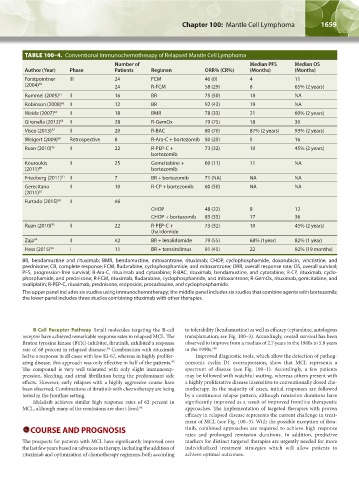
                   TABLE 100–4.  Conventional Immunochemotherapy of Relapsed Mantle Cell Lymphoma
                                                 Number of                                    Median PFS     Median OS
                   Author (Year)  Phase          Patients    Regimen           ORR% (CR%)     (Months)       (Months)
                   Forstpointner   III           24          FCM               46 (0)         4              11
                   (2004) 60                     24          R-FCM             58 (29)        8              65% (2 years)

                   Rummel (2005) 61  II          16          BR                75 (50)        18             NA
                   Robinson (2008) 62  II        12          BR                92 (42)        19             NA
                   Weide (2007) 63  II           18          BMR               78 (33)        21             60% (2 years)
                   Gironella (2012) 64  II       28          R-GemOx           79 (75)        18             30
                   Visco (2013) 42  II           20          R-BAC             80 (70)        87% (2 years)  93% (2 years)
                   Weigert (2009) 90  Retrospective  8       R-Ara-C + bortezomib 50 (25)     5              16
                   Ruan (2010) 95  II            22          R-PEP-C +         73 (32)        10             45% (2 years)
                                                             bortezomib
                   Kouroukis      II             25          Gemcitabine +     60 (11)        11             NA
                   (2011) 89                                 bortezomib
                   Friedberg (2011) 91  II       7           BR + bortezomib   71 (NA)        NA             NA
                   Gerecitano     II             10          R-CP + bortezomib  60 (50)       NA             NA
                   (2011) 92
                   Furtado (2015) 88  II         46
                                                             CHOP              48 (22)        8              12
                                                             CHOP + bortezomib  83 (35)       17             36
                   Ruan (2010) 95  II            22          R-PEP-C +         73 (32)        10             45% (2 years)
                                                             thalidomide
                   Zaja 94        II             42          BR + lenalidomide  79 (55)       68% (1year)    82% (1 year)
                   Hess (2015) 96  I             11          BR + temsirolimus  91 (45)       22             92% (19 months)
                  BR, bendamustine and rituximab; BMR, bendamustine, mitoxantrone, rituximab; CHOP, cyclophosphamide,  doxorubicin, vincristine, and
                  prednisone; CR, complete response; FCM, fludarabine, cyclophosphamide, and mitoxantrone; ORR, overall response rate; OS, overall survival;
                  PFS, progression-free survival; R-Ara-C, rituximab and cytarabine; R-BAC, rituximab, bendamustine, and cytarabine; R-CP, rituximab, cyclo-
                  phosphamide, and prednisone; R-FCM, rituximab, fludarabine, cyclophosphamide, and mitoxantrone; R-GemOx, rituximab, gemcitabine, and
                  oxaliplatin; R-PEP-C, rituximab, prednisone, etoposide, procarbazine, and cyclophosphamide.
                  The upper panel includes six studies using immunochemotherapy; the middle panel includes six studies that combine agents with bortezomib;
                  the lower panel includes three studies combining rituximab with other therapies.


                     B-Cell  Receptor  Pathway  Small molecules targeting the B-cell   to tolerability (bendamustine) as well as efficacy (cytarabine, autologous
                  receptor have achieved remarkable response rates in relapsed MCL. The   transplantation; see Fig. 100–3). Accordingly, overall survival has been
                  Bruton tyrosine kinase (BTK)-inhibitor, ibrutinib, exhibited a response   observed to improve from a median of 2.7 years in the 1980s to 5.8 years
                                              84
                  rate of 68 percent in relapsed disesase.  Combination with rituximab   in the 1990s. 100
                  led to a response in all cases with low Ki-67, whereas in highly prolifer-  Improved diagnostic tools, which allow the detection of pathog-
                  ating disease, this approach was only effective in half of the patients.    nomonic cyclin D1 overexpression, show that MCL represents a
                                                                    85
                  The compound is very well tolerated with only slight immunosup-  spectrum  of  disease  (see  Fig. 100–1). Accordingly, a  few  patients
                  pression,  bleeding,  and atrial fibrillation being  the  predominant  side   may be followed with watchful waiting, whereas others present with
                  effects. However, early relapses  with  a highly  aggressive  course  have   a highly proliferative disease insensitive to conventionally dosed che-
                  been observed. Combinations of ibrutinib with chemotherapy are being   motherapy. In the majority of cases, initial responses are followed
                  tested in the frontline setting.                      by a continuous relapse pattern, although remission durations have
                     Idelalisib achieves similar high response rates of 62 percent in   significantly improved as a result of improved frontline therapeutic
                  MCL, although many of the remissions are short-lived. 86  approaches. The implementation of targeted therapies with proven
                                                                        efficacy in relapsed disease represents the current challenge in treat-
                                                                        ment of MCL (see Fig. 100–3). With the possible exception of ibru-
                     COURSE AND PROGNOSIS                               tinib, combined approaches are required to achieve high response
                                                                        rates and prolonged remission durations. In addition, predictive
                  The prospects for patients with MCL have significantly improved over   markers for distinct targeted therapies are urgently needed for more
                  the last few years based on advances in therapy, including the addition of   individualized treatment strategies which will allow patients to
                  rituximab and optimization of chemotherapy regimens, both according   achieve optimal outcomes.


          Kaushansky_chapter 100_p1653-1662.indd   1659                                                                 9/18/15   5:06 PM

