


Page 1685 - Williams Hematology ( PDFDrive )
P. 1685
1660           Part XI:  Malignant Lymphoid Diseases                                                                                                                               Chapter 100:  Mantle Cell Lymphoma            1661


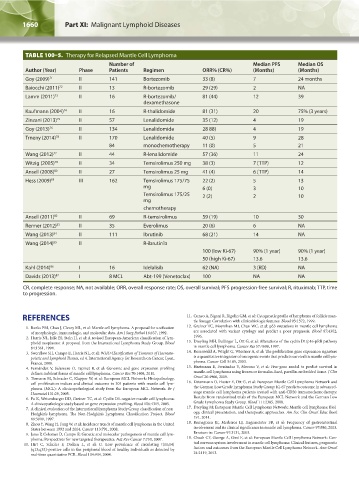
                TABLE 100–5.  Therapy for Relapsed Mantle Cell Lymphoma
                                             Number of                                       Median PFS     Median OS
                Author (Year)     Phase      Patients   Regimen             ORR% (CR%)       (Months)       (Months)
                Goy (2009) 71     II         141        Bortezomib          33 (8)           7              24 months
                Baiocchi (2011) 72  II       13         R-bortezomib        29 (29)          2              NA
                Lamm (2011) 73    II         16         R-bortezomib/       81 (44)          12             39
                                                        dexamethasone
                Kaufmann (2004) 74  II       16         R-thalidomide       81 (31)          20             75% (3 years)
                Zinzani (2013) 75  II        57         Lenalidomide        35 (12)          4              19
                Goy (2013) 76     II         134        Lenalidomide        28 88)           4              19
                Trneny (2014) 78  II         170        Lenalidomide        40 (5)           9              28
                                             84         monochemotherapy    11 (0)           5              21
                Wang (2012) 77    II         44         R-lenalidomide      57 (36)          11             24
                Witzig (2005) 79  II         34         Temsirolimus 250 mg  38 (3)          7 (TTP)        12
                Ansell (2008) 80  II         27         Temsirolimus 25 mg  41 (4)           6 (TTP)        14
                Hess (2009) 81    III        162        Temsirolimus 175/75   22 (2)         5              13
                                                        mg                  6 (0)            3              10
                                                        Temsirolimus 175/25   2 (2)          2              10
                                                        mg
                                                        chemotherapy
                Ansell (2011) 82  II         69         R-temsirolimus      59 (19)          10             30
                Renner (2012) 83  II         35         Everolimus          20 (6)           6              NA
                Wang (2013) 84    II         111        Ibrutinib           68 (21)          14             NA
                Wang (2014) 85    II                    R-ibrutinib
                                                                            100 (low Ki-67)  90% (1 year)   90% (1 year)
                                                                            50 (high Ki-67)  13.6           13.6
                Kahl (2014) 86    I          16         Idelalisib          62 (NA)          3 (RD)         NA
                Davids (2013) 87  I          8 MCL      Abt-199 (Venetoclax)  100            NA             NA

                CR, complete response; NA, not available; ORR, overall response rate; OS, overall survival; PFS progression-free survival; R, rituximab; TTP, time
                to progression.


               REFERENCES                                               11.  Cuneo A, Bigoni R, Rigolin GM, et al: Cytogenetic profile of lymphoma of follicle man-
                                                                         tle lineage: Correlation with clinicobiologic features. Blood 93:1372, 1999.
                 1.  Banks PM, Chan J, Cleary ML, et al: Mantle cell lymphoma. A proposal for unification     12.  Greiner TC, Moynihan MJ, Chan WC, et al: p53 mutations in mantle cell lymphoma
                  of morphologic, immunologic, and molecular data. Am J Surg Pathol 16:637, 1992.  are associated with variant cytology and predict a poor prognosis.  Blood 87:4302,
                 2.  Harris NL, Jaffe ES, Stein H, et al: A revised European-American classification of lym-  1996.
                  phoid neoplasms: A proposal from the International Lymphoma Study Group. Blood     13.  Dreyling MH, Bullinger L, Ott G, et al: Alterations of the cyclin D1/p16-pRB pathway
                  84:1361, 1994.                                         in mantle cell lymphoma. Cancer Res 57:4608, 1997.
                 3.  Swerdlow SH, Campo E, Harris NL, et al: WHO Classification of Tumours of Haemato-    14.  Rosenwald A, Wright G, Wiestner A, et al: The proliferation gene expression signature
                  poietic and Lymphoid Tissues, ed 4. International Agency for Research on Cancer, Lyon,   is a quantitative integrator of oncogenic events that predicts survival in mantle cell lym-
                  France, 2008.                                          phoma. Cancer Cell 3:185, 2003.
                 4.  Fernàndez V, Salamero O, Espinet B, et al: Genomic and gene expression profiling     15.  Hartmann E, Fernàndez V, Moreno V, et al: Five-gene model to predict survival in
                  defines indolent forms of mantle cell lymphoma. Cancer Res 70:1408, 2010.  mantle-cell lymphoma using frozen or formalin-fixed, paraffin-embedded tissue. J Clin
                 5.  Tiemann M, Schrader C, Klapper W, et al: European MCL Network: Histopathology,   Oncol 26:4966, 2008.
                  cell proliferation indices and clinical outcome in 304 patients with mantle cell lym-    16.  Determann O, Hoster E, Ott G, et al: European Mantle Cell Lymphoma Network and
                  phoma (MCL): A clinicopathological study from the European MCL Network. Br J   the German Low Grade Lymphoma Study Group: Ki-67 predicts outcome in advanced-
                  Haematol 131:29, 2005.                                 stage mantle cell lymphoma patients treated with anti-CD20 immunochemotherapy:
                 6.  Fu K, Weisenburger DD, Greiner TC, et al: Cyclin D1-negative mantle cell lymphoma:   Results from randomized trials of the European MCL Network and the German Low
                  A clinicopathologic study based on gene expression profiling. Blood 106:4315, 2005.  Grade Lymphoma Study Group. Blood 111:2385, 2008.
                 7.  A clinical evaluation of the International Lymphoma Study Group classification of non-     17.  Dreyling M; European Mantle Cell Lymphoma Network: Mantle cell lymphoma: Biol-
                  Hodgkin’s lymphoma. The Non-Hodgkin’s Lymphoma Classification Project.  Blood   ogy, clinical presentation, and therapeutic approaches. Am Soc Clin Oncol Educ Book
                  89:3909, 1997.                                         191, 2014.
                 8.  Zhou Y, Wang H, Fang W, et al: Incidence trends of mantle cell lymphoma in the United     18.  Romaguera JE, Medeiros LJ, Hagemeister FB, et al: Frequency of gastrointestinal
                  States between 1992 and 2004. Cancer 113:791, 2008.    involvement and its clinical significance in mantle cell lymphoma. Cancer 97:586, 2003.
                 9.  Jares P, Colomer D, Campo E: Genetic and molecular pathogenesis of mantle cell lym-  Erratum in: Cancer 97:3131, 2003.
                  phoma: Perspectives for new targeted therapeutics. Nat Rev Cancer 7:750, 2007.    19.  Cheah CY, George A, Giné E, et al: European Mantle Cell Lymphoma Network: Cen-
                 10.  Hirt C, Schuler F, Dolken L, et al: G. Low prevalence of circulating t(11;14)  tral nervous system involvement in mantle cell lymphoma: Clinical features, prognostic
                  (q13;q32)-positive cells in the peripheral blood of healthy individuals as detected by   factors and outcomes from the European Mantle Cell Lymphoma Network. Ann Oncol
                  real-time quantitative PCR. Blood 104:904, 2004.       24:2119, 2013.


          Kaushansky_chapter 100_p1653-1662.indd   1660                                                                 9/18/15   5:06 PM

