


Page 1707 - Williams Hematology ( PDFDrive )
P. 1707
1682           Part XI:  Malignant Lymphoid Diseases                                                                              Chapter 103:  Cutaneous T-Cell Lymphoma (Mycosis Fungoides and Sézary Syndrome)                1683


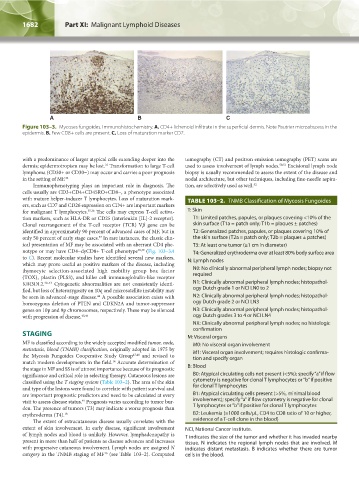
                         A                            B                             C
               Figure 103–3.  Mycoses fungoides. Immunohistochemistry. A. CD4+ lichenoid infiltrate in the superficial dermis. Note Pautrier microabscess in the
               epidermis. B. Few CD8+ cells are present. C. Loss of maturation marker CD7.


               with a predominance of larger atypical cells extending deeper into the   tomography (CT) and positron emission tomography (PET) scans are
                                           33
               dermis; epidermotropism may be lost.  Transformation to large T-cell   used to assess involvement of lymph nodes. 50,51  Excisional lymph node
               lymphoma (CD30+ or CD30−) may occur and carries a poor prognosis   biopsy is usually recommended to assess the extent of the disease and
               in the setting of MF. 34                               nodal architecture, but other techniques, including fine-needle aspira-
                   Immunophenotyping plays an important role in diagnosis. The   tion, are selectively used as well. 52
               cells usually are CD3+CD4+CD45RO+CD8−, a phenotype associated
               with mature helper-inducer T lymphocytes. Loss of maturation mark-  TABLE 103–2.  TNMB Classification of Mycosis Fungoides
               ers, such as CD7 and CD26 expression on CD4+ are important markers
               for malignant T lymphocytes. 35,36  The cells may express T-cell activa-  T: Skin
               tion markers, such as HLA-DR or CD25 (interleukin [IL]-2 receptor).   T1: Limited patches, papules, or plaques covering <10% of the
               Clonal rearrangement of the T-cell receptor (TCR) Vβ gene can be   skin surface (T1a = patch only; T1b = plaques ± patches)
               identified in approximately 90 percent of advanced cases of MF, but in   T2: Generalized patches, papules, or plaques covering 10% of
                                         37
               only 50 percent of early stage cases.  In rare instances, the classic clin-  the skin surface (T2a = patch only; T2b = plaques ± patches)
               ical presentation of MF may be associated with an aberrant CD4 phe-  T3: At least one tumor (≥1 cm in diameter)
               notype or may have CD4−dyCD8+ T-cell phenotype 38,39  (Fig. 103–3A   T4: Generalized erythroderma over at least 80% body surface area
               to C). Recent molecular studies have identified several new markers,   N: Lymph nodes
               which may prove useful as positive markers of the disease, including
               thymocyte selection-associated high mobility group box factor   N0: No clinically abnormal peripheral lymph nodes; biopsy not
               (TOX),  plastin (PLS3), and killer cell immunoglobulin-like receptor   required
               KIR3DL2. 40–43  Cytogenetic abnormalities are not consistently identi-  N1: Clinically abnormal peripheral lymph nodes; histopathol-
               fied, but loss of heterozygosity on 10q and microsatellite instability may   ogy Dutch grade 1 or NCI LN0 to 2
                                        44
               be seen in advanced-stage disease.  A possible association exists with   N2: Clinically abnormal peripheral lymph nodes; histopathol-
               homozygous deletion of PTEN and CDKN2A and tumor-suppressor   ogy Dutch grade 2 or NCI LN3
               genes on 10p and 9p chromosomes, respectively. These may be silenced   N3: Clinically abnormal peripheral lymph nodes; histopathol-
               with progression of disease. 45,46                        ogy Dutch grades 3 to 4 or NCI LN4
                                                                         NX: Clinically abnormal peripheral lymph nodes; no histologic
                                                                         confirmation
               STAGING                                                 M: Visceral organs
               MF is classified according to the widely accepted modified tumor, node,   M0: No visceral organ involvement
               metastasis, blood (TNMB) classification, originally adopted in 1975 by
               the Mycosis Fungoides Cooperative Study Group 47,48  and revised to   M1: Visceral organ involvement; requires histologic confirma-
                                                                         tion and specify organ
               match modern developments in the field.  Accurate determination of
                                              16
               the stage in MF and SS is of utmost importance because of its prognostic   B: Blood
               significance and critical role in selecting therapy. Cutaneous lesions are   B0: Atypical circulating cells not present (<5%); specify “a” if flow
               classified using the T staging system (Table 103–2). The area of the skin   cytometry is negative for clonal T lymphocytes or “b” if positive
               and type of the lesions were found to correlate with patient survival and   for clonal T lymphocytes
               are important prognostic predictors and need to be calculated at every   B1: Atypical circulating cells present (>5%, minimal blood
               visit to assess disease status.  Prognosis varies according to tumor bur-  involvement); specify “a” if flow cytometry is negative for clonal
                                   49
               den. The presence of tumors (T3) may indicate a worse prognosis than   T lymphocytes or “b” if positive for clonal T lymphocytes
               erythroderma (T4). 18                                     B2: Leukemia (≥1000 cells/μL, CD4 to CD8 ratio of 10 or higher,
                   The extent of extracutaneous disease usually correlates with the   evidence of a T-cell clone in the blood)
               extent of skin involvement. In early disease, significant involvement   NCI, National Cancer Institute.
               of lymph nodes and blood is unlikely. However, lymphadenopathy is   T indicates the size of the tumor and whether it has invaded nearby
               present in more than half of patients as disease advances and increases   tissue. N indicates the regional lymph nodes that are involved. M
               with progressive cutaneous involvement. Lymph nodes are assigned N   indicates distant metastasis. B indicates whether there are tumor
               category in the TNMB staging of MF  (see Table  103–2). Computed   cells in the blood.
                                           16


          Kaushansky_chapter 103_p1679-1692.indd   1682                                                                 9/21/15   12:50 PM

