


Page 1783 - Williams Hematology ( PDFDrive )
P. 1783
1758           Part XI:  Malignant Lymphoid Diseases                                                                                                                                             Chapter 107:  Myeloma           1759


               bisphosphonate exposure and is 5 to 15 percent at 4 years. 565–567  A fur-  TABLE 107–11.  Uniform Response Criteria from the
               ther predisposing factor for ONJ is invasive dental procedures such as
               extractions. 568,569  Approximately 50 percent of affected patients had den-  International Myeloma Working Group
               tal work prior to developing ONJ.  A genome-wide SNP analysis has   Response
                                        569
               shown that a polymorphism in the cytochrome P450–2C polypeptide is   Subcategory* Response Criteria
               associated with an increased risk of developing ONJ on bisphosphonate   CR  Negative immunofixation of the serum and urine
               therapy, although the mechanism underlying this genetic predisposi-  and disappearance of any soft-tissue plasmacyto-
               tion to ONJ has as yet not been elucidated. 570,571  To prevent ONJ, patients   mas and <5% plasma cells in marrow. †
               should be referred for dental evaluation prior to commencing intrave-  sCR  CR as defined above plus
               nous bisphosphonates and should be advised to maintain excellent oral
                                                                 534
               hygiene and avoid dental procedures while receiving these agents.       Normal FLC ratio and
                                                                                                            †
               Antibiotic prophylaxis before dental procedures may reduce the inci-     Absence of clonal cells in marrow  by immuno-
                                                            572
               dence of ONJ in patients receiving bisphosphonate therapy.  Man-    histochemistry or immunofluorescence. ‡
               agement is usually conservative (discontinuation of bisphosphonates,   VGPR  Serum and urine M-protein detectable by immu-
               limited debridement, antibiotic therapy, and topical mouth rinses).    nofixation but not on electrophoresis or 90 or
                                                                 573
               Surgical resection of necrotic bone should be reserved for refractory   greater reduction in serum M-protein plus urine
               cases. In a series of 97 patients, healing of ONJ was observed in 75 per-  M-protein <100 mg per 24 h.
               cent of patients. Patients who develop spontaneous ONJ have a signifi-  PR  >50% reduction of serum M-protein and reduc-
               cantly higher risk of nonhealing ONJ or recurrence. 568             tion in 24-h urinary M-protein by >90% or to
                                                                                   <200 mg per 24 h.
                                                                                   If the serum and urine M-protein are unmeasur-
                  COURSE AND PROGNOSIS                                             able, >50% decrease in the difference between
                                                                                   involved and uninvolved FLC levels is required in
               MONITORING DISEASE MARKERS FOR                                      place of the M-protein criteria.
               DOCUMENTATION OF RESPONSE AND                                       If serum and urine M-protein are unmeasurable,
               RELAPSE                                                             and serum-free light assay is also unmeasurable,
                                                                                   >50% reduction in plasma cells is required in
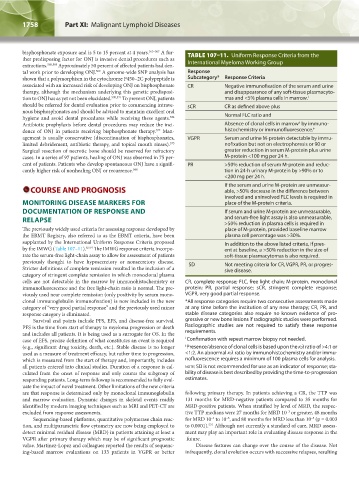
               The previously widely used criteria for assessing response developed by   place of M-protein, provided baseline marrow
               the EBMT Registry, also referred to as the EBMT criteria, have been   plasma cell percentage was >30%.
               supplanted by the International Uniform Response Criteria proposed      In addition to the above listed criteria, if pres-
               by the IMWG (Table 107–11). 8,574  The IMWG response criteria incorpo-  ent at baseline, a >50% reduction in the size of
               rate the serum-free light-chain assay to allow for assessment of patients   soft-tissue plasmacytomas is also required.
               previously thought to have hyposecretory or nonsecretory disease.    SD  Not meeting criteria for CR, VGPR, PR, or progres-
               Stricter definitions of complete remission resulted in the inclusion of a   sive disease.
               category of stringent complete remission in which monoclonal plasma
               cells are not detectable in the marrow by immunohistochemistry or   CR, complete response; FLC, free light chain; M-protein, monoclonal
               immunofluorescence and the free light-chain ratio is normal. The pre-  protein; PR, partial response; sCR, stringent complete response;
               viously used near complete remission (only positivity by serum mono-  VGPR, very good partial response.
               clonal immunoglobulin immunofixation) is now included in the new   *All response categories require two consecutive assessments made
               category of “very good partial response” and the previously used minor   at any time before the institution of any new therapy; CR, PR, and
               response category is eliminated.                       stable disease categories also require no known evidence of pro-
                   Survival end points include PFS, EFS, and disease-free survival.   gressive or new bone lesions if radiographic studies were performed.
               PFS is the time from start of therapy to myeloma progression or death   Radiographic  studies  are  not  required  to  satisfy  these  response
               and includes all patients. It is being used as a surrogate for OS. In the   requirements.
               case of EFS, precise definition of what constitutes an event is required   † Confirmation with repeat marrow biopsy not needed.
               (e.g., significant drug toxicity, death, etc.). Stable disease is no longer   ‡ Presence/absence of clonal cells is based upon the κ:λ ratio of >4:1 or
               used as a measure of treatment efficacy, but rather time to progression,   <1:2. An abnormal κ:λ ratio by immunohistochemistry and/or immu-
               which is measured from the start of therapy and, importantly, includes   nofluorescence requires a minimum of 100 plasma cells for analysis.
               all patients entered into clinical studies. Duration of a response is cal-  note: SD is not recommended for use as an indicator of response; sta-
               culated from the onset of response and only counts the subgroup of   bility of disease is best described by providing the time-to-progression
               responding patients. Long-term followup is recommended to fully eval-  estimates.
               uate the impact of novel treatment. Other limitations of the new criteria
               are that response is determined only by monoclonal immunoglobulin   following primary therapy. In patients achieving a CR, the TTP was
               and marrow evaluation. Dynamic changes in skeletal events readily   131 months for MRD-negative patients compared to 35 months for
               identified by modern imaging techniques such as MRI and PET-CT are   MRD-positive patients. When stratified by level of MRD, the respec-
                                                                                                        –3
               excluded from response assessments.                    tive TTP medians were 27 months for MRD 10  or greater, 48 months
                                                                               –3
                                                                                    –5
                                                                                                                –5
                   Sequencing-based platforms, quantitative polymerase chain reac-  for MRD 10  to 10 , and 80 months for MRD less than 10  (p = 0.003
               tion, and multiparametric flow cytometry are now being employed to   to 0.0001).  Although not currently a standard of care, MRD assess-
                                                                              575
               detect minimal residual disease (MRD) in patients attaining at least a   ment may play an important role in evaluating disease response in the
               VGPR after primary therapy which may be of significant prognostic    future.
               value. Martinez-Lopez and colleagues reported the results of sequenc-  Disease features can change over the course of the disease. Not
               ing-based  marrow  evaluations on 133 patients in VGPR  or  better   infrequently, clonal evolution occurs with successive relapses, resulting


          Kaushansky_chapter 107_p1733-1772.indd   1758                                                                 9/21/15   12:35 PM

