


Page 1778 - Williams Hematology ( PDFDrive )
P. 1778
1752  Part XI:  Malignant Lymphoid Diseases                                         Chapter 107:  Myeloma            1753


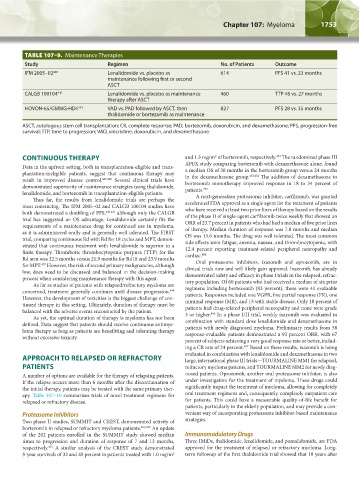
                   TABLE 107–9.  Maintenance Therapies
                   Study                      Regimen                               No. of Patients    Outcome
                   IFM 2005–02 440            Lenalidomide vs. placebo as           614                PFS 41 vs. 23 months
                                              maintenance following first or second
                                              ASCT
                   CALGB 100104 441           Lenalidomide vs. placebo as maintenance    460           TTP 46 vs. 27 months
                                              therapy after ASCT
                   HOVON-65/GMMG-HD4 443      VAD vs. PAD followed by ASCT, then    827                PFS 28 vs. 35 months
                                              thalidomide or bortezomib as maintenance
                  ASCT, autologous stem cell transplantation; CR, complete response; PAD, bortezomib, doxorubicin, and dexamethasone; PFS, progression-free
                  survival; TTP, time to progression; VAD, vincristine, doxorubicin, and dexamethasone.


                  CONTINUOUS THERAPY                                    and 1.3 mg/m  of bortezomib, respectively.  The randomized phase III
                                                                                  2
                                                                                                       452
                                                                        APEX study comparing bortezomib with dexamethasone alone, found
                  Data in the upfront setting, both in transplantation-eligible and trans-  a median OS of 30 months in the bortezomib group versus 24 months
                  plantation-ineligible patients, suggest that continuous therapy may   in the dexamethasone group. 453,454  The addition of dexamethasone to
                  result in  improved disease control. 447,448  Several clinical trials have   bortezomib monotherapy improved response in 18 to 34 percent of
                  demonstrated superiority of maintenance strategies using thalidomide,   patients. 455
                  lenalidomide, and bortezomib in transplantation-eligible patients.  A next-generation proteasome inhibitor, carfilzomib, was granted
                     Thus far, the results from lenalidomide trials are perhaps the   accelerated FDA approval as a single agent for the treatment of patients
                  most convincing. The IFM 2005–02 and CALGB 100104 studies have   who have received at least two prior lines of therapy based on the results
                  both demonstrated a doubling of PFS, 440,441  although only the CALGB   of the phase II of single-agent carfilzomib twice weekly that showed an
                  trial has suggested an OS advantage. Lenalidomide certainly fits the   ORR of 23.7 percent in patients who had had a median of five prior lines
                  requirements  of  a maintenance  drug  for  continued  use  in  myeloma,   of therapy. Median duration of response was 7.8 months and median
                  as it is administered orally and is generally well tolerated. The FIRST   OS was 15.6 months. The drug was well tolerated. The most common
                  trial, comparing continuous Rd with Rd for 18 cycles and MPT, demon-  side effects were fatigue, anemia, nausea, and thrombocytopenia, with
                  strated that continuous treatment with lenalidomide is superior to a   12.4 percent reporting treatment-related peripheral neuropathy and
                  finite  therapy.  Thrombotic  thrombocytopenic  purpura (TTP)  for  the   cardiac. 404
                  Rd arm was 32.5 months versus 21.9 months for Rd18 and 23.9 months   Oral proteasome inhibitors, ixazomib and oprozomib, are in
                        437
                  for MPT.  However, the risk of second primary malignancies, although   clinical trials now and will likely gain approval. Ixazomib, has already
                  low, does need to be discussed and balanced in the decision-making   demonstrated safety and efficacy in phase I trials in the relapsed, refrac-
                  process when considering maintenance therapy with this agent.  tory population. Of 60 patients who had received a median of six prior
                     As far as studies of patients with relapsed/refractory myeloma are   regimens including bortezomib (83 percent), there were 41 evaluable
                                                                   449
                  concerned, treatment generally continues until disease progression.    patients. Responses included one VGPR, five partial response (PR), one
                  However, the development of toxicities is the biggest challenge of con-  minimal response (MR), and 15 with stable disease. Only 10 percent of
                  tinued therapy in this setting. Ultimately, duration of therapy must be   patients had drug-related peripheral neuropathy and none were grade
                  balanced with the adverse events encountered by the patient.  3 or higher.  In a phase I/II trial, weekly ixazomib was evaluated in
                                                                                 456
                     As yet, the optimal duration of therapy is myeloma has not been   combination with standard dose lenalidomide and dexamethasone in
                  defined. Data suggest that patients should receive continuous antimye-  patients with newly diagnosed myeloma. Preliminary results from 58
                  loma therapy as long as patients are benefitting and tolerating therapy   response-evaluable patients demonstrated a 93 percent ORR, with 67
                  without excessive toxicity.
                                                                        percent of subjects achieving a very good response rate or better, includ-
                                                                        ing a CR rate of 24 percent.  Based on these results, ixazomib is being
                                                                                            457
                                                                        evaluated in combination with lenalidomide and dexamethasone in two
                  APPROACH TO RELAPSED OR REFRACTORY                    large, international phase III trials—TOURMALINE MM1 for relapsed,
                  PATIENTS                                              refractory myeloma patients, and TOURMALINE MM2 for newly diag-
                  A number of options are available for the therapy of relapsing patients.   nosed patients. Oprozomib, another oral proteasome inhibitor, is also
                  If the relapse occurs more than 6 months after the discontinuation of   under investigation for the treatment of myeloma. These drugs could
                  the initial therapy, patients may be treated with the same primary ther-  significantly impact the treatment of myeloma, allowing for completely
                  apy. Table 107–10 summarizes trials of novel treatment regimens for   oral treatment regimens and, consequently, completely outpatient care
                  relapsed or refractory disease.                       for  patients.  This  could  have  a  measurable  quality-of-life  benefit  for
                                                                        patients, particularly in the elderly population, and may provide a con-
                  Proteasome Inhibitors                                 venient way of incorporating proteasome inhibitor-based maintenance
                  Two phase II studies, SUMMIT and CREST, demonstrated activity of   strategies.
                  bortezomib in relapsed or refractory myeloma patients. 403,450  An update
                  of the 202 patients enrolled in the SUMMIT study showed median   Immunomodulatory Drugs
                  times to progression and duration of response of 7 and 13 months,   Three IMiDs, thalidomide, lenalidomide, and pomalidomide, are FDA
                           451
                  respectively.   A  similar  analysis  of  the  CREST  study  demonstrated   approved for the treatment of relapsed or refractory myeloma. Long-
                                                                    2
                  5-year survivals of 32 and 45 percent in patients treated with 1.0 mg/m    term followup of the first thalidomide trial showed that 10 years after


          Kaushansky_chapter 107_p1733-1772.indd   1753                                                                 9/21/15   12:35 PM

