


Page 1855 - Williams Hematology ( PDFDrive )
P. 1855
1830           Part XII:  Hemostasis and Thrombosis                                                                                                      Chapter 112:  Platelet Morphology, Biochemistry, and Function           1831


                    OVERVIEW OF PLATELET ADHESION,                    platelet interactions with the blood vessel wall by forcing platelets to
                                                                      the periphery of the bloodstream (as the erythrocytes disproportion-
                  AGGREGATION, AND PLATELET                           ately occupy the axial region), by imparting radially directed energy to
                  THROMBUS FORMATION                                  platelets as the erythrocytes engage in flip-flop motions, and perhaps
                                                                      by releasing the platelet activator adenosine diphosphate (ADP) at sites
                                                                                   2–4
               The hemostatic system is under elaborate control mechanisms lest the   of vascular injury ; and (5) the speed of blood flow and the size of the
               response be either inadequate to meet the hemorrhagic challenge or   blood vessel, which will determine the number of platelets passing by a
               result in inappropriate thrombosis in response to trivial provocation.   single point in a given time interval, the amount of time a platelet has
               Evolutionary pressures have probably favored a more active hemostatic   to interact with the blood vessel wall or other platelets, the rate of dilu-
               system as individuals with more active hemostatic systems were more   tion of platelet activating agents, and the forces tending to pull a platelet
               likely to avoid death from hemorrhage prior to attaining sexual matu-  from the vessel wall or another platelet (shear rate). 2,4–6  The vasospastic
               rity or in association with childbirth. Our active hemostatic system may   response that accompanies vascular injury, to which platelets contribute
               be less-well adapted to our modern age, which is characterized by long   by release of thromboxane (TX) A  and serotonin, probably plays a key
                                                                                               2
               life spans and progressive vascular disease, given that the deposition of   role in decreasing hemorrhage and facilitating platelet and fibrin depo-
               a platelet-fibrin thrombus on a damaged atherosclerotic plaque is the   sition via its effect on blood flow.
               cause of most myocardial infarctions and many strokes.     The initial adhesion of platelets occurs to the adhesive proteins
                   The platelet’s major function is to seal openings in the vascular   within the subendothelial layer immediately subjacent to the endo-
                                                                            1,5
               tree. It is appropriate, therefore, that the initiating signal for platelet   thelium  or to activated endothelium. The platelet expresses many
               deposition and activation is exposure of underlying portions of the   receptors that participate in adhesive interactions (Table 112–1).
               blood vessel wall that are normally concealed from circulating platelets   Intravital microscopy and ex vivo flow chamber studies indicate that
               by an intact endothelial lining (Fig.112–1).  Additional parameters that   discoid platelets that show minimal or no evidence of activation can
                                              1
               probably control the platelet response are: (1) the depth of injury, with   form the initial layers of platelet aggregates when laminar flow is dis-
               deeper damage exposing more platelet-reactive materials and tissue   rupted by a stenotic lesion, but that stable thrombus development
                                                                                                                   6
               factor (Chap. 115); (2) the vascular bed, with the blood vessels serving   requires  the  generation  and/or  release  of  soluble  activators.   Mem-
               mucocutaneous tissues especially dependent on platelets for hemostasis,   brane tethers, which can undergo restructuring and stabilization, are
               in contrast to the vascular beds in muscles and joints, which rely more   important in achieving interactions with matrix proteins and other
               on the coagulation mechanism; (3) the age of the individual, because   platelets.
               the composition of the blood vessel wall probably changes with age;     The  shear  rate  differentially  affects  platelet  adhesion  to  sur-
               (4) the hematocrit, because increased numbers of erythrocytes enhance   faces. 3,4,7–12  Shear rates, which reflect the differences in flow velocity


                                       A
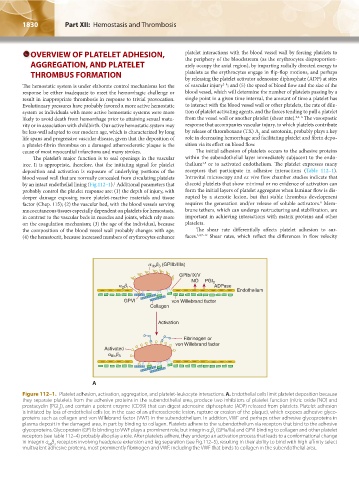
               Figure 112–1.  Platelet adhesion, activation, aggregation, and platelet-leukocyte interactions. A. Endothelial cells limit platelet deposition because
               they separate platelets from the adhesive proteins in the subendothelial area, produce two inhibitors of platelet function (nitric oxide [NO] and
               prostacyclin [PGI ]), and contain a potent enzyme (CD39) that can digest adenosine diphosphate (ADP) released from platelets. Platelet adhesion
                           2
               is initiated by loss of endothelial cells (or, in the case of an atherosclerotic lesion, rupture or erosion of the plaque), which exposes adhesive glyco-
               proteins such as collagen and von Willebrand factor (VWF) in the subendothelium. In addition, VWF and perhaps other adhesive glycoproteins in
               plasma deposit in the damaged area, in part by binding to collagen. Platelets adhere to the subendothelium via receptors that bind to the adhesive
               glycoproteins. Glycoprotein (GP) Ib binding to VWF plays a prominent role, but integrin α β  (GPIa/IIa) and GPVI binding to collagen and other platelet
                                                                              2 1
               receptors (see Table 112–4) probably also play a role. After platelets adhere, they undergo an activation process that leads to a conformational change
               in integrin α β  receptors involving headpiece extension and leg separation (see Fig.112–5), resulting in their ability to bind with high-affinity select
                        IIb 3
               multivalent adhesive proteins, most prominently fibrinogen and VWF, including the VWF that binds to collagen in the subendothelial area.


          Kaushansky_chapter 112_p1829-1914.indd   1830                                                                 17/09/15   3:25 pm

