


Page 1856 - Williams Hematology ( PDFDrive )
P. 1856
1830  Part XII:  Hemostasis and Thrombosis   Chapter 112:  Platelet Morphology, Biochemistry, and Function           1831


                                        B


                                                Leukocyte


                                       Tissue factor
                                       vesicle                         PSGL-1         DOWNSTREAM
                                                                       P-selectin
                                                                                      Platelet-leukocyte
                                                                                      aggregates

                                                                                      Platelet aggregates

                                                                                      Platelet microparticles

                                                                                      Thrombin

                                                                                      TXA 2  and LTs
                                                                                      Serotonin


                                    C
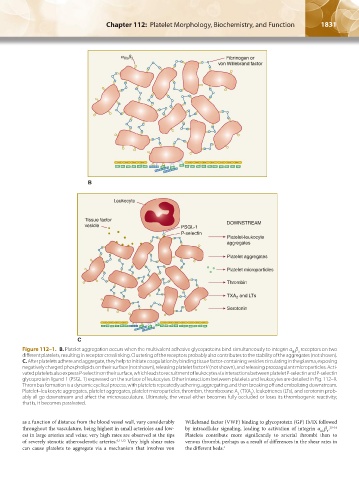
                  Figure 112–1.  B. Platelet aggregation occurs when the multivalent adhesive glycoproteins bind simultaneously to integrin α β  receptors on two
                                                                                                            IIb 3
                  different platelets, resulting in receptor crosslinking. Clustering of the receptors probably also contributes to the stability of the aggregates (not shown).
                  C. After platelets adhere and aggregate, they help to initiate coagulation by binding tissue factor-containing vesicles circulating in the plasma, exposing
                  negatively charged phospholipids on their surface (not shown), releasing platelet factor V (not shown), and releasing procoagulant microparticles. Acti-
                  vated platelets also express P-selectin on their surface, which leads to recruitment of leukocytes via interactions between platelet P-selectin and P-selectin
                  glycoprotein ligand-1 (PSGL-1) expressed on the surface of leukocytes. Other interactions between platelets and leukocytes are detailed in Fig. 112–9.
                  Thrombus formation is a dynamic cyclical process, with platelets repeatedly adhering, aggregating, and then breaking off and embolizing downstream.
                  Platelet–leukocyte aggregates, platelet aggregates, platelet microparticles, thrombin, thromboxane A  (TXA ), leukotrienes (LTs), and serotonin prob-
                                                                                          2
                                                                                              2
                  ably all go downstream and affect the microvasculature. Ultimately, the vessel either becomes fully occluded or loses its thrombogenic reactivity;
                  that is, it becomes passivated.
                  as a function of distance from the blood vessel wall, vary considerably   Willebrand factor (VWF) binding to glycoprotein (GP) Ib/IX followed
                  throughout the vasculature, being highest in small arterioles and low-  by intracellular signaling, leading to activation of integrin  α β . 13–16
                                                                                                                      IIb 3
                  est in large arteries and veins; very high rates are observed at the tips   Platelets contribute more significantly to arterial thrombi than to
                  of severely stenotic atherosclerotic arteries. 6,11,12  Very high shear rates   venous thrombi, perhaps as a result of differences in the shear rates in
                  can cause platelets to aggregate via a mechanism that involves von    the different beds. 5


          Kaushansky_chapter 112_p1829-1914.indd   1831                                                                 17/09/15   3:25 pm

