


Page 1966 - Williams Hematology ( PDFDrive )
P. 1966
1940  Part XII:  Hemostasis and Thrombosis  Chapter 113:  Molecular Biology and Biochemistry of the Coagulation Factors  1941


                                                                                                             NET DNA
                                                                          Immunothrombosis
                                                                                                          Fibrin

                                                                                                         VWF
                                                                 NET induction
                       Endothelial cell     Neutrophil  Monocyte
                       activation           recruitment  activation    FXIIa
                                                            TF


                              Bacterium
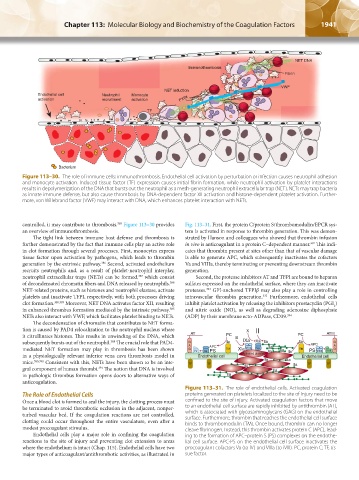
                  Figure 113–30.  The role of immune cells: immunothrombosis. Endothelial cell activation by perturbation or infection causes neutrophil adhesion
                  and monocyte activation. Induced tissue factor (TF) expression causes initial fibrin formation, while neutrophil activation by platelet interactions
                  results in depolymerization of the DNA that bursts out the neutrophil as a mesh-generating neutrophil extracellular trap (NET). NETs may trap bacteria
                  as innate immune defense, but also cause thrombosis by DNA-dependent factor XII activation and histone-dependent platelet activation. Further-
                  more, von Willebrand factor (VWF) may interact with DNA, which enhances platelet interaction with NETs.


                  controlled, it may contribute to thrombosis.  Figure 113–30 provides   Fig. 113–31. First, the protein C/protein S/thrombomodulin/EPCR sys-
                                                  385
                  an overview of immunothrombosis.                      tem is activated in response to thrombin generation. This was demon-
                     The tight link between immune host defense and thrombosis is   strated by Hanson and colleagues who showed that thrombin infusion
                  further demonstrated by the fact that immune cells play an active role   in vivo is anticoagulant in a protein C–dependent manner.  This indi-
                                                                                                                  392
                  in clot formation through several processes. First, monocytes express   cates that thrombin present at sites other than that of vascular damage
                  tissue factor upon activation by pathogens, which leads to thrombin   is able to generate APC, which subsequently inactivates the cofactors
                  generation by the extrinsic pathway.  Second, activated endothelium   Va and VIIIa, thereby terminating or preventing downstream thrombin
                                            386
                  recruits neutrophils and, as a result of platelet-neutrophil interplay,   generation.
                  neutrophil extracellular traps (NETs) can be formed,  which consist   Second, the protease inhibitors AT and TFPI are bound to heparan
                                                         387
                  of decondensated chromatin fibers and DNA released by neutrophils.    sulfates expressed on the endothelial surface, where they can inactivate
                                                                   388
                  NET-related proteins, such as histones and neutrophil elastase, activate   proteases.  GPI-anchored TFPIβ may also play a role in controlling
                                                                               393
                  platelets and inactivate TFPI, respectively, with both processes driving   intravascular thrombin generation.  Furthermore, endothelial cells
                                                                                                  332
                  clot formation. 338,389  Moreover, NET DNA activates factor XII, resulting   inhibit platelet activation by releasing the inhibitors prostacyclin (PGI )
                                                                                                                          2
                  in enhanced thrombus formation mediated by the intrinsic pathway.    and nitric oxide (NO), as well as degrading adenosine diphosphate
                                                                   385
                  NETs also interact with VWF, which facilitates platelet binding to NETs.  (ADP) by their membrane ecto-ADPase, CD39. 394
                     The decondensation of chromatin that contributes to NET forma-
                  tion is caused by PAD4 relocalization to the neutrophil nucleus where      X II
                  it citrullinates histones. This results in unwinding of the DNA, which   AT  PC  lX         PC        ATIII
                  subsequently bursts out of the neutrophil.  The crucial role that PAD4-  G  lla  lXa  Xa  lla  lla  APC  G
                                               388
                                                                                                    lla
                                                                                 APC
                  mediated NET formation may play in thrombosis has been shown   G A  IV  Va PS  TM  Xla  VIIIa  Va  lla  lla  TM  PS VIIIa  iVIII  A G
                  in a physiologically relevant inferior vena cava thrombosis model in   Endothelial cell  Activated platelet  lla  Endothelial cell
                  mice. 385,390  Consistent with this, NETs have been shown to be an inte-  TF  TF  lla   lla  lla  TF  TF
                  gral component of human thrombi.  The notion that DNA is involved         lla       lla
                                           391
                  in pathologic thrombus formation opens doors to alternative ways of   lla
                  anticoagulation.
                                                                        Figure 113–31.  The role of endothelial cells. Activated coagulation
                  The Role of Endothelial Cells                         proteins generated on platelets localized to the site of injury need to be
                  Once a blood clot is formed to seal the injury, the clotting process must   confined to the site of injury. Activated coagulation factors that move
                  be terminated to avoid thrombotic occlusion in the adjacent, nonper-  to an endothelial cell surface are rapidly inhibited by antithrombin (AT),
                  turbed vascular bed. If the coagulation reactions are not controlled,   which is associated with glycosaminoglycans (GAG) on the endothelial
                  clotting could occur throughout the entire vasculature, even after a   surface. Furthermore, thrombin that reaches the endothelial cell surface
                                                                        binds to thrombomodulin (TM). Once bound, thrombin can no longer
                  modest procoagulant stimulus.                         cleave fibrinogen. Instead, this thrombin activates protein C (APC), lead-
                     Endothelial cells  play  a  major  role in  confining  the  coagulation   ing to the formation of APC–protein S (PS) complexes on the endothe-
                  reactions to the site of injury and preventing clot extension to areas   lial cell surface. APC-PS on the endothelial cell surface inactivates the
                  where the endothelium is intact (Chap. 115). Endothelial cells have two   procoagulant cofactors Va (to IV) and VIIIa (to iVIII). PC, protein C; TF, tis-
                  major types of anticoagulant/antithrombotic activities, as illustrated in   sue factor.


          Kaushansky_chapter 113_p1915-1948.indd   1941                                                                 9/21/15   2:41 PM

