


Page 1964 - Williams Hematology ( PDFDrive )
P. 1964
1938  Part XII:  Hemostasis and Thrombosis  Chapter 113:  Molecular Biology and Biochemistry of the Coagulation Factors  1939


                  Although these earlier concepts of coagulation were extremely valuable,   → factor XIa → factor IXa → FXa → thrombin. This model explains the
                  investigators recognized that the intrinsic and extrinsic systems could   mild bleeding tendency observed in factor XI–deficient patients and the
                  not operate independently. The pivotal role of factor XII for the initi-  absence of bleeding in factor XII–deficient individuals. A revised coag-
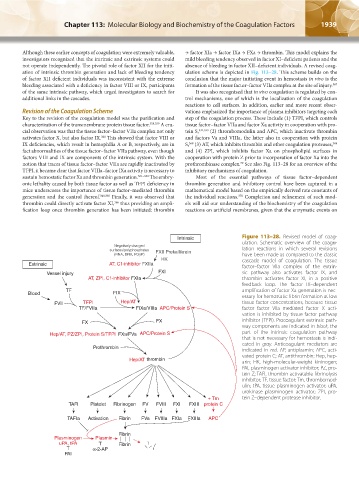
                  ation of intrinsic thrombin generation and lack of bleeding tendency   ulation scheme is depicted in Fig. 113–28. This scheme builds on the
                  of factor XII deficient individuals was inconsistent with the extreme   conclusion that the major initiating event in hemostasis in vivo is the
                  bleeding associated with a deficiency in factor VIII or IX, participants   formation of the tissue factor–factor VIIa complex at the site of injury. 367
                  of the same intrinsic pathway, which urged investigators to search for   It was also recognized that in vivo coagulation is regulated by con-
                  additional links in the cascades.                     trol mechanisms, one of which is the localization of the coagulation
                                                                        reactions to cell surfaces. In addition, earlier and more recent obser-
                  Revision of the Coagulation Scheme                    vations emphasized the importance of plasma inhibitors targeting each
                  Key to the revision of the coagulation model was the purification and   step of the coagulation process. These include (1) TFPI, which controls
                  characterization of the transmembrane protein tissue factor. 358,359  A cru-  tissue factor–factor VIIa and factor Xa activity in cooperation with pro-
                  cial observation was that the tissue factor–factor VIIa complex not only   tein S, 331,333  (2) thrombomodulin and APC, which inactivate thrombin
                                            360
                  activates factor X, but also factor IX.  This showed that factor VIII or   and factors Va and VIIIa, the latter also in cooperation with protein
                                                                                                                          369
                                                                          368
                  IX deficiencies, which result in hemophilia A or B, respectively, are in   S,  (3) AT, which inhibits thrombin and other coagulation proteases,
                  fact abnormalities of the tissue factor–factor VIIa pathway, even though   and (4) ZPI, which inhibits factor Xa on phospholipid surfaces in
                  factors VIII and IX are components of the intrinsic system. With the   cooperation with protein Z prior to incorporation of factor Xa into the
                                                                                           79
                  notion that traces of tissue factor–factor VIIa are rapidly inactivated by   prothrombinase complex.  See also Fig. 113–28 for an overview of the
                  TFPI, it became clear that factor VIIIa–factor IXa activity is necessary to   inhibitory mechanisms of coagulation.
                  sustain hemostatic factor Xa and thrombin generation. 361–364  The embry-  Most of the essential pathways of tissue factor–dependent
                  onic lethality caused by both tissue factor as well as TFPI deficiency in   thrombin generation and inhibitory control have been captured in a
                  mice underscores the importance of tissue factor–mediated thrombin   mathematical model based on the empirically derived rate constants of
                                                                                          370
                  generation and the control thereof. 340,365  Finally, it was observed that   the individual reactions.  Completion and refinement of such mod-
                  thrombin could directly activate factor XI,  thus providing an ampli-  els will aid our understanding of the biochemistry of the coagulation
                                                 366
                  fication loop once thrombin generation has been initiated: thrombin   reactions on artificial membranes, given that the enzymatic events on


                                                                      Intrinsic            Figure 113–28.  Revised model of coag-
                                                                                           ulation. Schematic overview of the coagu-
                                                 Negatively-charged
                                               surfaces/polyphosphates  FXII Prekallikrein  lation reactions in which several revisions
                                                 (RNA, DNA, PolyP)                         have been made as compared to the classic
                                                                HK                         cascade  model  of  coagulation.  The  tissue
                    Extrinsic                  AT, C1-inhibitor FXIIa                      factor–factor  VIIa complex of the extrin-
                          Vessel injury                        FXI                         sic pathway also activates factor IX, and
                                        AT, ZPI, C1-inhibitor FXIa                         thrombin activates factor XI, in a positive
                                                                                           feedback loop.  The factor IX–dependent
                                TF                                                         amplification of factor Xa generation is nec-
                    Blood                       FIX
                                                                                           essary for hemostatic fibrin formation at low
                            FVII      TFPI         Hep/AT                                  tissue factor concentrations, because tissue
                                     TF/FVIIa           FIXa/VIIIa APC/Protein S           factor–factor  VIIa–mediated factor X acti-
                                                                                           vation is inhibited by tissue factor pathway
                                      FX                       FX                          inhibitor (TFPI). Procoagulant extrinsic path-
                                                                                           way components are indicated in black, the
                           Hep/AT, PZ/ZPI, Protein S/TFPI  FXa/FVa APC/Protein S           part of the intrinsic coagulation pathway
                                                                                           that is not necessary for hemostasis is indi-
                                                                                           cated in  gray. Anticoagulant mediators are
                                         Prothrombin                                       indicated in  red. AP, antiplasmin;  APC, acti-
                                                                                           vated protein C; AT, antithrombin; Hep, hep-
                                                      Hep/AT  thrombin                     arin;  HK,  high-molecular-weight  kininogen;
                                                                                           PAI, plasminogen activator inhibitor; PZ, pro-
                                                                                           tein Z; TAFI, thrombin-activatable fibrinolysis
                                                                                           inhibitor; TF, tissue factor; Tm, thrombomod-
                                                                                           ulin; tPA, tissue plasminogen activator; uPA,
                                                                                           urokinase plasminogen activator; ZPI, pro-
                                                                                + Tm       tein Z–dependent protease inhibitor.
                                 TAFI    Platelet  Fibrinogen  FV  FVIII  FXI  FXIII protein C

                                 TAFIa  Activation  Fibrin  FVa  FVIIIa  FXIa  FXIIIa  APC


                                                  Fibrin
                             Plasminogen  Plasmin
                              uPA, tPA     T      Fibrin
                                 T       α-2-AP
                                PAI


          Kaushansky_chapter 113_p1915-1948.indd   1939                                                                 9/21/15   2:40 PM

