


Page 1963 - Williams Hematology ( PDFDrive )
P. 1963
1938           Part XII:  Hemostasis and Thrombosis                                                                                        Chapter 113:  Molecular Biology and Biochemistry of the Coagulation Factors           1939


               PROTEIN Z/PROTEIN Z–DEPENDENT PROTEASE                 the other Gla-containing coagulation proteins. There is an alternative
               INHIBITOR                                              exon that codes for a unique peptide of 22 amino acids in the prepro
                                                                      leader sequence. The gene is transcribed into a 1.6-kb mRNA.
               ZPI is a serine protease inhibitor (Mr ≈72,000; SERPINA10 in the sys-  Several mutations and polymorphisms have been described for the
               tematic nomenclature) that inhibits coagulation factors Xa and XIa. ZPI   gene encoding ZPI,  but the association between such gene variations
                                                                                    351
               circulates in plasma at 60 nM with a half-life of 60 hours (see Table    and risk of venous thrombosis has not been established with certainty. 352
                     343
               113–1).  The ZPI-dependent inhibition of factor Xa is enhanced in   The  human gene  mutation  database  lists  nine  loss-of-function
                                  79
               the presence of protein Z.  Protein Z is a vitamin K–dependent plasma   mutations in the protein Z gene. The relationship between these muta-
               GP (Mr ≈62,000) that circulates at 40 nM (see Table  113–1). In normal   tions and disease is uncertain at best, but a relationship with ischemic
               plasma, which has a molar excess of ZPI over protein Z, all protein Z   stroke and recurrent fetal loss cannot be excluded. 353–355
               circulates in complex with ZPI. 344
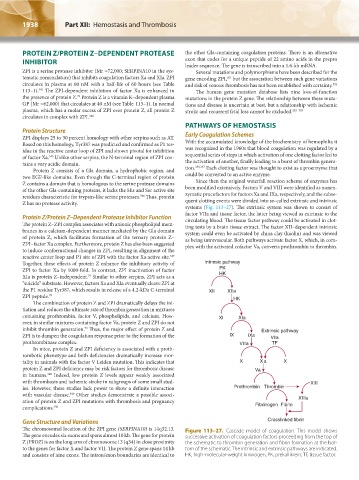
                                                                      PATHWAYS OF HEMOSTASIS
               Protein Structure
               ZPI displays 25 to 30 percent homology with other serpins such as AT.   Early Coagulation Schemes
               Based on this homology, Tyr387 was predicted and confirmed as P1 res-  With the accumulated knowledge of the biochemistry of hemophilia it
               idue in the reactive center loop of ZPI and shown pivotal for inhibition   was recognized in the 1960s that blood coagulation was regulated by a
                        345
               of factor Xa.  Unlike other serpins, the N-terminal region of ZPI con-  sequential series of steps in which activation of one clotting factor led to
               tains a very acidic domain.                            the activation of another, finally leading to a burst of thrombin genera-
                                                                         356,357
                   Protein Z consists of a Gla domain, a hydrophobic region, and   tion.   Each clotting factor was thought to exist as a proenzyme that
               two EGF-like domains. Even though the C-terminal region of protein   could be converted to an active enzyme.
               Z contains a domain that is homologous to the serine protease domains   Since then the original waterfall reaction scheme of enzymes has
               of the other Gla-containing proteins, it lacks the His and Ser active site   been modified extensively. Factors V and VIII were identified as nonen-
               residues characteristic for trypsin-like serine proteases.  Thus, protein   zymatic procofactors for factors Xa and IXa, respectively, and the subse-
                                                       346
               Z has no protease activity.                            quent clotting events were divided into so-called extrinsic and intrinsic
                                                                      systems (Fig. 113–27). The extrinsic system was shown to consist of
                                                                      factor VIIa and tissue factor, the latter being viewed as extrinsic to the
               Protein Z/Protein Z–Dependent Protease Inhibitor Function  circulating blood. The tissue factor pathway could be activated in clot-
               The protein Z–ZPI complex associates with anionic phospholipid mem-  ting tests by a brain tissue extract. The factor XII–dependent intrinsic
               branes in a calcium-dependent manner mediated by the Gla domain   system could even be activated by china clay (kaolin) and was viewed
               of  protein Z, which facilitates formation of the ternary protein Z–  as being intravascular. Both pathways activate factor X, which, in com-
               ZPI–factor Xa complex. Furthermore, protein Z has also been suggested   plex with the activated cofactor Va, converts prothrombin to thrombin.
               to induce conformational changes in ZPI, resulting in alignment of the
               reactive center loop and P1 site of ZPI with the factor Xa active site.
                                                                 347
               Together, these effects of protein Z enhance the inhibitory activity of   Intrinsic pathway
               ZPI to factor Xa by 1000-fold. In contrast, ZPI inactivation of factor   PK
                                     79
               XIa is protein Z–independent.  Similar to other serpins, ZPI acts as a   HK
               “suicide” substrate. However, factors Xa and XIa eventually cleave ZPI at
               the P1 residue Tyr387, which results in release of a 4.2-kDa C-terminal   XII  XIIa
               ZPI peptide. 79                                                        HK
                   The combination of protein Z and ZPI dramatically delays the ini-
               tiation and reduces the ultimate rate of thrombin generation in mixtures
               containing prothrombin, factor V, phospholipids, and calcium. How-  XI   XIa
               ever, in similar mixtures containing factor Va, protein Z and ZPI do not
                                    79
               inhibit thrombin generation.  Thus, the major effect of protein Z and            Extrinsic pathway
               ZPI is to dampen the coagulation response prior to the formation of the   IX  IXa   Vlla
               prothrombinase complex.                                                  Vllla      TF
                   In mice, protein Z and ZPI deficiency is associated with a proth-
               rombotic phenotype and both deficiencies dramatically increase mor-
               tality in animals with the factor V Leiden mutation. This indicates that   X    X a     X
               protein Z and ZPI deficiency may be risk factors for thrombotic disease       Va
                        348
               in humans.  Indeed, low protein Z levels appear weakly associated
               with thrombosis and ischemic stroke in subgroups of some small stud-                             XIII
               ies. However, these studies lack power to show a definite interaction   Prothrombin Thrombin
               with vascular disease.  Other studies demonstrate a possible associ-
                               349
               ation of protein Z and ZPI mutations with thrombosis and pregnancy                           XIIIa
               complications. 350                                                            Fibrinogen Fibrin

               Gene Structure and Variations                                                      Crosslinked fibrin
               The chromosomal location of the ZPI gene (SERPINA10) is 14q32.13.   Figure 113–27.  Cascade model of coagulation. This model shows
               The gene encodes six exons and spans almost 10 kb. The gene for protein   successive activation of coagulation factors proceeding from the top of
               Z (PROZ) is on the long arm of chromosome 13 (q34) in close proximity   the schematic to thrombin generation and fibrin formation at the bot-
               to the genes for factor X and factor VII. The protein Z gene spans 14 kb   tom of the schematic. The intrinsic and extrinsic pathways are indicated.
               and consists of nine exons. The intron/exon boundaries are identical to   HK, high-molecular-weight kininogen; PK, prekallikrein; TF, tissue factor.


          Kaushansky_chapter 113_p1915-1948.indd   1938                                                                 9/21/15   2:40 PM

