


Page 1961 - Williams Hematology ( PDFDrive )
P. 1961
1936           Part XII:  Hemostasis and Thrombosis                                                                                        Chapter 113:  Molecular Biology and Biochemistry of the Coagulation Factors           1937


                   In total, 19 SNPs have been identified in the gene encoding TAFI,   N-glycosylation  sites,  with  three  in  the carbohydrate-rich  domain
               of which six are in the coding region. Of the latter SNPs, two lead to an   (Asn96, Asn135, Asn155) and one in the serine protease-binding region
               amino acid substitution: an Ala/Thr substitution at position 147 and   (Asn192).
               a Thr/Ile substitution at position 325.  There appears to be a strong
                                           317
               correlation between plasma levels of TAFI and polymorphisms in the   Antithrombin Function
               promoter and 3′-region, but their clinical significance is unclear.  The primary proteases targeted by AT are thrombin, factor Xa, and
                   Epidemiologic studies have indicated that elevated TAFI levels   factor IXa. In addition, AT also inhibits factors XIa and XIIa, as well
               are correlated with an increased risk of venous thrombosis, albeit that   as tissue factor–factor VIIa; however, the latter is only inhibited in the
               methods to quantify TAFI or TAFIa have limitations. 318  presence of heparin.
                                                                          Similar to other serpins, AT acts as a “suicide” substrate for its tar-
                  INHIBITORS OF COAGULATION:                          get proteases. These cleave at site Arg393 in the reactive center loop of
                                                                      AT, upon which AT is, unlike normal substrates, not released, but forms
               ANTITHROMBIN, TISSUE FACTOR                            a 1:1 covalent complex with the protease, thereby blocking the active
               PATHWAY INHIBITOR, AND PROTEIN Z/                      site. This complex is facilitated by a conformational change of the reac-
                                                                      tive center loop that folds into the N-terminal region of AT. By doing so,
               PROTEIN Z–DEPENDENT PROTEASE                           the covalently attached protease is dragged along, resulting in distortion
               INHIBITOR                                              of its serine protease domain and effectively converting the protease
                                                                      back into a zymogen-like state.
                                                                                            320
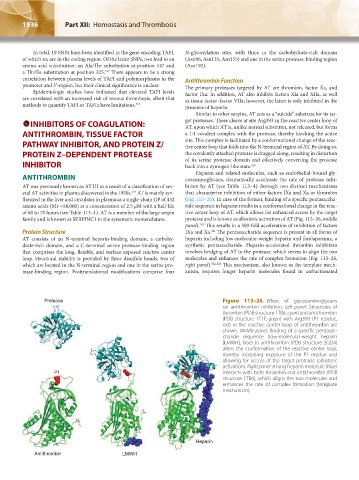
                                                                          Heparin and related molecules, such as endothelial-bound gly-
               ANTITHROMBIN                                           cosaminoglycans, dramatically accelerate the rate of protease inhi-
               AT was previously known as AT III as a result of a classification of sev-  bition by AT (see Table  113–4) through two distinct mechanisms
               eral AT activities in plasma discovered in the 1950s.  AT is mainly syn-  that  characterize inhibition of either factors IXa and Xa or thrombin
                                                    319
               thesized in the liver and circulates in plasma as a single-chain GP of 432   (Fig. 113–26). In case of the former, binding of a specific pentasaccha-
               amino acids (Mr ≈58,000) at a concentration of 2.5 μM with a half-life   ride sequence in heparin results in a conformational change in the reac-
               of 60 to 70 hours (see Table  113–1). AT is a member of the large serpin   tive center loop of AT, which allows for enhanced access by the target
               family and is known as SERPINC1 in the systematic nomenclature.  protease and is known as allosteric activation of AT (Fig. 113–26, middle
                                                                           320
                                                                      panel).  This results in a 500-fold acceleration of inhibition of factors
               Protein Structure                                      IXa and Xa.  The pentasaccharide sequence is present in all forms of
                                                                               321
               AT consists of an N-terminal heparin-binding domain, a carbohy-  heparin including low-molecular-weight heparin and fondaparinux, a
               drate-rich domain, and a C-terminal serine protease-binding region   synthetic pentasaccharide. Heparin-accelerated thrombin inhibition
               that comprises the long, flexible, and surface-exposed reactive center   involves bridging of AT to the protease, which serves to align the two
               loop. Structural stability is provided by three disulfide bonds, two of   molecules and enhances the rate of complex formation (Fig. 113–26,
               which are located in the N-terminal region and one in the serine pro-  right panel). 322,323  This mechanism, also known as the template mech-
               tease-binding region. Posttranslational modifications comprise four   anism, requires longer heparin molecules found in unfractionated


                       Protease                                                    Figure 113–26.  Effect of glycosaminoglycans
                                                                                   on antithrombin inhibition.  Left panel: Structures of
                                                                                   thrombin (PDB structure 1TB6, cyan) and antithrombin
                                                                                   (PDB structure 1T1F, green) with Arg393 (P1 residue,
                                                                                   red) in  the reactive center  loop  of antithrombin  are
                                                                                   shown. Middle panel: Binding of a specific pentasac-
                                                                                   charide sequence (low-molecular-weight heparin
                                                                                   [LMWH], blue) to antithrombin (PDB structure 2GD4)
                                                                                   alters the conformation of the reactive center loop,
                                                                                   thereby increasing exposure of the P1 residue and
                                                                                   allowing for access of the target protease (allosteric
                                                                                   activation). Right panel: A long heparin molecule (blue)
                          P1                                                       interacts with both thrombin and antithrombin (PDB
                                                                                   structure 1TB6), which aligns the two molecules and
                                                                                   enhances  the  rate  of  complex  formation  (template
                                                                                   mechanism).


                                                                          Heparin

                   Antithrombin                  LMWH


          Kaushansky_chapter 113_p1915-1948.indd   1936                                                                 9/21/15   2:40 PM

