


Page 1965 - Williams Hematology ( PDFDrive )
P. 1965
1940           Part XII:  Hemostasis and Thrombosis                                                                                        Chapter 113:  Molecular Biology and Biochemistry of the Coagulation Factors           1941


               cellular membranes under (reduced) flow are still complicated, which   that “prime” the clotting system for a subsequent burst of thrombin
               hampers their incorporation into a mathematical model. 370  generation. Experiments using tissue factor–activated whole blood
                                                                      and cell-based systems have shown that platelets can be activated by
               A Cell-Based Scheme of Coagulation                     thrombin that is generated by direct tissue factor–factor VIIa activation
               The goal of coagulation is to produce a fibrin clot that seals the site of   of factor Xa. 371–373  The small amounts of factor Va required for proth-
               injury in the vessel wall. This process is initiated when tissue factor–  rombinase assembly are likely provided by activated platelets, by factor
               bearing cells are exposed to blood at the damaged site. Tissue factor is   Xa activation, or potentially by noncoagulation proteases secreted by
               anchored to cells via a transmembrane domain and acts as a receptor for   the tissue factor–bearing cells. 335,374,375
               plasma factor VII. Both trace amounts of factor VIIa as well as zymogen   The small amounts of thrombin generated are capable of accom-
               factor VII that is rapidly converted to factor VIIa by factor Xa and/or   plishing the following: (1) activating platelets; (2) activating factor V;
               autoactivation bind to tissue factor. Tissue factor is expressed around   (3) activating factor VIII and dissociating factor VIII from VWF; and
               vessels and in the epithelium, where it forms a “hemostatic envelope.”   (4) activating factor XI (see Fig. 113–29). 366,372,373  The activity of the fac-
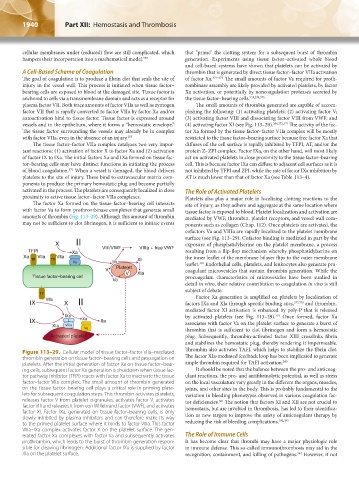
               The tissue factor surrounding the vessels may already be in complex   tor Xa formed by the tissue factor–factor VIIa complex will be mostly
               with factor VIIa, even in the absence of an injury. 253  restricted to the tissue factor–bearing surface because free factor Xa that
                   The tissue factor–factor VIIa complex catalyzes two very impor-  diffuses off the cell surface is rapidly inhibited by TFPI, AT, and/or the
               tant reactions: (1) activation of factor X to factor Xa and (2) activation   protein Z–ZPI complex. Factor IXa, on the other hand, will most likely
               of factor IX to IXa. The initial factors Xa and IXa formed on tissue fac-  act on activated platelets in close proximity to the tissue factor–bearing
               tor–bearing cells may have distinct functions in initiating the process   cell. This is because factor IXa can diffuse to adjacent cell surfaces as it is
                               371
               of blood coagulation.  When a vessel is damaged, the blood delivers   not inhibited by TFPI and ZPI, while the rate of factor IXa inhibition by
               platelets to the site of injury. These bind to extravascular matrix com-  AT is much lower than that of factor Xa (see Table  113–4).
               ponents to produce the primary hemostatic plug and become partially
               activated in the process. The platelets are consequently localized in close   The Role of Activated Platelets
               proximity to active tissue factor–factor VIIa complexes.  Platelets also play a major role in localizing clotting reactions to the
                   The factor Xa formed on the tissue factor–bearing cell interacts   site of injury, as they adhere and aggregate at the same location where
               with factor Va to form prothrombinase complexes that generate small   tissue factor is exposed to blood. Platelet localization and activation are
               amounts of thrombin (Fig. 113–29). Although this amount of thrombin   mediated by VWF, thrombin, platelet receptors, and vessel wall com-
               may not be sufficient to clot fibrinogen, it is sufficient to initiate events   ponents such as collagen (Chap. 112). Once platelets are activated, the
                                                                      cofactors Va and VIIIa are rapidly localized to the platelet membrane
                          X      II                                   surface (see Fig. 113–29). Cofactor binding is mediated in part by the
                                                                      exposure of phosphatidylserine on the platelet membrane, a process
                 TFPI           Xa        VIII/VWF     VIIIa + free VWF  resulting from a flip-flop mechanism whereby phosphatidylserine on
                Xa  Vlla   Vlla                                       the inner leaflet of the membrane bilayer flips to the outer membrane
                  TF     TF                           Xl
                                Va            IIa                     leaflet.  Endothelial cells, platelets, and leukocytes also generate pro-
                                                                           376
                                           V   Platelet               coagulant microvesicles that sustain thrombin generation. While the
                   Tissue factor–bearing cell     V   Xla             procoagulant characteristics of microvesicles have been studied in
                                              Va
                                                                      detail in vitro, their relative contribution to coagulation in vivo is still
                                                                      subject of debate.
                     TF                                                   Factor Xa generation is amplified on platelets by localization of
                       Vlla
                  IX         X    II                                  factors IXa and XIa through specific binding sites, 377,378  and thrombin-
               F                                                      mediated factor XI activation is enhanced by poly-P that is released
                              IXa                                     by activated platelets (see Fig. 113–29).  Once formed, factor Xa
                                                                                                    379
                  IX               Xa     IIa                         associates with factor Va on the platelet surface to generate a burst of
                         XIa  VIIIa
                                    Va                                thrombin that is sufficient to clot fibrinogen and form a hemostatic
                         Activated platelet                           plug. Subsequently, thrombin-activated factor XIII crosslinks fibrin
                                                                      and stabilizes the hemostatic plug, thereby rendering it impermeable.
                                                                      Thrombin also activates TAFI, which helps to stabilize the fibrin clot.
               Figure 113–29.  Cellular model of tissue factor–factor VIIa–mediated
               thrombin generation on tissue factor–bearing cells and propagation on   The factor XIa-mediated feedback loop has been implicated to generate
               platelets. After the initial generation of factor Xa on tissue factor–bear-  ample thrombin required for TAFI activation. 380
               ing cells, subsequent factor Xa generation is shutdown when tissue fac-  It should be noted that the balance between the pro- and anticoag-
               tor pathway inhibitor (TFPI) reacts with factor Xa to inactivate the tissue   ulant reactions, the pro- and antifibrinolytic potential, as well as stress
               factor–factor VIIa complex. The small amount of thrombin generated   on the local vasculature vary greatly in the different the organs, muscles,
               on the tissue factor–bearing cell plays a critical role in priming plate-  joints, and other sites in the body. This is probably fundamental to the
               lets for subsequent coagulation steps. This thrombin activates platelets,   variation in bleeding phenotypes observed in various coagulation fac-
               releases factor V from platelet α-granules, activates factor V, activates   tor deficiencies.  The notion that factors XI and XII are not crucial to
                                                                                 381
               factor VIII and releases it from von Willebrand factor (VWF), and activates   hemostasis, but are involved in thrombosis, has led to their identifica-
               factor  XI. Factor  IXa, generated on tissue  factor–bearing cells, is only   tion as new targets to improve the safety of anticoagulant therapy by
               slowly inhibited by plasma inhibitors and can therefore make its way                  382,383
               to the primed platelet surface where it binds to factor VIIIa. This factor   reducing the risk of bleeding complications.
               VIIIa–IXa complex activates factor X on the platelet surface. The gen-
               erated factor Xa complexes with factor Va and subsequently activates   The Role of Immune Cells
               prothrombin, which leads to the burst of thrombin generation respon-  It has become clear that thrombi may have a major physiologic role
               sible for cleaving fibrinogen. Additional factor IXa is supplied by factor   in immune defense. This so-called immunothrombosis may aid in the
               XIa on the platelet surface.                           recognition, containment, and killing of pathogens.  However, if not
                                                                                                            384


          Kaushansky_chapter 113_p1915-1948.indd   1940                                                                 9/21/15   2:40 PM

