


Page 2020 - Williams Hematology ( PDFDrive )
P. 2020
1994  Part XII:  Hemostasis and Thrombosis                                Chapter 117:  Thrombocytopenia             1995


                     ex vivo platelet clumping is shown in Chap. 1, Fig. 1–6H, accompanied by   of platelets from patients with type I Glanzmann thrombasthenia or in
                  platelet–neutrophil satellitism (see “Platelet Satellitism” below).  the presence of neutrophils from patients with congenital absence of
                                                                              32
                                                                        FcγRIII.  Typically, the platelets form a rosette around the periphery of
                  ANTIBODY-INDUCED PLATELET                             leukocytes. Neutrophils are most frequently involved, but the phenom-
                                                                                                             37,38
                  AGGLUTINATION                                         enon also is occasionally observed with monocytes.   These antibodies
                                                                        also are naturally occurring, and their presence does not clearly correlate
                  Platelet agglutination ex vivo can be induced by antiplatelet antibodies   with any specific clinical situation, disease, or drug. As with the anti-
                  or by activation of the platelets during collection. The responsible anti-  bodies that induce only platelet clumping, exposure of a cryptic antigen
                  bodies do not appear to be associated with a pathologic process, as they   on EDTA-treated platelets and leukocytes may trigger this phenomenon.
                  are found in normal individuals. One hypothesis put forth to explain
                  their presence is that the antibodies are responsible for clearing aged   ANTIPHOSPHOLIPID ANTIBODIES
                  and damaged platelets. Most antibodies implicated in pseudothrombo-
                  cytopenia recognize platelet membrane glycoproteins that are modified   Some antiplatelet antibodies from patients with pseudothrombocytope-
                  to expose new epitopes when calcium is chelated. Typically, the artifact   nia crossreact with negatively charged phospholipids and may exhibit
                                                                                         30
                  is most prominent in the presence of EDTA, but other anticoagulants   anticardiolipin activity.  The sera of these patients lose their ability to
                  can also cause platelet clumping, including sodium citrate, sodium   clump platelets when adsorbed onto either cardiolipin or activated nor-
                  oxalate, acid citrate dextrose, and heparin. The antibodies usually are   mal platelets, supporting the hypothesis that antibody subpopulations
                  of the immunoglobulin (Ig) G type; IgM and IgA antibodies also have   directed against negatively charged phospholipids can bind to antigens
                  been described. 29–31  Most antibodies react at room temperature; thus,   modified by EDTA on the platelet membrane. Another possibility is that
                  the reaction can be prevented by keeping the blood sample at 37°C. In   the antigens in this case are negatively charged phospholipids on the
                  20 percent of cases, however, the antibodies, usually of the IgM type, are   surface of platelets.
                  reactive at both 22°C and 37°C.  Clumping usually is evident within 60
                                        30
                  minutes after the blood is drawn, but may require incubations of 2 to   INTEGRIN α β  ANTAGONISTS
                                                                                     IIB 3
                  3 hours. Agglutination can be reproduced by incubating plasma from   Thrombocytopenia has been described in patients suffering from acute
                  patients with pseudothrombocytopenia with blood from normal indi-  coronary syndromes treated with the abciximab and other integrin
                  viduals in the presence of EDTA.                      α β  antagonists. 39–41  Abciximab is associated with both pseudothrom-
                                                                         IIb 3
                     In most cases, the antibodies are directed against the integrin   bocytopenia and true thrombocytopenia. The mechanism for platelet
                  α β  (also termed glycoprotein [GP] IIbIIIa), a conclusion supported   clumping with abciximab is unknown; the drug itself likely is not cross-
                   IIb 3
                  by the observation that platelets from patients with Glanzmann throm-  linking the platelets because it is monovalent. More likely, other agglu-
                  basthenia, who lack the integrin α β  complex, fail to agglutinate in the   tinins bind integrin α β  at new epitopes induced by the combination
                                          IIb 3
                                                                                        IIb 3
                  presence of patient sera. 32–35  Moreover, pretreatment of fresh blood with   of abciximab binding and calcium chelation. True abciximab-induced
                  anti–integrin α β  dramatically reduces EDTA-induced platelet agglu-  thrombocytopenia occurs in approximately 0.3 to 1 percent of patients
                             IIb 3
                        36
                  tination.  The responsible epitope normally is cryptic and located in the   treated with the drug.  The mechanism is incompletely understood,
                                                                                         42
                  integrin α  subunit. Low temperature and calcium chelation combine   but likely includes reaction of preformed antibodies with a neoepitope
                         IIb
                  to change the conformation of integrin α β  and expose the epitope. 33  expressed after binding of abciximab to integrin α β  (ligand-induced
                                               IIb 3
                                                                                                             IIb 3
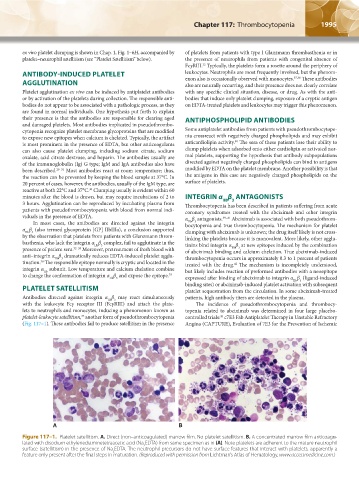
                  PLATELET SATELLITISM                                  binding sites) or abciximab-induced platelet activation with subsequent
                                                                        platelet sequestration from the circulation. In some abciximab-treated
                  Antibodies directed against integrin  α β  may react simultaneously   patients, high antibody titers are detected in the plasma.
                                              IIb 3
                  with the leukocyte Fcγ receptor III (FcγRIII) and attach the plate-  The incidence of pseudothrombocytopenia and thrombocy-
                  lets to neutrophils and monocytes, inducing a phenomenon known as     topenia related to abciximab  was determined  in  four  large placebo-
                  platelet-leukocyte satellitism,  another form of pseudothrombocytopenia   controlled trials:  c7E3 Fab Antiplatelet Therapy in Unstable Refractory
                                                                                    40
                                      32
                  (Fig. 117–1). These antibodies fail to produce satellitism in the presence   Angina (CAPTURE), Evaluation of 7E3 for the Prevention of Ischemic


                            A                                         B
                  Figure 117–1.  Platelet satellitism. A. Direct (non–anticoagulated) marrow film. No platelet satellitism. B. A concentrated marrow film anticoagu-
                  lated with disodium ethylenediaminetetraacetic acid (Na EDTA) from same specimen as in (A). Note platelets are adherent to the mature neutrophil
                                                          2
                  surface (satellitism) in the presence of Na EDTA. The neutrophil precursors do not have surface features that interact with platelets, apparently a
                                                2
                  feature only present after the final steps in maturation. (Reproduced with permission from Lichtman’s Atlas of Hematology, www.accessmedicine.com.)


          Kaushansky_chapter 117_p1993-2024.indd   1995                                                                 9/21/15   2:31 PM

