


Page 2265 - Williams Hematology ( PDFDrive )
P. 2265
2240           Part XII:  Hemostasis and Thrombosis                                                                                                                      Chapter 131:  The Antiphospholipid Syndrome             2241


               CUTANEOUS MANIFESTATIONS                               majority of patients with CAPS (see “Catastrophic Antiphospholipid
               The cutaneous manifestations of APS may comprise the first signs of   Syndrome” above) have dyspnea, and most of these individuals have
                                                                           218
               APS in some patients. 198,199  Livedo reticularis is relatively common,   ARDS.
               occurring in 24 percent of a series of 1000 aPL patients,  and occa-
                                                         200
               sionally presents in a necrosing form.  Noninflammatory vascular   ABDOMINAL MANIFESTATIONS
                                            201
               thrombosis is the most frequent histopathologic feature. Necrotizing
               vasculitis, livedoid vasculitis,  thrombophlebitis,  cutaneous  ulceration   The liver is the most frequently affected abdominal organ in APS, with
                                                                                                                       219
               and necrosis, erythematous macules, purpura, ecchymoses, painful skin   occlusion of hepatic vessels, including those supplying the biliary tree.
               nodules,  and subungual splinter hemorrhages, anetoderma (macular   aPL antibody levels frequently are elevated in patients with chronic liver
               atrophy), discoid lupus erythematosus, and cutaneous T-cell lymphoma   disease of various causes. In one prospective study of patients with liver
               have all been reported.                                disease, approximately half of patients with alcoholic liver disease and
                                                                      one-third of patients with chronic hepatitis C virus had elevated aPL
                                                                      antibody levels. The frequency was even higher in patients with more
               CORONARY ARTERY DISEASE                                severe cirrhosis.  A review reported that approximately 20 percent of
                                                                                  220
               aPL antibodies are associated with increased susceptibility to coro-  patients with chronic hepatitis B and hepatitis C had aPL antibodies,
                                                                                                    221
                              202
               nary artery disease,  particularly premature atherosclerosis. 203,204  APS   most of which were cofactor independent.  Some patients with hepati-
               should  be  considered  in patients  who  lack  the  usual  risk  factors  for   tis C present with true autoimmune aPL antibodies, the most common
               coronary artery disease and in patients with evidence for thrombotic   features reported being intraabdominal thrombosis and myocardial
               or embolic coronary artery occlusion that lack angiographic evidence   infarction. 222
               of atherosclerotic disease. aPL antibodies appear to be a risk factor   Reported gastrointestinal manifestations of APS also include
               for adverse outcomes following all coronary revascularization proce-  esophageal necrosis with perforation, intestinal ischemia and infarc-
                                                                                                                       223
               dures,  and for restenosis after percutaneous transluminal coronary   tion, pancreatitis, and colonic ulceration. Primary biliary cirrhosis,
                    202
               angioplasty. 205,206  An ultrasound study of carotid arteries provided evi-  acute acalculous cholecystitis with gallbladder necrosis, 224,225  and giant
                                                                                                     226
               dence supporting an association of aPL antibodies with premature ath-  gastric ulceration are associated with APS.  APS has been reported in
                                                                                                                  227
               erosclerosis; relatively young primary APS patients (mean age: 37 ± 11   patients with mesenteric inflammatory venoocclusive disease  and in
               years) had significantly increased intimal medial thickness compared to   patients with mesenteric and portal venous obstruction. 228
               control non-APS groups. 207
                                                                      THROMBOCYTOPENIA
               VALVULAR HEART DISEASE                                 Approximately  20  to  40  percent  of  patients  with  APS  have  varying
               Approximately 35 percent of patients with primary APS have cardiac   degrees of thrombocytopenia. The decrease in platelet count is gener-
               valvular abnormalities detected by echocardiography.  In one study,   ally mild or moderate and is rarely significant enough to cause bleed-
                                                       208
               approximately 20 percent of cardiac patients with valvular heart dis-  ing  complications or affect  anticoagulant  therapy. 229,230   The  majority
               ease had evidence for aPL antibodies compared with approximately   of patients with APS and thrombocytopenia have antibodies against
               10 percent of matched control subjects.  Valvulopathy includes leaf-  α β  integrin and/or glycoprotein Ib-IX complex.  Patients present-
                                            209
                                                                                                           231
                                                                       IIb 3
               let thickening, vegetations,  regurgitation, and stenosis.  The mitral   ing with immune thrombocytopenic purpura frequently have elevated
                                                        210
               valve is mainly affected, followed by the aortic valve.  Histologically,   aPL antibodies, and these patients are more prone to thrombosis.
                                                      211
                                                                                                                       232
               APS valvular lesions consist mainly of superficial or intravalvular fibrin   aPL antibodies and antibodies against platelet membrane glycoprotein
               deposits in association with variable degrees of vascular proliferation,   were  present  simultaneously  in  approximately  70  percent  of  patients
               fibroblast  influx,  fibrosis,  and calcification.  These  can  result  in  valve   with immune-mediated thrombocytopenia.  Thrombocytopenia itself
                                                                                                     233
               thickening, fusion, and rigidity, and lead to functional abnormalities.    is not protective against thrombosis in these patients. In a prospec-
                                                                 212
               Deposits of immunoglobulins, including aCL antibodies, and of com-  tive cohort study, 5-year thrombosis-free survival of aPL-positive and
               plement components are commonly found in the affected valves. 213  aPL-negative immune thrombocytopenic purpura patients were 39 per-
                                                                      cent and 98 percent, respectively. 234
               PERIPHERAL VASCULAR DISEASE
               Approximately one-third of patients with peripheral arterial disease   BLEEDING
               undergoing bypass grafting procedures had elevated aPL antibody lev-  The presence of a concurrent hemostasis defect needs to be con-
               els (mostly aCL antibodies).  Intraarterial thromboembolic events are   sidered when patients with APS exhibit a bleeding tendency (Table
                                    214
               common at presentation of these patients and may complicate surgical   131–5). Acquired hypoprothrombinemia with severe bleeding has
               management. However, these patients did not have an increased risk for   been reported. 235,236  This diagnosis may be missed when coagulation
               reocclusion, a finding that was attributable to the use of anticoagulant   abnormalities are attributed only to the LA effect, so a specific assay
               therapy.
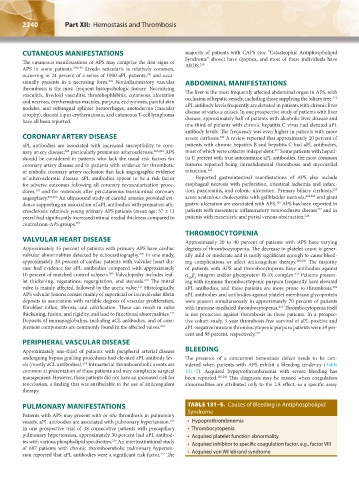
               PULMONARY MANIFESTATIONS                                TABLE 131–5.  Causes of Bleeding in Antiphospholipid
               Patients with APS may present with in situ thrombosis in pulmonary   Syndrome
               vessels. aPL antibodies are associated with pulmonary hypertension.    •   Hypoprothrombinemia
                                                                 215
               In one prospective trial of 38 consecutive patients with precapillary   •   Thrombocytopenia
               pulmonary hypertension, approximately 30 percent had aPL antibod-  •   Acquired platelet function abnormality
               ies with various phospholipid specificities.  An interinstitutional study   •   Acquired inhibitor to specific coagulation factor, e.g., factor VIII
                                             216
               of  687 patients  with  chronic  thromboembolic  pulmonary  hyperten-
               sion reported that aPL antibodies were a significant risk factor.  The   •  Acquired von Willebrand syndrome
                                                              217


          Kaushansky_chapter 131_p2233-2252.indd   2240                                                                 9/18/15   5:10 PM

