


Page 306 - Williams Hematology ( PDFDrive )
P. 306
280  Part IV:  Molecular and Cellular Hematology                   Chapter 19:  The Inflammatory Response             281


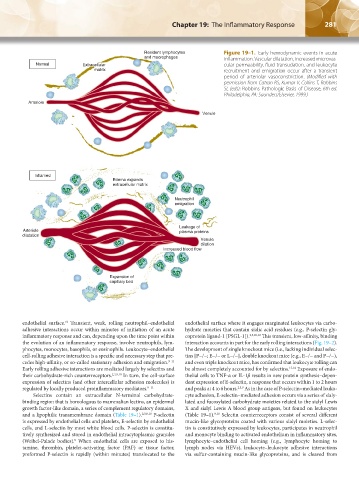
                                                           Resident lymphocytes      Figure 19–1.  Early hemodynamic events in acute
                                                           and macrophages           inflammation. Vascular dilatation, increased microvas-
                      Normal          Extracellular                                  cular permeability, fluid transudation, and leukocyte
                                          matrix                                     recruitment and emigration occur after a transient
                                                                                     period of arteriolar vasoconstriction.  (Modified with
                                                                                     permission from Cotran RS, Kumar V, Collins T, Robbins
                                                                                     SL (eds): Robbins Pathologic Basis of Disease, 6th ed.
                                                                                     Philadelphia, PA: Saunders/Elsevier, 1999.)
                    Arteriole

                                                                              Venule


                      Inflamed
                                                Edema expands
                                                extracellular matrix

                                                                     Neutrophil
                                                                     emigration


                                                                      Leakage of
                  Arteriole                                           plasma proteins
                  dilatation
                                                                              Venule
                                                                              dilation
                                                                 Increased blood flow


                                               Expansion of
                                               capillary bed


                  endothelial surface.  Transient, weak, rolling neutrophil–endothelial   endothelial surface where it engages marginated leukocytes via carbo-
                                10
                  adhesive interactions occur within minutes of initiation of an acute   hydrate moieties that contain sialic acid residues (e.g., P-selectin gly-
                  inflammatory response and can, depending upon the time point within   coprotein ligand-1 [PSGL-1]). 2,3,10,12  This transient, low-affinity, binding
                  the evolution of an inflammatory response, involve neutrophils, lym-  interaction accounts in part for the early rolling interactions (Fig. 19–2).
                  phocytes, monocytes, basophils, or eosinophils. Leukocyte–endothelial   The development of single knockout mice (i.e., lacking individual selec-
                  cell-rolling adhesive interaction is a specific and necessary step that pre-  tins [P−/−; E−/− or L−/−], double knockout mice (e.g., E−/− and P−/−),
                  cedes high-affinity, or so-called stationary adhesion and emigration. 9–11    and even triple knockout mice, has confirmed that leukocyte rolling can
                  Early rolling adhesive interactions are mediated largely by selectins and   be almost completely accounted for by selectins. 13,14  Exposure of endo-
                  their carbohydrate-rich counterreceptors. 2,3,9,10  In turn, the cell-surface   thelial cells to TNF-α or IL-1β results in new protein synthesis–depen-
                  expression of selectins (and other intercellular adhesion molecules) is   dent expression of E-selectin, a response that occurs within 1 to 2 hours
                  regulated by locally produced proinflammatory mediators. 9–11  and peaks at 4 to 6 hours. 2,3,9  As in the case of P-selectin–mediated leuko-
                     Selectins contain an extracellular N-terminal carbohydrate-   cyte adhesion, E-selectin–mediated adhesion occurs via a series of sialy-
                  binding region that is homologous to mammalian lectins, an epidermal   lated and fucosylated carbohydrate moieties related to the sialyl Lewis
                  growth factor-like domain, a series of complement regulatory domains,   X and sialyl Lewis A blood group antigens, but found on leukocytes
                  and a lipophilic transmembrane domain (Table 19–1). 2,3,9,10  P-selectin   (Table   19–1).  Selectin counterreceptors consist of several different
                                                                                  9,10
                  is expressed by endothelial cells and platelets, E-selectin by endothelial   mucin-like glycoproteins coated with various sialyl moieties. L-selec-
                  cells, and L-selectin by most white blood cells. P-selectin is constitu-  tin is constitutively expressed by leukocytes, participates in neutrophil
                  tively synthesized and stored in endothelial intracytoplasmic granules     and monocyte binding to activated endothelium in inflammatory sites,
                  (Weibel-Palade  bodies).   When  endothelial  cells  are  exposed to  his-  lymphocyte–endothelial cell homing (e.g., lymphocyte homing to
                                   9
                  tamine, thrombin, platelet-activating factor (PAF) or tissue factor,   lymph nodes via HEVs), leukocyte–leukocyte adhesive interactions
                  preformed P-selectin is rapidly (within minutes) translocated to the   via sulfur-containing mucin-like glycoproteins, and is cleaved from


          Kaushansky_chapter 19_p0279-0292.indd   281                                                                   9/17/15   5:51 PM

