


Page 307 - Williams Hematology ( PDFDrive )
P. 307
282            Part IV:  Molecular and Cellular Hematology                                                                                                                     Chapter 19:  The Inflammatory Response              283


                TABLE 19–1.  Adhesion Molecules in Inflammation
                Family               Structure            Members               Tissue Distribution  Counterreceptor*
                Selectin             N-terminal lectin domain,  P-selectin      Endothelium, platelets  PSGL-1, SLe  glycoprotein
                                                                                                             x
                                     epidermal growth factor   E-selectin       Endothelium          PSGL-1, SLe  glycoprotein
                                                                                                             x
                                     domain, multiple comple-
                                     ment regulatory repeats,   L-selectin      Leukocytes           PNAds: GlyCAM-1, Mad-
                                     transmembrane, and                                              CAM-1, CD34
                                     short cytoplasmic tail
                Immunoglobulin       Multiple immunoglobulin  ICAM-1            Endothelium, other cells  CD11a/CD18
                superfamily          domains, transmembrane   ICAM-2                                 CD11b/CD18
                                     region and cytoplasmic
                                     tail                 ICAM-3
                                                          VCAM-1                Endothelium          VLA-4
                                                          CD31 (PECAM)          Endothelium          CD31
                Integrin (β ; leukocyte)  Heterodimers: distinct α   CD11a/CD18 (LFA-1)  Neutrophils, monocytes,   ICAM-1
                        2
                                     subunits with common β                     macrophages, and     ICAM-2
                                     subunits                                   lymphocytes
                                                                                                     ICAM-3
                                                          CD11b/CD18 (Mac-1)    Neutrophils, monocytes,   ICAM-1, iC3b, LPS, and
                                                                                and macrophages      fibronectin
                                                          VLA-4                 Monocytes and        VCAM-1 and fibronectin
                                                                                lymphocytes
               CD, cluster of differentiation; ICAM, intercellular adhesion molecule; LFA-1, leukocyte function-associated antigen-1; LPS, lipopolysaccharide;
               PECAM, platelet endothelial cell adhesion molecule; PSGL-1, P-selectin glycoprotein ligand-1; sLe , sialyl Lewis X; VCAM, vascular cell adhesion
                                                                                        x
               molecule; VLA, very-late antigen.
               *”Counterreceptor” refers to a complementary moiety to which a receptor specifically binds. For example, P-selectin binds to PSGL-1.


               cells by means of “sheddase” enzymes such as a disintegrin and metal-  low  cell-surface  densities.   ICAM-1  is  involved  in the  recruitment
                                                                                         2,3
               loproteinase (ADAM)-17 (TNF-α converting enzyme [TACE]) when   of all types of leukocytes and VCAM-1 is involved in the recruitment
               the leukocyte is activated (see Table  19–1).  The relevant mucin-like   of chronic inflammatory leukocytes (lymphocytes, monocytes, eos-
                                               3,15
               glycoprotein counter-receptors on HEVs are collectively referred to as   inophils, and basophils). 2,3,9  ICAM-1 binds to  β  (leukocyte) integ-
                                                                                                          2
               peripheral node addressins (PNAds) and include mucosal addressin   rins, which are heterodimeric structures that contain one species of α
               cell adhesion molecule (MadCAM)-1, GlyCAM-1, and CD34.  L-   chain (e.g., CD11a, CD11b, CD11c, CD11d) and a common β chain
                                                              3,15
               selectin shedding facilitates leukocyte emigration by allowing the weakly   (CD18).  VCAM-1 binds to β  integrins (e.g., very-late antigen [VLA]-
                                                                            16
                                                                                            1
               adherent white blood cell to detach from the endothelium. Low-affinity   4/α β ) (see Table  19–1).  Activated endothelial cells secrete PAF and
                                                                                        2,3
                                                                        4 1
               rolling adhesive interactions set the stage for β-integrin– and immuno-  CXCL8 (IL-8), which activate overlying selectin-bound leukocytes. 2,3,9,16
               globulin superfamily mediated high-affinity adhesive interactions and   Individual  leukocyte  CD11a/CD18  (LFA-1)  heterodimers  undergo  a
               leukocyte transmigration. 2,3,9                        transient conformational change and groups of CD11a/CD18 mol-
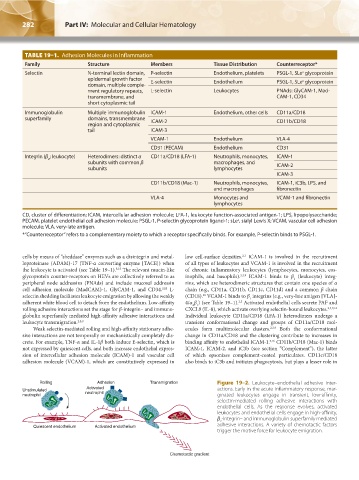
                   Weak selectin-mediated rolling and high-affinity stationary adhe-  ecules form multimolecular clusters. 2,3,9  Both the conformational
               sive interactions are not temporally or mechanistically completely dis-  change in CD11a/CD18 and the clustering contribute to increases in
               crete. For example, TNF-α and IL-1β both induce E-selectin, which is   binding affinity to endothelial ICAM-1.  CD11b/CD18 (Mac-1) binds
                                                                                                  3,16
               not expressed by quiescent cells, and both increase endothelial expres-  ICAM-1, ICAM-2, and iC3b (see section “Complement”), the latter
               sion of intercellular adhesion molecule (ICAM)-1 and vascular cell   of which opsonizes complement-coated particulates. CD11c/CD18
               adhesion  molecule  (VCAM)-1,  which  are  constitutively  expressed in   also binds to iC3b and initiates phagocytosis, but plays a lesser role in
                     Rolling            Adhesion          Transmigration         Figure 19–2.  Leukocyte–endothelial adhesive inter-
                                     Activated
               Unstimulated         neutrophil                                   actions. Early in the acute inflammatory response, mar-
               neutrophil                                                        ginated  leukocytes  engage  in transient,  low-affinity,
                                                                                 selectin-mediated rolling adhesive interactions with
                                                                                 endothelial cells. As the response evolves, activated
                                                                                 leukocytes and endothelial cells engage in high-affinity,
                                                                                 β -integrin– and immunoglobulin superfamily mediated
                                                                                  2
                                                                                 adhesive  interactions.  A  variety  of  chemotactic  factors
                   Quiescent endothelium  Activated endothelium
                                                                                 trigger the motive force for leukocyte emigration.


                                                                 Chemotactic gradient


          Kaushansky_chapter 19_p0279-0292.indd   282                                                                   9/17/15   5:51 PM

