


Page 309 - Williams Hematology ( PDFDrive )
P. 309
284            Part IV:  Molecular and Cellular Hematology                                                                                                                     Chapter 19:  The Inflammatory Response              285


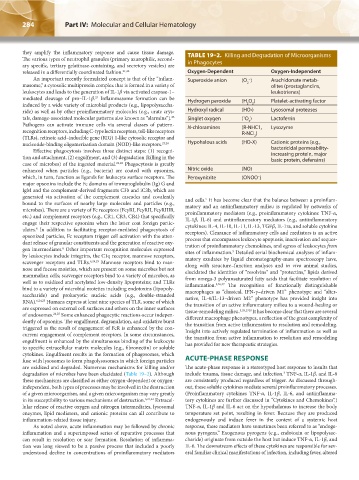
               they amplify the inflammatory response and cause tissue damage.     TABLE 19–2.  Killing and Degradation of Microorganisms
               The various types of neutrophil granules (primary azurophilic, second-
               ary specific, tertiary gelatinase-containing, and secretory vesicles) are   in Phagocytes
               released in a differentially coordinated fashion. 21,22  Oxygen-Dependent           Oxygen-Independent
                   An important recently formulated concept is that of the “inflam-  Superoxide anion  (O )  Arachidonate metab-
                                                                                           −
               masome,” a cytosolic multiprotein complex that is formed in a variety of    2       olites (prostaglandins,
               leukocytes and leads to the generation of IL-1β via activated caspase-1–            leukotrienes)
                                        23
               mediated cleavage of pro–IL-1β.  Inflammasome formation can be   Hydrogen peroxide  (H O )  Platelet-activating factor
               induced by a wide variety of microbial products (e.g., lipopolysaccha-      2  2
               ride) as well as by other proinflammatory molecules (e.g., urate crys-  Hydroxyl radical  (HO•)  Lysosomal proteases
                                                                 23
               tals, damage-associated molecular patterns also known as “alarmins”).    Singlet oxygen  ( O )  Lactoferrin
                                                                                          1
                                                                                           2
               Pathogens  can  activate immune  cells  via  several classes  of pattern-   N-chloramines  (R-NHC1,   Lysozyme
               recognition receptors, including C-type lectin receptors, toll-like receptors   R-NCl )
               (TLRs), retinoic acid–inducible gene (RIG) 1-like cytosolic receptor and      2
               nucleotide-binding oligomerization domain (NOD)-like receptors. 23,24  Hypohalous acids  (HO-X)  Cationic proteins (e.g.,
                   Effective phagocytosis involves three distinct steps: (1) recogni-              bactericidal permeability-
                                                                                                   increasing protein, major
               tion and attachment, (2) engulfment, and (3) degradation (killing in the            basic protein, defensins)
               case of microbes) of the ingested material. 21,22  Phagocytosis is greatly
               enhanced when particles (e.g., bacteria) are coated with opsonins,   Nitric oxide  (NO)
               which, in turn, function as ligands for leukocyte surface receptors. The   Peroxynitrite  (ONOO )
                                                                                              −
               major opsonins include the Fc domains of immunoglobulin (Ig) G and
               IgM and the complement-derived fragments C3b and iC3b, which are
               generated via activation of the complement cascades and covalently   and cells.  It has become clear that the balance between a proinflam-
                                                                             5
               bound to the surfaces of nearby large molecules and particles (e.g.,   matory and an antiinflammatory milieu is regulated by networks of
               microbes). There are a variety of Fc receptors (FcγRI, FcγRII, FcγRIIIB,   proinflammatory mediators (e.g., proinflammatory cytokines: TNF-α,
               etc.) and complement receptors (e.g., CR1, CR3, CR4) that specifically   IL-1β,  IL-6)  and  antiinflammatory  mediators  (e.g.,  antiinflammatory
               engage their respective opsonins when the latter coat foreign partic-  cytokines: IL-4, IL-10, IL-11, IL-13, TGFβ, IL-1ra, and soluble cytokine
               ulates.  In  addition to  facilitating receptor-mediated phagocytosis of   receptors). Clearance of inflammatory cells and mediators is an active
                    6
               opsonized particles, Fc receptors trigger cell activation with the atten-  process that encompasses leukocyte apoptosis, inactivation and seques-
               dant release of granular constituents and the generation of reactive oxy-  tration of proinflammatory chemokines, and egress of leukocytes from
                             6
               gen intermediates.  Other important recognition molecules expressed   sites of inflammation.  Detailed serial biochemical analyses of inflam-
                                                                                      5
               by leukocytes include integrins, the C1q receptor, mannose receptors,   matory  exudates  by  liquid  chromatography-mass  spectroscopy  have,
               scavenger receptors and TLRs. 6,24,25  Mannose receptors bind to man-  along with structure–function analyses and  in vivo animal studies,
               nose and fucose moieties, which are present on some microbes but not   elucidated the identities of “resolvins” and “protectins,” lipids derived
               mammalian cells; scavenger receptors bind to a variety of microbes, as   from omega-3 polyunsaturated fatty acids that facilitate resolution of
               well as to oxidized and acetylated low-density lipoproteins; and TLRs   inflammation. 5,26,27   The recognition  of  functionally  distinguishable
               bind to a variety of microbial moieties including endotoxins (lipopoly-  macrophages as “classical, IFN-γ–driven M1” phenotype and “alter-
               saccharide) and prokaryotic nucleic acids (e.g., double-stranded   native, IL-4/IL-13–driven M2” phenotype has provided insight into
               RNA). 6,24,25  Humans express at least nine species of TLR, some of which   the transition of an active inflammatory milieu to a wound-healing or
               are expressed on external cell surfaces and others on the inner surfaces   tissue-remodeling milieu. 5,28,2928  It has become clear that there are several
               of endosomes. 24,25  Some enhanced phagocytic reactions occur indepen-  different macrophage phenotypes, a reflection of the great complexity of
               dently of opsonins. The engulfment, degranulation, and oxidative burst   the transition from active inflammation to resolution and remodeling.
               triggered as the result of engagement of FcR is enhanced by the con-  Insight into actively regulated termination of inflammation as well as
               current engagement of complement receptors. In some circumstances,   the transition from active inflammation to resolution and remodeling
               engulfment is enhanced by the simultaneous binding of the leukocyte   has provided for new therapeutic strategies.
               to specific extracellular matrix molecules (e.g., fibronectin) or soluble
               cytokines. Engulfment results in the formation of phagosomes, which
               fuse with lysosomes to form phagolysosomes in which foreign particles   ACUTE-PHASE RESPONSE
               are oxidized and degraded. Numerous mechanisms for killing and/or   The acute-phase response is a stereotyped host response to insults that
               degradation of microbes have been elucidated (Table 19–2). Although   include trauma, tissue damage, and infection.  TNF-α, IL-1β, and IL-6
                                                                                                       3
               these mechanisms are classified as either oxygen-dependent or oxygen-   are consistently produced regardless of trigger. As discussed through-
               independent, both types of processes may be involved in the destruction   out, these soluble cytokines mediate several proinflammatory processes.
               of a given microorganism, and a given microorganism may vary greatly   (Proinflammatory cytokines TNF-α, IL-1β, IL-6, and antiinflamma-
               in its susceptibility to various mechanisms of destruction. 6,21,22  Extracel-  tory cytokines are further discussed in “Cytokines and Chemokines”.)
               lular release of reactive oxygen and nitrogen intermediates, lysosomal   TNF-α, IL-1β and IL-6 act on the hypothalamus to increase the body
               enzymes, lipid mediators, and cationic proteins can all contribute to   temperature set point, resulting in fever. Because they are produced
               inflammation-related tissue injury.                    endogenously and induce fever in the context of a systemic host
                   As noted above, acute inflammation may be followed by chronic   response, these mediators have sometimes been referred to as “endoge-
               inflammation and a superimposed series of reparative processes that   nous pyrogens.” Exogenous pyrogens (e.g., endotoxin or lipopolysac-
               can result in resolution or scar formation. Resolution of inflamma-  charide) originate from outside the host but induce TNF-α, IL-1β, and
               tion was long viewed to be a passive process that included a poorly   IL-6. The downstream effects of these cytokines are responsible for sev-
               understood decline in concentrations of proinflammatory mediators   eral familiar clinical manifestations of infection, including fever, altered


          Kaushansky_chapter 19_p0279-0292.indd   284                                                                   9/17/15   5:51 PM

