


Page 311 - Williams Hematology ( PDFDrive )
P. 311
286            Part IV:  Molecular and Cellular Hematology                                                                                                                     Chapter 19:  The Inflammatory Response              287


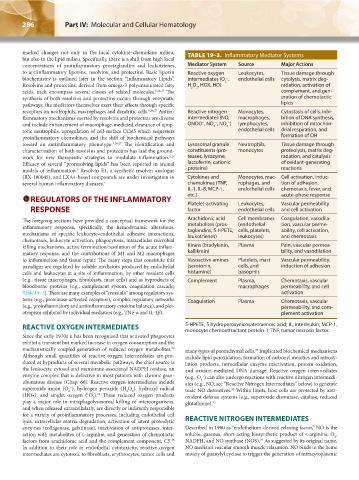
               marked changes not only in the local cytokine–chemokine milieu,   TABLE 19–3.  Inflammatory Mediator Systems
               but also in the lipid milieu. Specifically, there is a shift from high local
               concentrations  of proinflammatory  prostaglandins  and  leukotrienes   Mediator System  Source  Major Actions
               to  antiinflammatory lipoxins,  resolvins,  and protectins.  Basic  lipoxin   Reactive oxygen   Leukocytes,   Tissue damage through
               biochemistry is outlined later in the section “Inflammatory Lipids”.   intermediates (O ,   endothelial cells  cytolysis, matrix deg-
                                                                                    −
                                                                                   2
               Resolvins and protectins, derived from omega-3 polyunsaturated fatty   H O , HOX, HO)  radation, activation of
                                                                          2
                                                                        2
               acids, each encompass several classes of related molecules. 5,26,27  The               complement, and gen-
               synthesis of both resolvins and protectins occurs through enzymatic                    eration of chemotactic
               pathways; the mediators themselves exert their effects through specific                lipids
               receptors on neutrophils, macrophages and dendritic cells. 5,26,27  Antiin-  Reactive nitrogen   Monocytes,   Cytostasis of cells, inhi-
               flammatory mechanisms exerted by resolvins and protectins are diverse   intermediates (NO,   macrophages,   bition of DNA synthesis,
                                                                            −
                                                                                −
                                                                                    −
               and include enhancement of macrophage-mediated clearance of apop-  ONOO , NO , NO )  lymphocytes,   inhibition of mitochon-
                                                                                2
                                                                                    3
               totic neutrophils, upregulation of cell-surface CCR5 which sequesters    endothelial cells  drial respiration, and
               proinflammatory chemokines, and the shift of biochemical pathways                      formation of OH
               toward an antiinflammatory phenotype. 3,26,27  The identification and   Lysosomal granule   Neutrophils,   Tissue damage through
               characterization of both resolvins and protectins has laid the ground-  constituents (pro-  monocytes  proteolysis, matrix deg-
               work for new therapeutic strategies to modulate inflammation.    teases, lysozyme,     radation, and catalysis
                                                                 5,26
               Efficacy of several “proresolving lipids” has been reported in animal   lactoferrin, cationic   of oxidant-generating
               models of inflammation.  Resolvin E1, a synthetic resolvin analogue   proteins)        reactions
                                  5
               (RX-100045), and LXA4-based compounds are under investigation in   Cytokines and   Monocytes, mac- Cell activation, induc-
               several human inflammatory diseases. 5                  chemokines (TNF,   rophages, and   tion of adhesion,
                                                                       IL-1, IL-8, MCP-1,   endothelial cells  chemotaxis, fever, and
                    REGULATORS OF THE INFLAMMATORY                     etc.)            Leukocytes,   acute-phase response
                                                                       Platelet-activating
                                                                                                      Vascular permeability
                  RESPONSE                                             factor           endothelial cells  and cell activation
               The foregoing sections have provided a conceptual framework for the   Arachidonic acid   Cell membranes   Coagulation, vasodila-
               inflammatory response, specifically,  the hemodynamic  alterations,   metabolites (pros-  (endothelial   tion, vascular perme-
                                                                       taglandins, 5-HPETE,  cells, platelets,
                                                                                                      ability, cell activation,
               mechanisms of specific leukocyte–endothelial adhesive interactions,   leukotrienes)  leukocytes)  and chemotaxis
               chemotaxis, leukocyte activation, phagocytosis, intracellular microbial
               killing mechanisms, active termination/resolution of the acute inflam-  Kinins (bradykinin,   Plasma  Pain, vascular permea-
               matory response, and the contributions of M1 and M2 macrophages   kallikrein)          bility, and vasodilation
               to inflammation and tissue repair. The many steps that constitute this   Vasoactive amines   Platelets, mast   Vascular permeability,
               paradigm are regulated by soluble mediators produced by endothelial   (serotonin,   cells, and   induction of adhesion
               cells and leukocytes at a site of inflammation, by other resident cells   histamine)  basophils
               (e.g., tissue macrophages, fibroblasts, mast cells) and as byproducts of   Complement  Plasma,   Chemotaxis, vascular
               bloodborne proteins (e.g., complement system, coagulation cascade;       macrophages   permeability, and cell
               Table 19–3). There are many examples of “crosstalk” among regulatory sys-              activation
               tems (e.g., proteinase-activated receptors), complex regulatory networks   Coagulation  Plasma  Chemotaxis, vascular
               (e.g., proinflammatory and antiinflammatory cytokine balance), and plei-               permeability, and com-
               otropism exhibited by individual mediators (e.g., TNF-α and IL-1β).                    plement activation

               REACTIVE OXYGEN INTERMEDIATES                          5-HPETE, 5 hydroperoxyeicosatetraenoic acid; IL, interleukin; MCP-1,
                                                                      monocyte chemoattractant protein-1; TNF, tumor necrosis factor.
               Since the early 1970s it has been recognized that activated phagocytes
               exhibit a transient but marked increase in oxygen consumption and the
               mechanistically  coupled  generation  of  reduced  oxygen  metabolites.    many types of parenchymal cells.  Implicated biochemical mechanisms
                                                                 32
                                                                                              33
               Although small quantities of reactive oxygen intermediates are pro-  include lipid peroxidation, formation of carbonyl moieties and nitrosy-
               duced as byproducts of several metabolic pathways, the chief source is   lation products, intracellular enzyme inactivation, protein oxidation,
               the leukocyte cytosol and membrane-associated NADPH oxidase, an   and oxidant-mediated DNA damage. Reactive oxygen intermediates
               enzyme complex that is defective in most patients with chronic gran-  (e.g., O ) can also undergo reactions with reactive nitrogen intermedi-
                                                                            −
                                                                           2
               ulomatous disease (Chap. 66). Reactive oxygen intermediates include   ates (e.g., NO; see “Reactive Nitrogen Intermediates” below) to generate
               superoxide anion (O ), hydrogen peroxide (H O ), hydroxyl radical   toxic NO derivatives.  Within limits, host cells are protected by anti-
                               −
                                                                                     33
                                                    2
                                                  2
                               2
               (HO•),  and  singlet  oxygen  ( O ).  These reduced oxygen products   oxidant defense systems (e.g., superoxide dismutase, catalase, reduced
                                         32
                                     1
                                       2
               play a major role in intraphagolysosomal killing of microorganisms,   glutathione). 33
               and when released extracellularly, are directly or indirectly responsible
               for a variety of proinflammatory processes, including endothelial cell
               lysis, extracellular matrix degradation, activation of latent proteolytic   REACTIVE NITROGEN INTERMEDIATES
               enzymes (collagenase, gelatinase), inactivation of antiproteases, inter-  Described in 1980 as “endothelium-derived relaxing factor,” NO is the
               action with metabolites of l-arginine, and generation of chemotactic   soluble, gaseous, short-acting biosynthetic product of l-arginine, O ,
                                                                                                                        2
                                                                                               34
               factors from arachidonic acid and the complement component, C5.    NADPH, and NO synthase (NOS).  As suggested by its original name,
                                                                 33
               In addition to their role in endothelial cytotoxicity, reactive oxygen   NO mediates vascular smooth muscle relaxation. NO binds to the heme
               intermediates are cytotoxic to fibroblasts, erythrocytes, tumor cells and   moiety of guanylyl cyclase to trigger the generation of intracytoplasmic
          Kaushansky_chapter 19_p0279-0292.indd   286                                                                   9/17/15   5:51 PM

