


Page 312 - Williams Hematology ( PDFDrive )
P. 312
286  Part IV:  Molecular and Cellular Hematology                   Chapter 19:  The Inflammatory Response             287


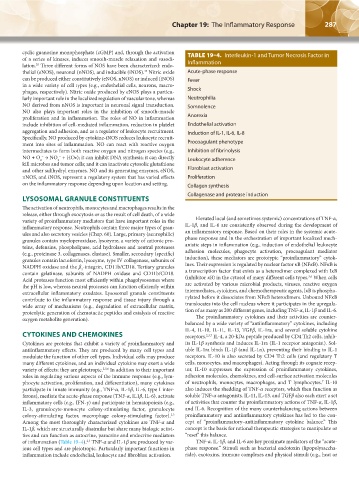
                  cyclic guanosine monophosphate (cGMP) and, through the activation   TABLE 19–4.  Interleukin-1 and Tumor Necrosis Factor in
                  of a series of kinases, induces smooth-muscle relaxation and vasodi-
                  lation.  Three different forms of NOS have been characterized: endo-  Inflammation
                      35
                                                           35
                  thelial (eNOS), neuronal (nNOS), and inducible (iNOS).  Nitric oxide   Acute-phase response
                  can be produced either constitutively (eNOS, nNOS) or induced (iNOS)   Fever
                  in a wide variety of cell types (e.g., endothelial cells, neurons, macro-
                  phages, respectively). Nitric oxide produced by eNOS plays a particu-  Shock
                  larly important role in the localized regulation of vascular tone, whereas   Neutrophilia
                  NO derived from nNOS is important in neuronal signal transduction.   Somnolence
                  NO also plays important roles in the inhibition of smooth-muscle
                  proliferation and in inflammation. The roles of NO in inflammation   Anorexia
                  include inhibition of cell-mediated inflammation, reduction in platelet   Endothelial activation
                  aggregation and adhesion, and as a regulator of leukocyte recruitment.   Induction of IL-1, IL-6, IL-8
                  Specifically, NO produced by cytokine-iNOS reduces leukocyte recruit-
                  ment into sites of inflammation. NO can react with reactive oxygen   Procoagulant phenotype
                  intermediates to form both reactive oxygen and nitrogen species (e.g.,   Inhibition of fibrinolysis
                              −
                        −
                  NO + O  → NO  + HO•); it can inhibit DNA synthesis; it can directly   Leukocyte adherence
                        2
                              2
                  kill microbes and tumor cells; and it can inactivate cytosolic glutathione
                  and other sulfhydryl enzymes. NO and its generating enzymes, eNOS,   Fibroblast activation
                  nNOS, and iNOS, represent a regulatory system that has varied effects   Proliferation
                  on the inflammatory response depending upon location and setting.  Collagen synthesis
                                                                         Collagenase and protease induction
                  LYSOSOMAL GRANULE CONSTITUENTS
                  The activation of neutrophils, monocytes and macrophages results in the
                  release, either through exocytosis or as the result of cell death, of a wide
                  variety of proinflammatory mediators that have important roles in the   Elevated local (and sometimes systemic) concentrations of TNF-α,
                  inflammatory response. Neutrophils contain three major types of gran-  IL-1β, and IL-6 are consistently observed during the development of
                  ules and also secretory vesicles (Chap. 60). Large, primary (azurophilic)   an inflammatory response. Based on their roles in the systemic acute-
                  granules contain myeloperoxidase, lysozyme, a variety of cationic pro-  phase response and in the orchestration of important localized mech-
                  teins, defensins, phospholipase, acid hydrolases and neutral proteases   anistic steps in inflammation (e.g., induction of endothelial leukocyte
                  (e.g., proteinase 3, collagenases, elastase). Smaller, secondary (specific)   adhesion molecules, phagocyte activation, procoagulant mediator
                  granules contain lactoferrin, lysozyme, type IV collagenase, subunits of   induction), these  mediators are prototypic “proinflammatory”  cytok-
                  NADPH oxidase and the β -integrin, CD11b/CD18. Tertiary granules   ines. Their expression is regulated by nuclear factor κB (NFκB). NFκB is
                                      2
                  contain gelatinase, subunits of NADPH oxidase and CD11b/CD18.   a transcription factor that exists as a heterodimer complexed with IκB
                                                                                                                  3,6
                  Acid proteases function most efficiently within phagolysosomes where   (inhibitor κB) in the cytosol of many different cells types.  When cells
                  the pH is low, whereas neutral proteases can function efficiently within   are activated by various microbial products, viruses, reactive oxygen
                  extracellular inflammatory exudates. Lysosomal granule constituents   intermediates, cytokines, and chemotherapeutic agents, IκB is phospho-
                  contribute to the inflammatory response and tissue injury through a   rylated before it dissociates from NFκB heterodimers. Unbound NFκB
                  wide array of mechanisms (e.g., degradation of extracellular matrix,   translocates into the cell nucleus where it participates in the upregula-
                  proteolytic generation of chemotactic peptides and catalysis of reactive   tion of as many as 200 different genes, including TNF-α, IL-1β and IL-6.
                  oxygen metabolite generation).                            The proinflammatory cytokines and their activities are counter-
                                                                        balanced by a wide variety of “antiinflammatory” cytokines, including
                                                                        IL-4, IL-10, IL-11, IL-13, TGFβ, IL-1ra, and several soluble cytokine
                  CYTOKINES AND CHEMOKINES                              receptors. 2,3,7  IL-4, a 20-kDa peptide produced by CD4 Th2 cells, inhib-
                  Cytokines are proteins that exhibit a variety of proinflammatory and   its IL-1β synthesis and induces IL-1ra (IL-1 receptor antagonist). Sol-
                  antiinflammatory  effects.  They  are  produced by  many  cell  types  and   uble IL-1ra binds IL-1β (and IL-1α), preventing their binding to IL-1
                  modulate the function of other cell types. Individual cells may produce   receptors. IL-10 is also secreted by CD4 Th2 cells (and regulatory T
                  many different cytokines, and an individual cytokine may exert a wide   cells, monocytes, and macrophages). Acting through its cognate recep-
                  variety of effects; they are pleiotropic. 2,3,6  In addition to their important   tor, IL-10 suppresses the expression of proinflammatory cytokines,
                  roles in regulating various aspects of the immune response (e.g., lym-  adhesion molecules, chemokines, and cell-surface activation molecules
                  phocyte activation, proliferation, and differentiation), many cytokines   of neutrophils, monocytes, macrophages, and T lymphocytes.  IL-10
                                                                                                                      7
                  participate in innate immunity (e.g., TNF-α, IL-1β, IL-6, type I inter-  also induces the shedding of TNF-α receptors, which then function as
                  ferons), mediate the acute-phase response (TNF-α, IL1β, IL-6), activate   soluble TNF-α antagonists. IL-11, IL-13, and TGFβ also each exert a set
                  inflammatory cells (e.g., IFN-γ) and participate in hematopoiesis (e.g.,   of activities that counter the proinflammatory actions of TNF-α, IL-1β,
                  IL-3, granulocyte-monocyte colony-stimulating factor, granulocyte   and IL-6. Recognition of the many counterbalancing actions between
                  colony-stimulating factor, macrophage colony-stimulating factor).    proinflammatory and antiinflammatory cytokines has led to the con-
                                                                    2,3
                  Among the most thoroughly characterized cytokines are TNF-α and   cept of “proinflammatory–antiinflammatory cytokine balance.” This
                  IL-1β, which are structurally dissimilar but share many biologic activi-  concept is the basis for rational therapeutic strategies to manipulate or
                  ties and can function as autocrine, paracrine and endocrine mediators   “reset” this balance.
                  of inflammation (Table 19–4).  TNF-α and IL-1β are produced by var-  TNF-α, IL-1β, and IL-6 are key proximate mediators of the “acute-
                                       2,3
                  ious cell types and are pleiotropic. Particularly important functions in   phase response.” Stimuli such as bacterial endotoxin (lipopolysaccha-
                  inflammation include endothelial, leukocyte and fibroblast activation.  ride), exotoxins, immune complexes and physical stimuli (e.g., heat or


          Kaushansky_chapter 19_p0279-0292.indd   287                                                                   9/17/15   5:51 PM

