


Page 313 - Williams Hematology ( PDFDrive )
P. 313
288            Part IV:  Molecular and Cellular Hematology                                                                                                                     Chapter 19:  The Inflammatory Response              289


               trauma) can induce macrophages (and other cell types) to secrete TNF-  of chemokines is based on the locations of N-terminal cysteine resi-
               α, IL-1β, and IL-6. 2,3,7  In turn, TNF-α, IL-1β, and IL-6 mediate fever,   dues whereby “CC” indicates two adjacent residues, “CXC” indicates
               somnolence, increased production of proteins such as  α -antitrypsin   two cysteine residues separated by one intervening amino acid, and so
                                                         1
               (α -antiprotease) and α -macroglobulin, and decreased production of   on. Individual chemokines contain the letter “L” for ligand, followed by
                                2
                 1
               proteins such as albumin and transferrin. As noted, the acute-phase   individual numbers (e.g., CCL1, CCL2, CCL3, etc.); more than 40 have
               response is a stereotyped host metabolic response to a wide variety of   been identified. The two most studied subfamilies include the alpha, or
               insults. In addition to the systemic acute-phase response, TNF-α and   “CXC” chemokines, and the beta, or “CC” chemokines. Alpha chemok-
               IL-1β induce endothelial activation marked by increases in leukocyte   ines, of which IL-8 (CXCL8) is the prototype, consistently exhibit neu-
               adherence  and a procoagulant state, leukocyte activation marked  by   trophil chemotactic activity, whereas the beta, or “CC” chemokines, of
               cytokine secretion, and fibroblast activation marked by proliferation,   which MCP-1 (CCL2) is the prototype, exhibit monocyte chemotactic
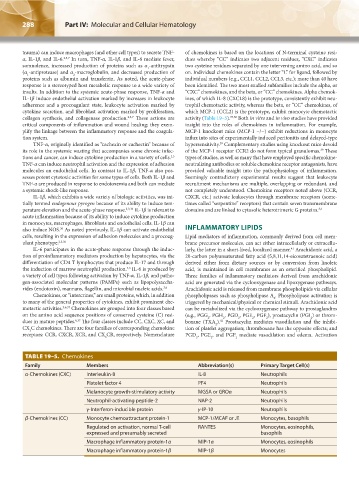
               collagen synthesis, and collagenase production. 2,3,7  These actions are   activity (Table 19–5). 37,38  Both in vitro and in vivo studies have provided
               critical components of inflammation and wound healing; they exem-  insight into the roles of chemokines in inflammation. For example,
               plify the linkage between the inflammatory response and the coagula-  MCP-1 knockout mice (MCP-1 −/−) exhibit reductions in monocyte
               tion system.                                           influx into sites of experimentally induced peritonitis and delayed-type
                   TNF-α, originally identified as “cachexin or cachectin” because of   hypersensitivity.  Complementary studies using knockout mice devoid
                                                                                  39
               its role in the systemic wasting that accompanies some chronic infec-  of the MCP-1 receptor CCR2 do not form typical granulomas.  These
                                                                                                                   39
                                                                 2,3
               tions and cancer, can induce cytokine production in a variety of cells.    types of studies, as well as many that have employed specific chemokine-
               TNF-α can induce neutrophil activation and the expression of adhesion   neutralizing antibodies or soluble chemokine receptor antagonists, have
               molecules on endothelial cells. In contrast to IL-1β, TNF-α also pos-  provided  valuable  insight into the  pathophysiology  of inflammation.
               sesses potent cytotoxic activities for some types of cells. Both IL-1β and   Seemingly contradictory experimental results suggest that leukocyte
               TNF-α are produced in response to endotoxemia and both can mediate   recruitment mechanisms are multiple, overlapping or redundant, and
               a systemic shock-like response.                        not completely understood. Chemokine receptors noted above (CCR,
                   IL-1β, which exhibits a wide variety of biologic activities, was ini-  CXCR, etc.) activate leukocytes through membrane receptors (some-
               tially termed endogenous pyrogen because of its ability to induce tem-  times called “serpentine” receptors) that contain seven transmembrane
               perature elevation and the acute-phase response. 2,3,36  IL-1β is relevant to   domains and are linked to cytosolic heterotrimeric G proteins. 3,6
               acute inflammation because of its ability to induce cytokine production
               in monocytes, macrophages, fibroblasts and endothelial cells. IL-1β can
                            36
               also induce NOS.  As noted previously, IL-1β can activate endothelial   INFLAMMATORY LIPIDS
               cells, resulting in the expression of adhesion molecules and a procoag-  Lipid mediators of inflammation, commonly derived from cell mem-
               ulant phenotype. 2,3,36                                brane precursor molecules, can act either intracellularly or extracellu-
                   IL-6 participates in the acute-phase response through the induc-  larly, the latter in a short-lived, localized manner.  Arachidonic acid, a
                                                                                                         41
               tion of proinflammatory mediators production by hepatocytes, via the   20-carbon polyunsaturated fatty acid (5,8,11,14-eicosatetraenoic acid)
               differentiation of CD4 T lymphocytes that produce IL-17 and through   derived either from dietary sources or by conversion from linoleic
               the induction of marrow neutrophil production.  IL-6 is produced by   acid, is maintained in cell membranes as an esterified phospholipid.
                                                  2,3
               a variety of cell types following activation by TNF-α, IL-1β, and patho-  Three families of inflammatory mediators derived from arachidonic
               gen-associated molecular patterns (PAMPs) such as lipopolysaccha-  acid are generated via the cyclooxygenase and lipoxygenase pathways.
               rides (endotoxin), mannans, flagellin, and microbial nucleic acids. 3,6  Arachidonic acid is released from membrane phospholipids via cellular
                   Chemokines, or “intercrines,” are small proteins, which, in addition   phospholipases such as phospholipase A . Phospholipase activation is
                                                                                                    2
               to many of the general properties of cytokines, exhibit prominent che-  triggered by mechanical/physical or chemical stimuli. Arachidonic acid
               motactic activities. 3,6,37  Chemokines are grouped into four classes based   can be metabolized via the cyclooxygenase pathway to prostaglandins
               on the amino acid sequence positions of conserved cysteine (C) resi-  (e.g., PGG , PGH , PGD , PGE , PGF ), prostacyclin (PGI ) or throm-
                                                                                                 2
                                                                              2
                                                                                                                2
                                                                                        2
                                                                                   2
                                                                                             2
               dues in mature peptides.  The four classes include CC, CXC, XC, and   boxane (TXA ).  Prostacyclin mediates vasodilation and the inhibi-
                                 6,37
                                                                                  41
                                                                                2
               CX C chemokines. There are four families of corresponding chemokine   tion of platelet aggregation; thromboxane has the opposite effects; and
                  3
               receptors: CCR, CXCR, XCR, and CX CR, respectively. Nomenclature   PGD , PGE , and PGF  mediate vasodilation and edema. Activation
                                           3
                                                                               2
                                                                                       2
                                                                          2
                TABLE 19–5.  Chemokines
                Family               Members                              Abbreviation(s)      Primary Target Cell(s)
                α-Chemokines (CXC)   Interleukin-8                        IL-8                 Neutrophils
                                     Platelet factor 4                    PF4                  Neutrophils
                                     Melanocyte growth-stimulatory activity  MGSA or GROα      Neutrophils
                                     Neutrophil-activating peptide-2      NAP-2                Neutrophils
                                     γ-Interferon-inducible protein       γ-IP-10              Neutrophils
                β-Chemokines (CC)    Monocyte chemoattractant protein-1   MCP-1/MCAF or JE     Monocytes, basophils
                                     Regulated on activation, normal T-cell   RANTES           Monocytes, eosinophils,
                                     expressed and presumably secreted                         basophils
                                     Macrophage inflammatory protein-1α   MIP-1α               Monocytes, eosinophils
                                     Macrophage inflammatory protein-1β   MIP-1β               Monocytes


          Kaushansky_chapter 19_p0279-0292.indd   288                                                                   9/17/15   5:51 PM

