


Page 314 - Williams Hematology ( PDFDrive )
P. 314
288  Part IV:  Molecular and Cellular Hematology                   Chapter 19:  The Inflammatory Response             289


                  of the lipoxygenase pathway results in the synthesis of 5-hydroperox-  factor (factor XIIa), also known as the prekallikrein activator, converts
                  yeicosatetraenoic acid (5-HPETE), which is a potent chemoattractant   plasma prekallikrein to kallikrein. In turn, kallikrein cleaves high-
                  of neutrophils and can be enzymatically modified to yield a series of   molecular-weight kininogen to produce bradykinin. Models of septic
                  other leukotrienes. LTB  induces neutrophil chemotaxis, aggregation,   shock reveal decreases in plasma kininogen that parallel decreases in
                                   4
                  degranulation, and adherence, while LTC , LTD , and LTE  trigger   peripheral arterial resistance. 44
                                                      4
                                                 4
                                                               4
                  smooth-muscle  constriction,  increases  in  vascular  permeability  and
                                 41
                  bronchoconstriction.  Members of both of these families of lipid-   VASOACTIVE AMINES
                  derived mediators and their catabolites have been detected in inflamma-
                  tory exudates. There are two important branches within the lipoxygenase   Histamine  and  serotonin  (5-hydroxytryptamine)  are low-molecular-
                  pathway. 41,42  Lipoxins (A  [LXA ] and B  [LXB ]) are generated via the   weight vasoactive amines. Histamine is contained in mast cell and
                                              4
                                   4
                                         4
                                                   4
                                                                                                                          45
                  12-lipooxygenase branch of the lipoxygenase pathway in conjunction   basophil granules, whereas platelets are a chief source of serotonin.
                  with a unique transcellular biosynthetic pathway.  Neutrophils gener-  Localized release of histamine results in wheal formation as a conse-
                                                      42
                  ate LTA  via the 5-lipoxygenase pathway branch; in turn, lipoxins (LXA    quence of increases in vascular permeability. Histamine induces the
                       4
                                                                    4
                  and LXB ) are generated through the action of platelet 12-lipooxygense   formation of reversible openings in endothelial tight junctions, trig-
                        4
                  on neutrophil LTA . Prevention of neutrophil-platelet binding interrupts   gers the formation of prostacyclin by endothelial cells and induces NO
                               4
                  this pathway. Lipoxins inhibit neutrophil chemotaxis and adhesion to   release from the endothelium. In addition, histamine, like thrombin,
                                                                                                                   45
                           42
                  endothelium.  As noted above, resolvins and protectins each encompass   can induce the rapid upregulation of endothelial P-selectin.  Serotonin,
                  several molecular species—all derived from omega-3 polyunsaturated   acting through receptors on vascular smooth-muscle cells, is responsi-
                  fatty acids. 26,27                                    ble for vasoconstriction, whereas interaction with endothelial receptors
                                                                                                                           2
                     PAF is a potent proinflammatory lipid produced by a variety of   results in vasodilation (via release of NO) and increased permeability.
                  cell types, including neutrophils, monocytes, endothelial cells and IgE-   Release of histamine and serotonin from mast cells and platelets can
                  sensitized basophils.  Derived from the cell membrane constituent,   be triggered by IgE-mediated type I hypersensitivity reactions, directly
                                 43
                  choline phosphoglyceride, PAF is an acetyl glycerol ether phosphocho-  by C3a or C5a, and directly by neutrophil granule-derived cationic
                  line that is synthesized following the activation of phospholipase A .   proteins.
                                                                    2
                  PAF triggers platelet aggregation and degranulation, increases vascular
                  permeability, and promotes leukocyte accumulation and activation. In
                  vivo studies using specific PAF antagonists have suggested a role for PAF   COMPLEMENT
                  in a variety of acute inflammatory lesions. 43        The  complement  system,  including  its  soluble  and  cell  membrane-
                                                                        associated regulators, consists of nearly two dozen plasma proteins that
                  KININS                                                give rise to mediators of chemotaxis, increased vascular permeability,
                                                                        opsonic activity, phagocyte activation, and cytolysis.  In a manner
                                                                                                                46
                  The kinin system is activated by contact activation of clotting factor   analogous to coagulation, the complement system is activated through
                  XII (Hageman factor) (Chaps. 113 and 114).  Activation of the kinin   a cascade of proteolytic cleavage reactions. There are three convergent
                                                  44
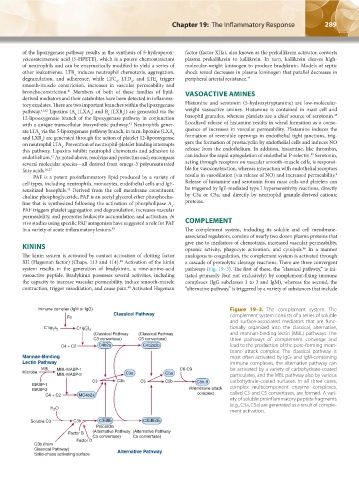
                  system results in the generation of bradykinin, a nine-amino-acid   pathways (Fig. 19–3). The first of these, the “classical pathway,” is ini-
                  vasoactive peptide. Bradykinin possesses several activities, including   tiated primarily (but not exclusively) by complement-fixing immune
                  the capacity to increase vascular permeability, induce smooth-muscle   complexes (IgG subclasses 1 to 3 and IgM), whereas the second, the
                  contraction, trigger vasodilation, and cause pain.  Activated Hageman   “alternative pathway,” is triggered by a variety of substances that include
                                                     44
                       Immune complex (IgM or IgG)                                     Figure 19–3.  The complement system.  The
                                                Classical Pathway                      complement system consists of a series of soluble
                                 Fc
                                                                                       and  surface-associated  mediators  that  are  func-
                             s                                                         tionally organized into the classical, alternative,
                         C1qr 2 2   C1qr s
                                       2 2
                                          (Classical Pathway  (Classical Pathway       and mannan-binding lectin (MBL) pathways. The
                                          C3 convertase)  C5 convertase)               three pathways of complement converge and
                               C4 + C2     C4b2a          C4b2a3b                      lead to the production of the pore-forming mem-
                                                                                       brane  attack  complex.  The  classical pathway  is
                  Mannan-Binding                                                       most often activated by IgG- and IgM-containing
                  Lectin Pathway                                                       immune complexes, the alternative pathway can
                        MBL  MBL-MASP-1                                C6-C9           be activated by a variety of carbohydrate-coated
                  Microbe                           C3a           C5a
                             MBL-MASP-2                                                particulates, and the MBL pathway also by various
                                         C3       C3b    C5       C5b       C5b-9      carbohydrate-coated  surfaces.  In  all  three  cases,
                     MASP-1                                                            complex multicomponent enzyme complexes,
                     MASP-2                                               (Membrane attack
                          C4 + C2    MC4b2a                                 complex)   called C3 and C5 convertases, are formed. A vari-
                                                                                       ety of soluble proinflammatory peptide fragments
                                                                                       (e.g., C3a, C5a) are generated as a result of comple-
                           H 2 O
                                                                                       ment activation.
                     Soluble C3    C3b     C3bBb          C3bBb3b
                                           Properdin
                                 Factor B  (Alternative Pathway  (Alternative Pathway
                                         C3 convertase)  C5 convertase)
                                    Factor D
                      C3b (from
                      Classical Pathway)          Alternative Pathway
                      Solid-phase activating surface
          Kaushansky_chapter 19_p0279-0292.indd   289                                                                   9/17/15   5:51 PM

